.png)


.png)
.png)

Many people hear “Market Research” and immediately think of a Survey.
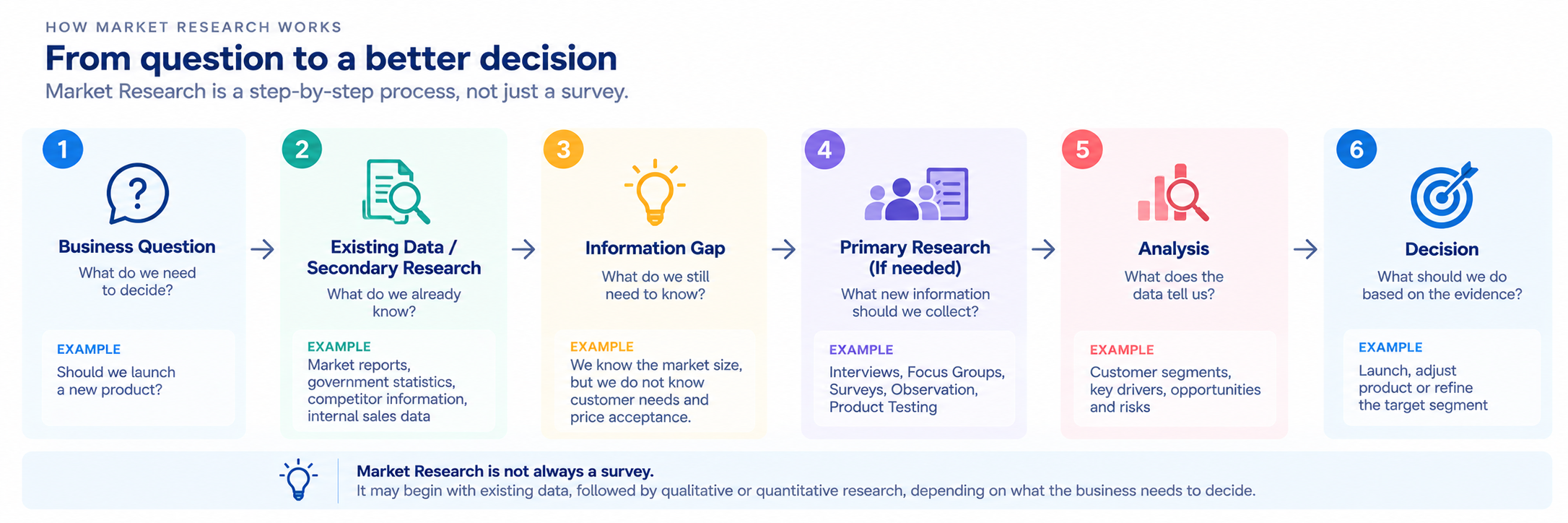
But a questionnaire is only one research tool. A project may begin with existing market data, followed by customer interviews, observation, quantitative surveys or analysis of internal business data.
The more important question is not which method to use first, but what the business needs to decide, what remains unknown, and what evidence would make that decision better informed.
Market Research is the systematic process of gathering, analysing and interpreting information to understand people, markets, organisations and other factors relevant to a business decision.
ESOMAR describes Research as the systematic gathering and interpretation of information about individuals and organisations, using methods from social, behavioural and data sciences to generate insights and support decision-making.
In practice, Market Research can help answer questions such as: Is there a real market for this idea? Why do customers choose one brand over another? Why are customers not returning? Which price is acceptable? Should a new concept move forward? Which customer group should the business prioritise?
Market Research does not guarantee the future or make the decision for management. Its role is to reduce uncertainty with evidence that fits the question.
Market Research starts with a decision, not a questionnaire
Market Research systematically gathers and interprets information to understand customers, markets, competitors and business opportunities. Research may use existing evidence such as government statistics, industry reports and sales data, or collect new evidence through Interviews, Focus Groups, Surveys and other methods. Qualitative Research is useful for understanding context, motivation and why something happens, while Quantitative Research is suited to measuring size, proportion, differences and patterns. Good research therefore asks not only “What did the data show?” but also “What decision does this evidence support, and what can we still not conclude?”
Market Research is not the same as running a Survey
A Survey is one common Research Method, but it is not the whole of Market Research.
Some questions can be answered using information that already exists. Others require deep conversations to understand why customers behave in a certain way. Some need a larger Sample to measure how common a pattern is.
For example, an SME considering a new retail location may not need to begin by asking “How many people should we survey?” It may first need to examine population data, competitors, pricing, foot traffic, existing sales and available customer information.
The U.S. Small Business Administration explains that Market Research combines consumer behaviour and economic trends to help businesses confirm and improve business ideas, and can be used together with Competitive Analysis to understand the competitive environment.
The more useful question is therefore not “Do we need a Survey?” but “What do we still need to know before making the decision?”
How does Market Research work?
At Blue Eagle Eye, a useful research principle is that Research starts with a Decision, not a Questionnaire. The logic is Decision → Uncertainty → Hypothesis → Evidence → Method → Analysis → Action Rule.
In practical terms, this means deciding what the business needs to choose before deciding how data should be collected.
1. Start with the Business Decision
Imagine a company deciding whether to launch a new beverage flavour.
“Research the beverage market” is still too broad.
More decision-ready questions might be:
- Is the target customer interested in the Concept?
- Are the proposed benefits relevant to customer needs?
- Is the Price acceptable?
- Why would customers choose or reject the product?
- Which assumptions should be tested before full investment?
Once the question becomes clearer, the required evidence becomes clearer too.
2. Identify what is already known and what remains unknown
Businesses often hold more useful data than they realise, including Sales Data, CRM information, Customer Complaints, Website Analytics, Search Data, Sales Team feedback and previous research.
Before collecting new data, review what existing evidence can already answer.
This can prevent duplicated research and make any new Primary Research more focused.
What is Secondary Research?
Secondary Research uses information that has already been collected, such as government statistics, industry reports, academic research, company reports, competitor information or previous studies.
Qualtrics notes that Secondary Research can be faster and less costly than collecting new data, making it useful for building initial context. Its main limitation is that the data was not necessarily created to answer the specific question your business is asking.
A business exploring the coffee-shop market, for example, might first review population data, competitor locations, pricing, customer reviews, consumption trends and its own historical sales.
If that evidence answers the decision question, a new Survey may not be necessary.
If important questions remain, such as why customers choose particular stores or whether a new Concept is relevant, Primary Research may be the next step.
What is Primary Research?
Primary Research is new information collected specifically for the current research objective.
Examples include Surveys, In-depth Interviews, Focus Groups, Observation, Product Tests and Concept Tests.
The advantage is relevance: the Target, Questions and Measurements can be designed around the Business Question. The trade-off is that Primary Research usually requires more time, budget and methodological planning.
Primary Research does not always need to begin at a large scale. A smaller set of carefully designed customer interviews can sometimes be more useful for identifying patterns and hypotheses than sending a large questionnaire before the team understands what it should ask.
What is the difference between Qualitative and Quantitative Research?
Neither is automatically better. They are designed for different questions.
Qualitative Research: useful for understanding Why and Context
Qualitative Research is useful when the business needs to understand meaning, motivation, language, perceptions or context.
Common methods include In-depth Interviews, Focus Groups, Observation and Diary Studies.
If a business knows customers are not buying but does not know why, Qualitative Research can explore whether the issue is Price, Trust, Usability, Product Understanding or something the team has not considered.
Qualtrics describes Qualitative Research as depth-oriented research that is particularly useful for exploring motivations, perceptions, language and unmet needs.
A small number of interviews, however, should not be converted into claims such as “70% of the market thinks this way.” Qualitative Research is not normally designed to estimate population percentages.
Quantitative Research: useful for measuring How Many, How Much and Differences
Quantitative Research is useful for measuring size, proportions, differences, relationships and numerical patterns.
Surveys are common, but Quantitative Research can also involve Sales Data, Customer Data, Experiments and other numerical evidence depending on the design.
Typical questions include:
- What percentage of customers know the brand?
- Which group has higher Purchase Intent?
- How much do Concept A and Concept B differ?
- How do Customer Segments behave differently?
- Which factors are associated with Satisfaction or Retention?
Qualtrics describes Quantitative Research as focused on measurement and scale, using structured data to examine patterns, comparisons and relationships.
Numbers do not automatically make a conclusion reliable. If the Sample does not match the Target Population, questions are biased, subgroup bases are too small or Metrics are poorly defined, quantitative results can still lead to weak decisions.
Do you have to choose between Qualitative and Quantitative Research?
No.
Many business questions are better served by Mixed Method Research or by using several forms of evidence in sequence.
Consider a company trying to understand declining customer usage.
The team might first analyse Customer Data to identify where the decline is occurring.
It could then conduct In-depth Interviews to understand possible reasons and develop hypotheses.
A Quantitative Survey could measure how widespread those issues are across a broader Target Population.
Finally, Survey findings might be connected with Operational Data to examine whether reported experiences are associated with actual behaviour.
Using several sources is useful not simply because “more data is better,” but because different evidence answers different parts of the question.
What are the main steps in the Market Research process?
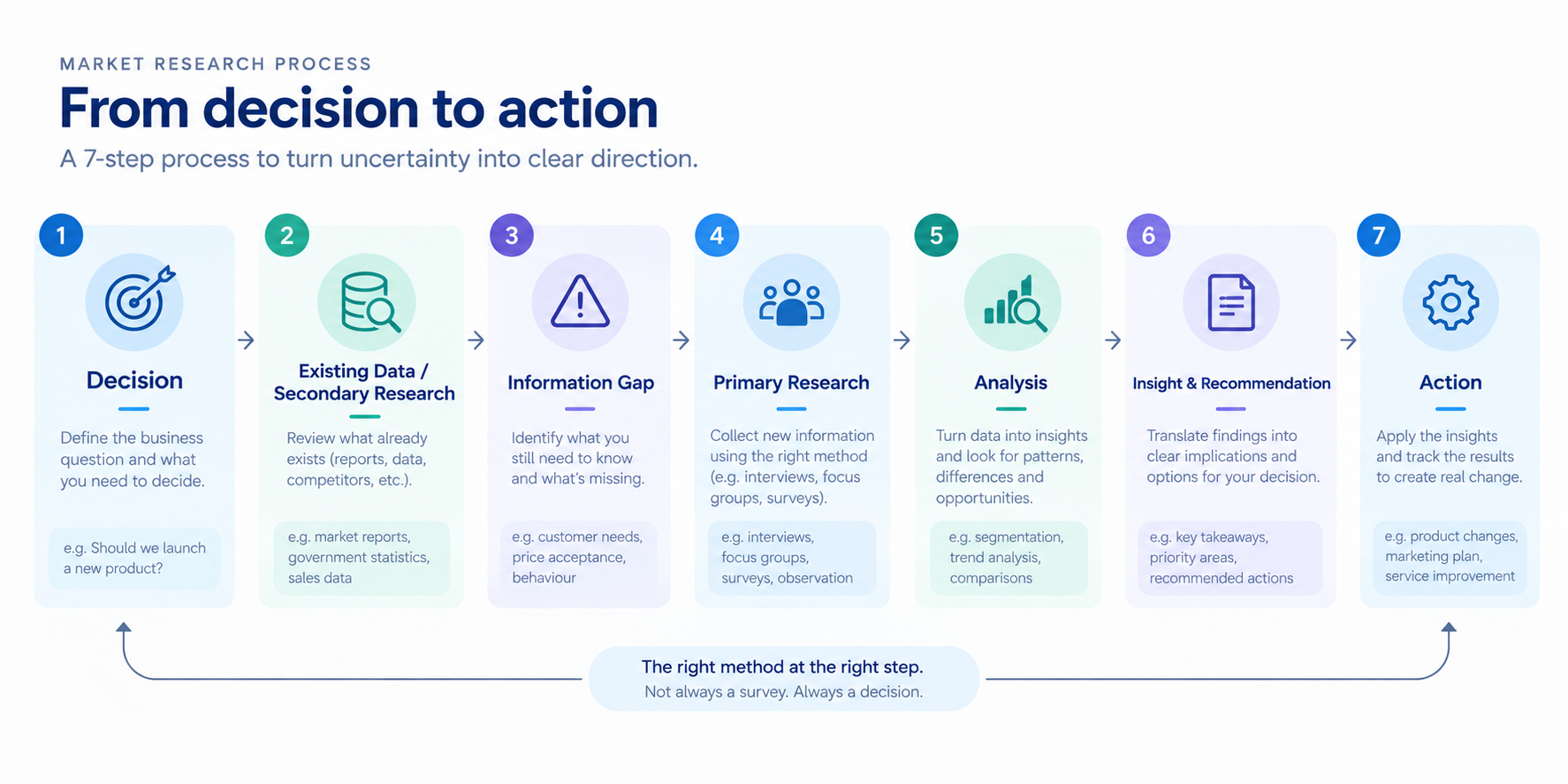
The exact process varies by project, but a practical seven-step structure is:
- Define the Decision: What does the business need to decide?
- Define the Information Gap: What uncertainty matters to that decision?
- Review Existing Evidence: What Internal Data or Secondary Research is already available?
- Select the Method: Should the project use Qualitative, Quantitative, Secondary Research, Data Analytics or Mixed Method?
- Collect Data: Gather evidence from the appropriate Target Population using suitable and ethical methods.
- Analyse and Interpret: What does the evidence show, what does it not show, and what Alternative Explanations remain?
- Connect to Action: How will the evidence inform a decision to Go, Revise, Test Further, Prioritise or Stop?
Example: How would Market Research work for an SME considering a new location?
Imagine an entrepreneur considering a second restaurant location.
“Do people around here like this type of food?” may not be enough.
The real Business Decision is closer to: “Should we open in this location, and if we do, how should the offer be designed?”
The Information Gap might include Demand, Customer Profile, Competitor Density, Price Level, Peak Time, Customer Needs, Access and reasons people choose particular restaurants.
Secondary Research can provide area data, competitor information, pricing, reviews and historical sales from the existing location.
Observation can help assess traffic and behaviours in the location.
Interviews can explore why customers choose certain restaurant types.
A Survey may then measure preferences or Concept Acceptance across a broader relevant audience.
Even after completing this research, the business cannot guarantee that the new branch will succeed. Actual Sales will also depend on execution, location quality, competitor responses, economic conditions and other factors.
Research reduces Blind Spots and makes investment assumptions clearer. It does not remove uncertainty completely.
What business questions can Market Research help answer?
ESOMAR notes that Data, Research and Insights are used to measure markets, understand consumers, support product development and guide organisational decisions.
Business applications can include:
- Market Opportunity: Is this market attractive enough to pursue?
- Customer Understanding: Who are our customers and what drives their decisions?
- Brand: How well is the brand known and perceived?
- Product & Concept: Should this idea move forward?
- Pricing: How do customers perceive Price and Value?
- Customer Experience: Where are the main Journey problems?
- Segmentation: Which customer groups have different Needs or Behaviours?
- Communication: Which messages are understood and relevant?
- Growth: Is the opportunity more likely to come from existing customers, new customers, new products or new channels?
The Research Method should change with the question. A single generic Survey should not be expected to answer all of them.
What can Market Research not tell you?
Research is more useful when its limitations are understood.
Research cannot guarantee future Sales.
Purchase Intent is not Actual Purchase.
What people say they will do may differ from what they actually do.
Correlation does not establish Causation.
Social Media Comments do not represent the whole population.
Search Interest is not the same as Market Demand or Sales.
A large Sample does not solve a problem if it represents the wrong population.
And a high average score does not automatically identify the strongest Driver.
BEE Research principles therefore emphasise the Target, Sample, Base, Method, definitions and limitations, and distinguish Statistical Significance from Business Significance.
Does AI make Market Research unnecessary?
AI is changing many parts of the Research workflow, but it does not remove the need for sound Research Principles.
AI can support Search, Synthesis, Questionnaire Drafting, Open-ended Coding and Analysis. Human review is still needed for sources, sample validity, question design, calculations, interpretation, privacy and claims.
The ICC and ESOMAR updated their International Code in 2025 to address developments including AI, Synthetic Data, Data Privacy, Transparency and Human Oversight. The technology may change, but accountability for research quality and ethical practice remains fundamental.
The useful question is therefore not “Can AI replace Market Research?” but “Which parts of the Research process can AI accelerate, and which still require Research Judgment?”
Ask these six questions before starting Market Research
- What decision do we need to make?
- If we do not conduct Research, which assumptions are we currently making?
- What evidence already exists, and how reliable is it?
- Does the remaining uncertainty require understanding Why, measuring How Many, or both?
- Who is the real Target Population we need to understand?
- When we receive the findings, how could the evidence change the decision?
If the final question cannot yet be answered, it may be too early to start writing the Questionnaire.
The takeaway: Market Research does not start with how to collect data. It starts with what you need to decide
Market Research is the systematic use of evidence to reduce uncertainty about customers, markets, competitors, Products, Brands and Business Opportunities.
Some questions can begin and end with Secondary Research. Others require Interviews to understand Why. Some need Surveys to measure How Many. Complex decisions may require several methods together.
There is no single Research Method that is best for every problem. The right method depends on the question.
And the value of Market Research does not appear when the report is delivered. It appears when an organisation can explain what the evidence means, what remains unknown, and what should be decided or tested next.

Market Research is not simply running a Survey. It is a decision-oriented process that defines what is unknown, selects the appropriate evidence and method, collects and analyses information, and connects the findings back to a business decision. Depending on the question, a business may use Secondary Research, Qualitative Research, Quantitative Research or a combination of methods.
Sources
- ESOMAR. Data, Research and Insights Explained. Research is described as systematic gathering and interpretation of information to generate insights and support decision-making.
- International Chamber of Commerce and ESOMAR. ICC/ESOMAR International Code on Market, Opinion and Social Research and Data Analytics, 2025 edition.
U.S. Small Business Administration. Market Research and Competitive Analysis. Market research combines consumer behaviour and economic trends to support business planning. - Qualtrics. Market Research: Definition, Types, and Analysis. Published 27 February 2026. Explanation of Primary and Secondary Research, Qualitative Research and Quantitative Research.


.png)
.png)
.png)