.png)

.png)
.png)

Imagine two customers who are both 35-year-old women living in Bangkok with similar incomes.
The first chooses a service because she values Convenience, is willing to pay more to save time and purchases almost every week.
The second purchases only during Promotions, compares several competitors and buys once a month.
Demographically, they look very similar.
From a Customer Need and Behavioral perspective, they may require completely different Propositions, Messages and Offers.
This does not mean Age or Gender is useless. It shows the limitation of using Demographics as the entire explanation for customer differences.
People who look similar demographically can buy for different reasons, while customers of different ages can share the same Need.
The more important test of a segmentation is therefore not: “Can we divide customers into groups?”
It is: “Do these groups help us make meaningfully different decisions?”
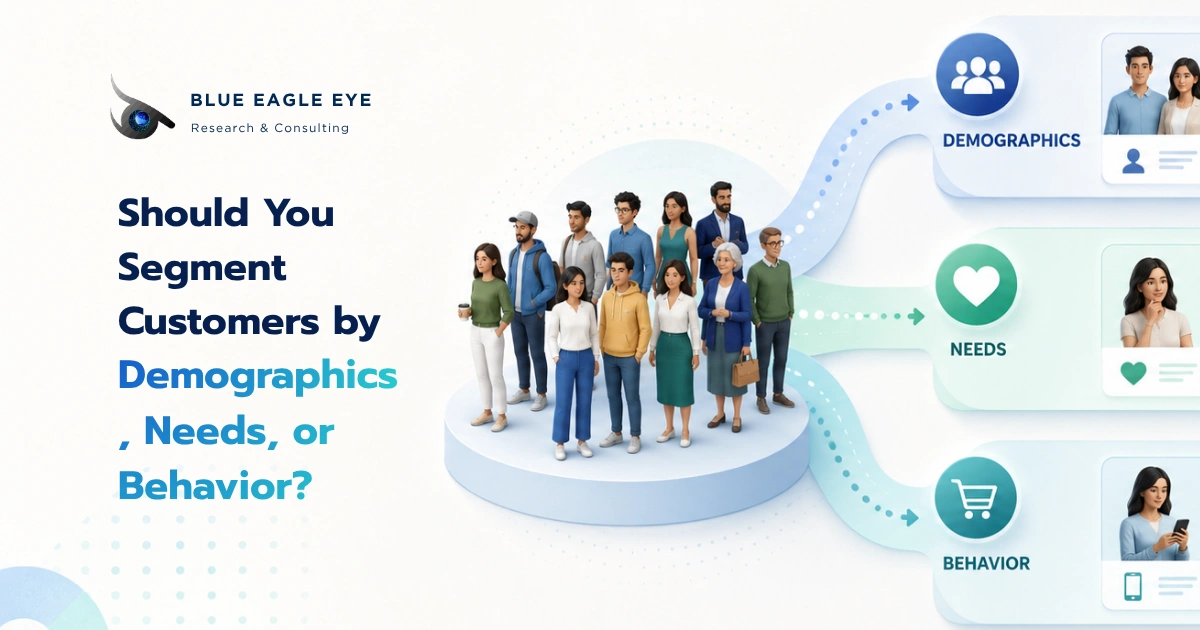
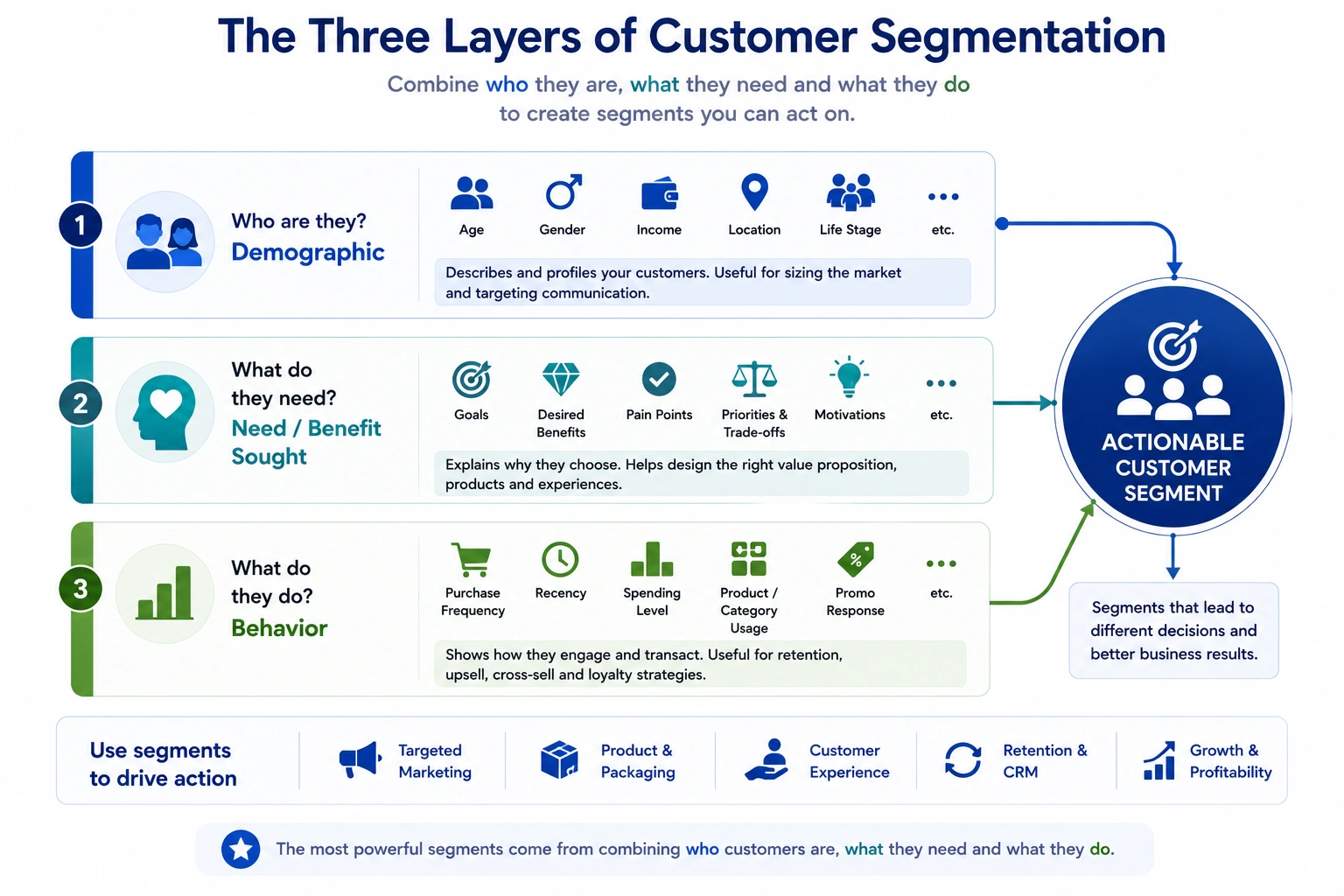
Demographics often explain “who.” Needs and Behavior can better explain “why” and “what to do next.”
Customer Segmentation should not begin with: “Should we use Age or Behavior?”
It should begin with: “What decision will these segments support?”
Age, Gender, Income, Geography and Life Stage remain useful when the business needs Market Sizing, Media Targeting or clear customer profiles.
When the objective is Product Design, Value Proposition, CRM, Retention Strategy or Personalized Offers, variables such as Need, Benefit Sought, Purchase Frequency, Usage Behavior and Customer Value may be more directly actionable.
A practical approach is:
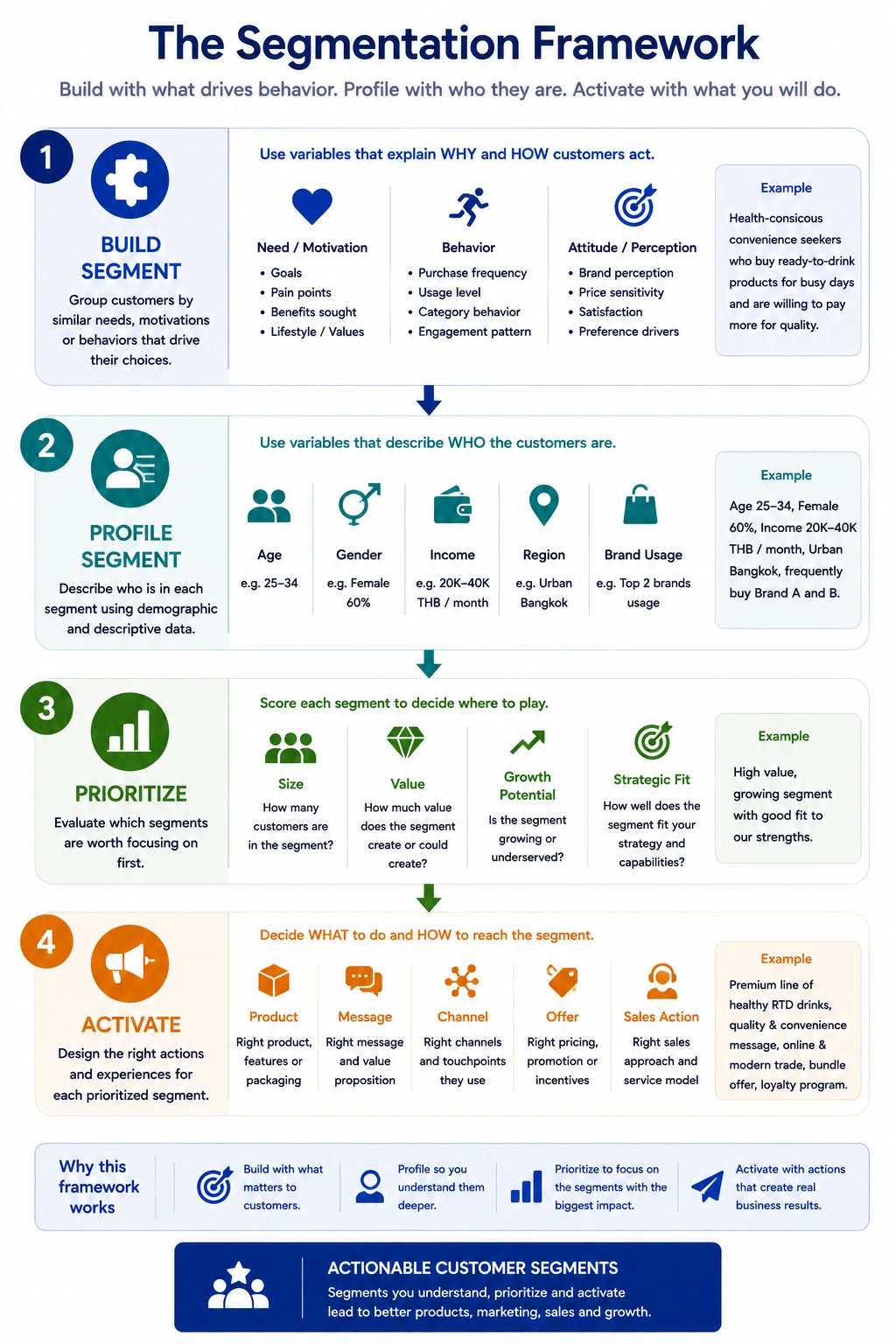
Need / Behavior → Build meaningful differences related to the Decision
Demographics → Describe, size and help activate the resulting Segments
Research on Need-based Segmentation has long supported combining underlying customer needs with descriptive buyer information rather than treating Needs and Demographics as mutually exclusive approaches.
Start Segmentation with the Decision, not the variables already available in the database
Businesses often begin with the easiest data to access:
- Age
- Gender
- Province
- Income
- Membership Tier
These variables are convenient.
Convenience does not make them the best Segmentation Base.
First define how the Segments will be used.
For example:
Media Targeting → Demographic, Geography and Platform Behavior may matter
Product Package Design → Needs, Benefits Sought and Willingness to Pay may matter more
Repeat Purchase → Frequency, Recency, Category Usage and Promotion Response may be more actionable than Age
Brand Positioning → Needs, Motivation, Perception and Competitive Alternatives may be important
The principle is straightforward:
The Segmentation Base should connect to the Business Action that follows.
Demographic Segmentation answers “Who are the customers?”
Common Demographic Variables include:
- Age
- Gender
- Income
- Education
- Occupation
- Household Structure
- Life Stage
They offer several practical advantages.
They are usually easier to collect.
They are easy for teams to understand.
They can be connected to Market Sizing and Media Planning.
They create quick profiles of different customer groups.
And in some Categories, Life Stage or Demographic factors genuinely relate to customer requirements.
The problem is not using Demographics.
The problem is assuming that Demographics automatically explain Behavior.
Knowing that someone is 25–34 does not necessarily explain:
Why they chose the Product
What problem they are trying to solve
Why they switch Brands
Why they will pay more
Why they return
Need-based Segmentation asks “What is the customer trying to achieve?”
Need-based Segmentation groups customers according to the Needs or Benefits they seek.
For a Food Delivery Platform, for example, customers might be grouped as:
Convenience Seekers
Focused on saving time and reducing effort
Value Seekers
Focused on affordability and Promotions
Choice Seekers
Focused on restaurant and menu variety
Reliability Seekers
Focused on predictability and on-time delivery
These Needs can exist across multiple Age Groups.
Research on Need-based Segmentation proposes using Needs or Buyer Motives to identify groups that require different Propositions, and then adding descriptive information to understand and target those groups.
Behavioral Segmentation asks “What are customers actually doing?”
Behavioral Data provides another perspective because it is based on observed actions.
Examples include:
- Purchase Frequency
- Recency
- Average Order Value
- Product Category Used
- Usage Frequency
- Promotion Redemption
- Channel Used
- Feature Usage
- Churn / Retention
- Customer Lifetime Value
Consider: Customer A
Age 28
Purchases twice per month
Uses a Coupon on 80% of Orders
Customer B
Age 48
Purchases twice per month
Uses a Coupon on 75% of Orders
Their Demographic Profiles are different.
Their Promotion Behavior may be very similar.
In a Loyalty context, McKinsey has advocated Behavioral Segmentation because interventions can be anchored in what customers currently do and what behaviors the business wants to encourage next.
Behavior still does not tell you the full “why”
Businesses can easily move from one oversimplification to another.
From: “Age explains everything.”
to: “Transaction Data explains everything.”
Imagine two customers who both purchase once per month with the same Average Basket.
Their Behavior looks identical.
One may buy because of strong Brand Trust.
Another because the store is closest.
Another because competitors are frequently out of stock.
Behavior tells you what happened.
Need, Motivation and Context can help explain why.
Therefore: Behavior ≠ Motivation
just as: Demographic ≠ Need
A practical approach: Build Segments from Needs or Behavior, then use Demographics to Profile them
Suppose research identifies four Need-based Segments:
Segment 1: Convenience First
Segment 2: Value Maximizers
Segment 3: Quality Seekers
Segment 4: Explorers
The next step is not simply giving each group a name.
Profile them using:
- Age
- Gender
- Income
- Region
- Channel
- Purchase Frequency
- Customer Value
- Brand Usage
- Media Behavior
The analysis might show:
Convenience First spans several Age Groups but is concentrated in urban areas and has high Purchase Frequency.
Value Maximizers also span several ages but respond more strongly to Promotions.
Quality Seekers have higher Average Order Value and use more Premium Products.
Demographics still add value.
Their role becomes:
Descriptor and Activation Variable
rather than the sole reason the Segment exists.
This is consistent with Need-based Segmentation approaches that combine underlying Needs with Descriptive Buyer Data to make segments commercially usable.
Do not build Segments around differences that are statistically visible but commercially irrelevant
Suppose Segment A has an average age of 36.
Segment B has an average age of 41.
With a large Sample, the difference may be statistically significant.
But ask:
Will Marketing do something different?
Will the Product change?
Will the Offer change?
Will the Sales Approach change?
If the answer is no, that age difference may have limited Business Significance as a primary Segmentation Base.
A useful segmentation should identify differences that can lead to different Actions, not simply differences a Model is capable of detecting.
Customers within a Segment should be similar on what matters, while Segments should differ meaningfully from one another
Conceptually, Segmentation attempts to create groups where:
Customers within a Segment are sufficiently similar on variables relevant to the Decision.
Different Segments are meaningfully different.
Consider: Segment A = Customers aged 20–29
Within the group are:
Price-sensitive Buyers
Premium Buyers
Heavy Users
Non-users
If internal variation is extremely high, the Age Band may not help the business make a better decision.
Research using large online customer populations has also identified cases where customers were behaviorally similar but demographically different, and others where customers were demographically similar but behaviorally different.
Need-based Segments are valuable only when different groups require different Actions
Suppose research produces:
Segment A: Convenience
Segment B: Quality
Segment C: Value
But all three receive:
The same Product
The same Message
The same Offer
The same Channel
The same Customer Experience
The segmentation may look convincing in a presentation but offer limited Decision Value.
For each Segment, ask:
- Should the Proposition differ?
- Which Message should be emphasized?
- Should Product or Service Design change?
- Should Price or Package differ?
- Which Channels should be prioritized?
- Should Retention Actions differ?
If these questions cannot be answered, revisit whether the segmentation variables are actually connected to the Business Question.
Behavioral Segments also have a limitation: the past is not automatically the future
Behavioral Segmentation often relies on Historical Data.
Examples:
High Frequency
High Value
Promotion-sensitive
Lapsed
New Customer
These are extremely useful for CRM and Sales Activation.
But they have limitations.
A High-value Customer today can decline tomorrow.
A Lapsed Customer may have left because their Need changed, not because of a poor Brand Experience.
Promotion-sensitive Behavior may partly reflect how Promotions were historically designed.
Historical Behavior should therefore be interpreted alongside:
Current Need
Context
Lifecycle
and the future Outcome the business wants to predict or change.
Age and Gender become more useful when there is a defensible business reason
There is no need to avoid Demographics.
If the Business Hypothesis has a clear rationale, they may be important.
Examples:
Life Stage affects Product Need
Household Size relates to Package Size
Age relates to Eligibility or Usage Context
Geography affects Availability
Income or Budget Context affects Affordability
The key is to use Demographics because Business Logic and Evidence support them.
Not simply because those columns already exist in the CRM.
In B2B, do not stop at Industry and Company Size either
The same principle applies in B2B.
Firmographic Variables such as:
- Industry
- Revenue
- Company Size
- Region
- Number of Employees
play a role similar to Demographics in consumer markets.
They describe what an Account is.
But two similar-sized companies in the same industry may have very different Needs.
For example:
Company A wants Cost Reduction
Company B wants Speed
Company C wants Compliance
Company D wants Integration
A 2024 Industrial Marketing Management study proposed a multi-dimensional B2B segmentation approach combining Customer Needs, Behaviors and the Needs of downstream customers rather than relying on a single segmentation base.
Useful Segmentation is often multi-dimensional
In practice, a commercially useful segmentation may combine several layers.
Primary Segmentation Base:
Need / Motivation
Profile Variables:
Age / Gender / Region
Behavior Variables:
Frequency / Spend / Channel
Value Variables:
Revenue / Margin / CLV
Activation Variables:
CRM Reachability / Media / Sales Channel
For example:
“Convenience-led Heavy Users”
Primary Need = Convenience
Uses the service 4+ times per month
Concentrated in urban areas
Medium-to-high AOV
Responds strongly to Push Notifications
This definition may be more actionable than:
“Women aged 25–34”
when Age and Gender do not explain the decision the business needs to make.
Example: Segmenting a coffee shop by Age versus Need
Version A: Demographic Segmentation
18–24
25–34
35–44
45+
Easy to report. But the Proposition for each group remains unclear.
Version B: Need-based Segmentation
Quick Routine
Wants a familiar drink quickly during a working day
Coffee Enthusiasts
Values Taste, Beans and Quality
Affordable Treat
Wants a rewarding experience at a reasonable Price
Social / Experience
Uses the store as a place to meet or take a break
The business can then profile the Age Mix within each Need Segment.
This makes it easier to differentiate:
Product
Store Experience
Message
Promotion
Channel
Age remains useful, but it helps explain the Segment rather than automatically defining it.
Another example: Should CRM start with Behavior rather than Personas?
If the question is: “Who should receive an Offer next week?”
Behavior may be more actionable than a broad Need-based Persona.
For example:
- New Customers without a Second Purchase
- High-frequency Customers whose Frequency is declining
- Customers lapsed for 90 days
- Promotion-dependent Customers
- High-value Active Customers
The time horizon is short and the action requires data that can be updated continuously.
By contrast, if the question is:
“Which customers should a new Product Proposition be designed for?”
Need-based Segmentation may be more appropriate.
There is no universally best Segmentation Base.
The right one depends on the Decision.
Validate the Segments before activation
Once Segments have been created, do not ask only: “Do the Clusters look convincing?”
Check whether they are:
- Distinct: Are they meaningfully different on variables relevant to the Decision?
- Interpretable: Can the team explain what those differences mean?
- Substantial: Is each Segment large or valuable enough to justify attention?
- Reachable: Can the business identify or reach the Segment in real systems?
- Actionable: Can Product, Marketing or Sales do something different?
- Stable Enough: Are the Segments sufficiently stable for the intended Use Case?
- Measurable: Can outcomes be tracked after activation?
Six well-named Personas do not automatically make a useful segmentation if the business cannot identify and act on the underlying customers.
Do not confuse a Persona with Segmentation Evidence
A Persona can help teams visualize a Segment.
For example:
“May, 32, Busy Urban Professional” But a Persona is a Representation.
It is not the Segment itself.
If the Segment was built from Need-based Research but the organization later remembers only:
Female
32
Bangkok
the Segment may unintentionally collapse back into a Demographic stereotype.
A safer approach is to name Segments around their meaningful Driver, such as:
Convenience First
Quality-led Explorers
Value Optimizers
rather than using labels that make a fictional Age or Lifestyle appear to be the actual Segment Definition.
Eight questions before choosing a Segmentation Base
- What decision should these Segments improve?
- Does that decision require understanding “who,” “why” or “what customers do”?
- Which variables have a defensible relationship with the Outcome we want to change?
- Do customers with similar Demographics have very different Needs or Behaviors?
- Do customers with the same Need appear across multiple Demographic Groups?
- Can we identify the resulting Segment in real operational systems?
- Will Product, Message, Offer or Sales Actions genuinely differ by Segment?
- How will we determine whether the segmentation improves decisions or Business Outcomes?
If these questions remain unclear, adding more Variables or a more sophisticated Algorithm usually does not solve the fundamental problem.
The takeaway: Do not choose between Demographics, Needs and Behavior give each the right job
The answer to: “Should we Segment customers by Age and Gender, or by Need and Behavior?”
is not that Demographics are always wrong and Need-based Segmentation is always right.
They answer different questions.
Demographics help answer: Who are they?
Needs help answer: What are they trying to achieve or solve?
Behavior helps answer: What are they actually doing?
Customer Value helps answer: How commercially important is the relationship?
For many Business Decisions, a practical approach is to create Segments around Needs or Behaviors that can change the business Action, then use Demographics, Geography and other data to Profile, Size and Activate those Segments.
Research in both consumer and B2B segmentation supports combining Needs, Behaviors and Descriptive Variables rather than assuming one segmentation base is always sufficient.
The final question should therefore not simply be: “How old is this Customer Segment?”
It should be: “What makes this group need or behave differently from others, and is that difference meaningful enough for the business to make a different decision?”

Age and Gender are useful for describing who customers are and can support Market Sizing, Media Planning and Targeting, but they do not always explain why customers choose or what the business should do differently. For Product, Proposition, CRM and Customer Strategy, Needs and Behavior are often stronger segmentation bases. Demographics can then be used to Profile and Activate those segments. The approaches are complementary rather than mutually exclusive.
Sources
- Peltier & Schribrowsky. The Use of Need-Based Segmentation for Developing Segment-Specific Direct Marketing Strategies. Supports combining Needs / Buyer Motives with descriptive buyer data to develop segment-specific Marketing Strategies.
- Industrial Marketing Management. Need-based Segmentation and Customized Communication Strategies in a Complex-commodity Industry. Applies Needs, Buying Motives and Benefits Sought to the development of actionable customer segments.
- Industrial Marketing Management, 2024. Incorporating Direct Customers' Customer Needs in a Multi-dimensional B2B Market Segmentation Approach. Develops a B2B approach combining Needs, Behaviors and downstream customer needs.
- McKinsey & Company. Next in Loyalty: Eight Levers to Turn Customers into Fans. Discusses Behavioral Segmentation as a foundation for interventions connected to current and desired customer behavior.
- Harvard Business Review. Rediscovering Market Segmentation. Argues for segmentation that identifies meaningful unmet Needs and groups whose Behavior can be influenced, rather than relying primarily on descriptive profiling.


.png)
.png)
.png)