.png)


.png)
.png)

When this month's sales are higher than last month's—or this year's revenue is ahead of last year—the initial reaction is naturally positive. And in many cases, it should be. But a more useful management question is: “We are selling more—but are we keeping more value from those sales?” A company can increase Revenue while Profit falls if product costs, discounts, advertising, commissions, labor, delivery costs, or other expenses rise faster than sales. So while Revenue Growth can be one sign of progress, it is not sufficient evidence on its own that the overall business has become healthier.
When sales are higher than last month or annual Revenue is ahead of last year that is naturally encouraging. But before concluding that the business is improving,
ask: “We are selling more—but are we keeping more value from those sales?”
Revenue can increase while Profit declines if product costs, discounts, advertising, commissions, or other expenses rise faster than sales.
So Revenue Growth can be one sign of progress, but it is not sufficient evidence on its own that the business has become healthier.
Quick Answer: Does Higher Revenue Mean the Business Is Improving?
Not necessarily.
Higher Revenue tells you that the business generated more sales revenue, but it does not show whether Profit or Cash Flow improved.
Before drawing that conclusion, examine Revenue Growth alongside Gross Profit, Gross Margin, Operating Expenses, Net Profit, and Cash Flow.
Then ask:
What drove the growth? → What Margin did you retain? → How much additional cost and cash were required?
1. Revenue, Profit and Cash Answer Different Questions
Revenue - How much did the business sell?
Profit - How much remains after costs and expenses?
Cash Flow - What happened to actual cash entering and leaving the business?
A business can sell more while making less Profit if discounts, product costs, or marketing expenditure rise quickly. It can also report Profit without having collected all the corresponding cash yet. Revenue, Profit, and Cash Flow should therefore be viewed as different dimensions of business performance.
2. Example: Revenue Grows 20%, but Gross Profit Falls
Year A
- Revenue = THB 10 million
- Gross Profit = THB 4 million
- Gross Margin = 40%
Year B
- Revenue = THB 12 million
- Gross Profit = THB 3.6 million
- Gross Margin = 30%
Revenue grew 20%. But Gross Profit fell from THB 4 million to THB 3.6 million. The business sold more but retained less value after direct costs. Possible explanations include higher product costs, deeper discounts, changes in Product Mix, or more sales through higher-cost channels.
So after asking: “Did Revenue grow?”
ask: “What happened to Margin?”
3. If Revenue Is Growing, Ask “What Is Driving It?”
The same Revenue Growth can have very different business meanings.
More Customers
Check: Acquisition Cost and customer quality
Higher Average Order Value
Check: Price, units per transaction, and Product Mix
Higher Prices
Check: Sales Volume after the increase
Promotion-driven Growth
Check: Discounts, Margin, and Profit
Product or Channel Mix
Check: Profitability of the additional Revenue
BEE INTERPRETATION:
Knowing the source of growth is more useful for decision-making than looking at the Growth % alone because different sources of growth require different actions.

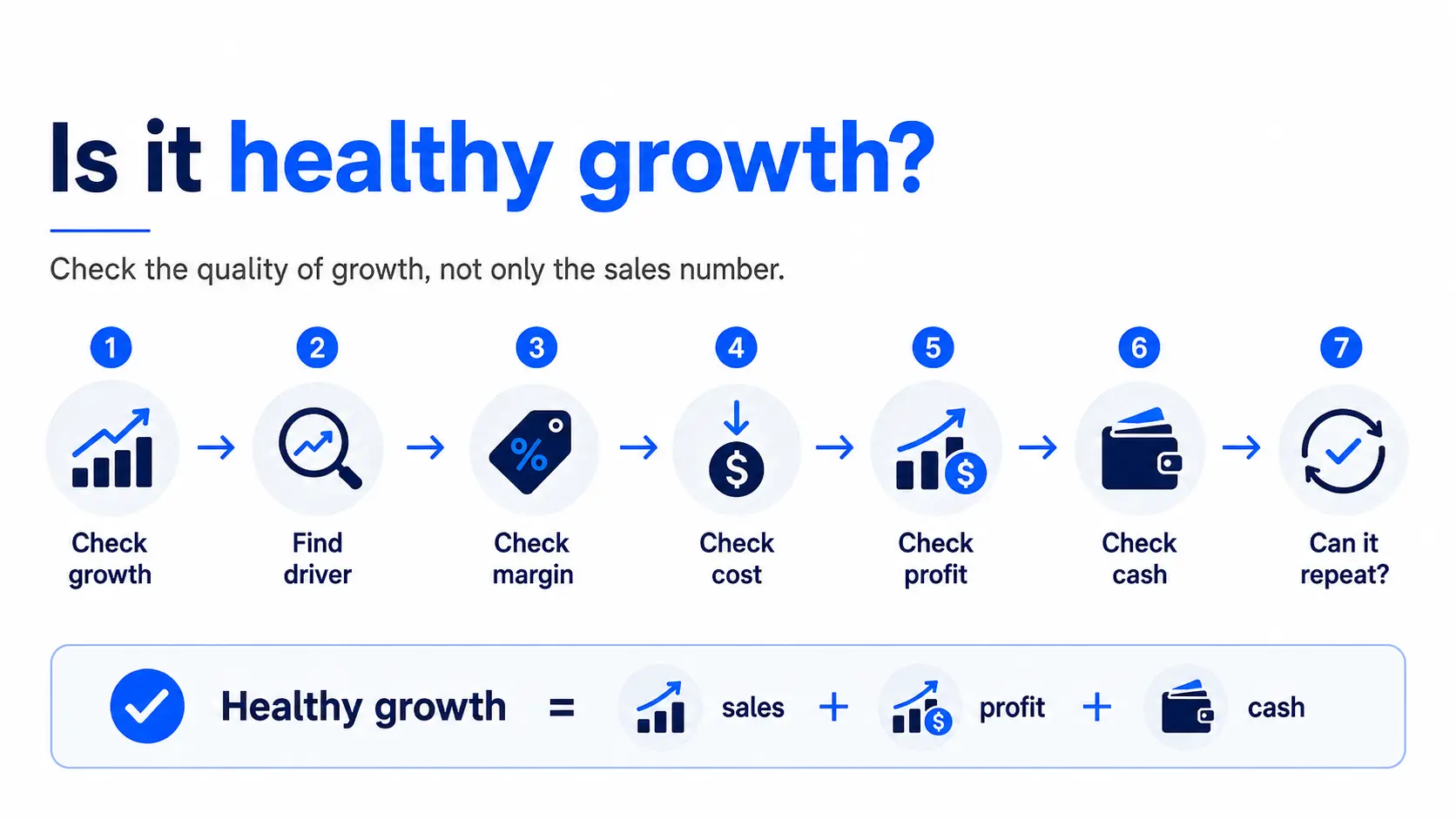
4. Revenue Growth Health Check
- VERIFY, Is the growth real against the right comparison?
- EXPLAIN, What created the growth?
- MARGIN, Did the additional Revenue generate more Gross Profit?
- COST, How much additional spending was required?
- PROFIT, Did Net Profit and Net Margin improve?
- CASH, Did Operating Cash Flow improve?
- REPEAT, Can this Growth reasonably happen again?
5. Higher Profit Still Does Not Automatically Mean More Cash
Profit is not the same as cash in the bank.
For example, a B2B company may generate THB 2 million in additional sales while giving customers 60-day payment terms.
Revenue and Profit may increase before the business collects all the cash.
Meanwhile, it may still need to pay suppliers, inventory, salaries, and advertising.
So even when Revenue and Profit improve, ask: “Did Operating Cash Flow improve as well?”
6. FACT / BEE INTERPRETATION / UNKNOWN
FACT
Revenue, Profit, and Cash Flow represent different dimensions of performance. Revenue Growth alone should not be used as a substitute for evaluating Profitability or Cash Flow.
BEE INTERPRETATION
For SME decision-making, reviewing Revenue Growth together with Margin, Expenses, Profit, and Cash provides a more useful view of the quality of growth than Revenue alone.
UNKNOWN
If all we know is: “Revenue increased 20%” we cannot yet conclude that the business became healthier. We still do not know what happened to Margin, Expenses, Profit, Cash Flow, what drove the growth, or whether that growth can be repeated.
7. Six Questions Before Calling It “Healthy Growth”
When your dashboard shows: Revenue +20%
ask:
1. What drove the growth? Customers, price, volume, or Product Mix?
2. Did Gross Margin improve or deteriorate?
3. How much did expenses increase?
4. Did Net Profit improve?
5. Did Operating Cash Flow improve?
6. Is this Growth repeatable?
The purpose of business data is not simply to know which number moved.
It is to understand: “What does that movement mean for the decision we need to make?”
Key Takeaway
Higher sales can be good news, but Revenue Growth alone is not enough to conclude that the business is improving.
Before making that judgment, ask:
What drove the Growth → What Margin remains → How much Cost and Cash were required to create it?
Limitations
This framework is a management diagnostic, not a universal accounting formula. Retail, subscription, service, marketplace, and B2B businesses have different revenue models and cost structures. The most useful KPIs should reflect how the specific business actually generates Revenue and incurs costs.

Revenue Growth should be evaluated together with Margin, Expenses, Profit, Cash Flow, and the source of growth before concluding that the business is becoming stronger.


.png)
.png)
.png)