.png)

.png)
.png)

Imagine a Survey containing 5,000 Open-ended Responses.
Reading and Coding every response manually can require substantial time.
AI therefore appears well suited to categorization and early-stage synthesis.
The problem begins when: “Use AI to support Coding”
quietly becomes: “Let AI analyze everything.”
Qualitative Coding is not simply Keyword Matching followed by Category Assignment. What counts as analytically relevant depends on the Research Question, Context and the researcher's analytical orientation. In Reflexive Thematic Analysis, Braun and Clarke explicitly treat Coding as a subjective, situated and interpretive process rather than one in which a single objectively correct coding exists independently of the researcher.
AI should therefore help make analysis more efficient and reviewable without becoming the automatic authority on what the data mean.
Let AI help organize and find. Let the researcher interpret and decide.
Generative AI can process large volumes of text, suggest Codes, organize responses and identify patterns more quickly.
A 2026 comparison of several AI tools for Thematic Analysis found relevant insights and substantial time savings, but none fully replicated the interpretive depth of the human analysis used as the reference in that study.
The useful question is therefore not simply: “Can AI code qualitative data?”
It is: “Which parts should AI support, and which parts require researchers to retain Analytical Authority?”
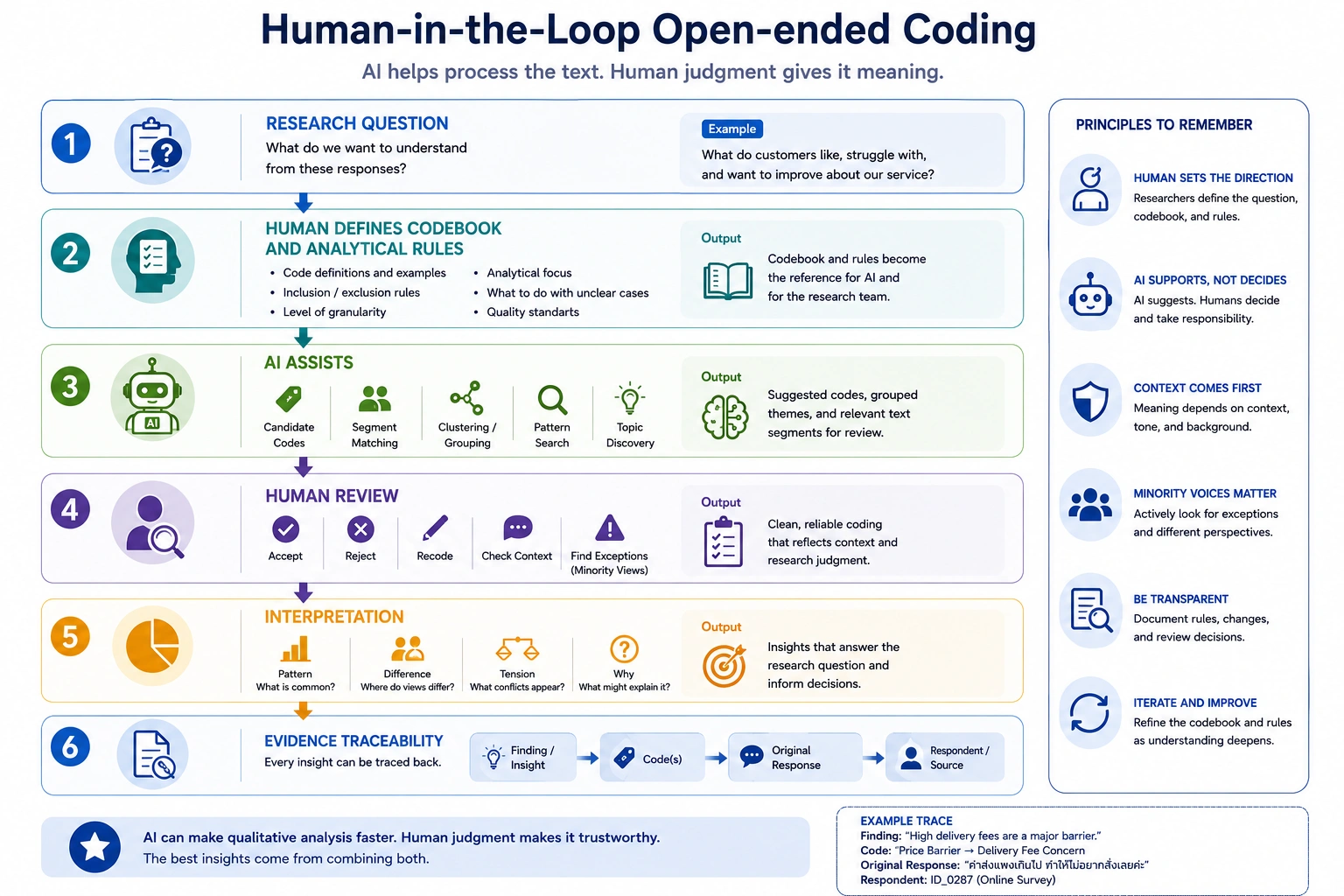
A practical model is: Human Framing → AI Assistance → Human Review → Context Check → Interpretation → Evidence Traceability
Open-ended Coding is more than attaching Labels to text
Consider the response: “The product is good, but at this price I probably wouldn't buy it often.”
Possible Codes include:
- Product Satisfaction
- Price Barrier
- Low Repeat Purchase Potential
- Value Concern
If the Research Question is about Product Experience, “the product is good” may be important.
If the question is Pricing, “at this price” becomes central.
For Retention, “wouldn't buy it often” may matter most.
A Code therefore emerges from: Data + Research Question + Analytical Lens
Reflexive Thematic Analysis treats Coding and Theme Development as interpretive activities in which researcher engagement with the Dataset is central to analytic quality.
AI can suggest a Code.
It should not independently determine the final Analytical Meaning.
What can AI support effectively?
AI can be particularly useful when the task is well defined and repetitive.
For example:
- Suggesting Candidate Codes from selected responses
- Finding Text Segments that may match an existing Code
- Suggesting possible Subcodes for researcher review
- Grouping semantically similar responses
- Flagging Topics the current Codebook may not cover
- Summarizing material within a Code as a starting point for review
- Helping search for Negative Cases or exceptions to a dominant Pattern
Qualitative analysis tools such as MAXQDA now implement this type of workflow by allowing AI to suggest coded segments against researcher-defined criteria, provide an explanation for the suggestion and leave the final review and adjustment to the researcher.
AI Output should therefore be treated as: Candidate Analysis
not: Final Finding
AI assistance is easier to control when the Codebook already exists
Compare two instructions.
Instruction 1: “Analyze all responses and tell me what customers think.”
Instruction 2: “Identify responses that meet the Price Barrier Code. Include cases where customers say the price is too high relative to perceived value. Exclude responses that mention price only when comparing brands without indicating a barrier.”
The second instruction creates a clearer Analytical Constraint.
A 2025 methodological paper on LLM-assisted qualitative coding proposes a Hybrid Workflow in which human researchers develop the Codebook first and then adapt it for LLM-assisted application, with machine output evaluated against human-derived benchmarks.
For Codes where consistency matters, define at least:
- Code Name
- Definition
- Inclusion Criteria
- Exclusion Criteria
- Example
- Boundary with related Codes
Clear Definitions do not make AI understand the data exactly as a researcher does.
They reduce the amount of interpretation the system has to guess.
AI is more likely to struggle with Context, Ambiguity and implicit meaning
Consider: “It's great, if you have half an hour to wait every time.”
A literal reading may pick up the positive expression: “It's great.”
In context, the comment is likely sarcastic and describes a negative Service Experience.
Interpretation becomes harder when the Dataset contains:
Sarcasm
Cultural References
Dialect
Mixed Emotions
Implicit Meaning
Contradictions
Power Relationships
Meaning dependent on earlier parts of a conversation
A 2026 methodological study using ChatGPT to support Thematic Coding of Roman Urdu interviews found that the model handled surface content relatively well but flattened some cultural and emotional nuance, making Human-in-the-loop oversight important for interpretive depth.
Another 2026 comparison of AI tools with human Thematic Analysis found only partial convergence, with none of the evaluated tools fully reproducing the depth of human interpretation.
Therefore: Text Classification ≠ Full Qualitative Interpretation
Do not let AI make Minority Views disappear
AI-assisted Pattern Detection can naturally emphasize recurring material because repetition is easier to identify.
But an important Qualitative Insight is not always the most frequent Theme.
A small number of responses may reveal:
A Critical Safety Issue
A New Use Case
An Emerging Need
An Unexpected Barrier
A meaningful difference within an important Customer Segment
Suppose 90% of respondents describe Onboarding as easy, but five Screen Reader users cannot complete one critical step.
A summary saying: “Onboarding is not a problem” would miss an important finding.
The useful BEE principle is: Frequency ≠ Importance
Researchers should therefore use AI to examine Main Patterns while also asking:
- Which responses do not fit this Pattern?
- Are there Negative Cases?
- Does an important Segment respond differently?
- Is there a low-frequency but high-severity issue?
Qualitative Analysis should explain Pattern, Difference, Tension and Context—not simply rank what was mentioned most often.
Human Review should return to Original Responses, not only the AI Summary
A risky workflow is: Raw Data → AI Summary → Researcher reads Summary → Finding
The researcher may no longer have sufficient contact with the source material.
A stronger workflow is: Raw Data → AI-assisted Coding → Original Extracts → Human Review → Interpretation
MAXQDA's current AI-assisted workflow maintains links to source passages and supplies explanations for coding suggestions so researchers can review and validate output against the original material.
Maintain the principle:
A Finding should trace back to a Code
A Code should trace back to an Original Response
and the researcher should be able to explain:
Why was this passage coded this way?
AI Coding requires Privacy and Data Governance before it requires a good Prompt
Before uploading Interview Transcripts, Open-ended Responses or Client Data to an AI system, ask:
Does the Dataset contain Personal Data or Confidential Information?
What were respondents told about data processing?
Has the Client approved AI processing of the data?
Where will the data be processed or stored?
Can the provider use the data for model training?
Who can access the inputs and outputs?
The current ICC/ESOMAR International Code requires clients to be informed when AI is used in dataset compilation, analysis, reporting or interpretation, including the extent of Human Oversight. It also requires research materials used with AI to remain confidential within secure and controlled environments.
ESOMAR also recommends clarifying Data Ownership, permissions and restrictions before placing client or research data into AI-based services.
Therefore: Can AI process it? ≠ Are we allowed to upload it?
A practical workflow for AI-assisted Open-ended Coding
- Define the Research Question
Clarify what the Coding needs to help answer. - Read a Human Sample First
Researchers should read part of the Dataset to understand language, Context and response diversity before automation. - Draft the Codebook
Define Codes, Definitions, Inclusion Criteria, Exclusion Criteria and examples. - Pilot AI Coding
Test the approach on a small Sample before running the full Dataset. - Compare with Human Judgment
Review both agreement and disagreement and understand why they occur. - Refine the Rules
Improve Code Definitions or instructions where boundaries remain unclear. - Scale with Review
Use AI on larger volumes while keeping Human Review for Ambiguous Cases and Critical Codes. - Search for Exceptions
Look deliberately for Minority Views, Negative Cases and data that challenge the dominant Pattern. - Interpret as a Researcher
Move from Observation → Pattern → Tension → Why → Business Implication. - Document AI Use
Record the Tool, relevant Model or Version, rules or prompts, date, Human Review process and limitations to maintain an Audit Trail.
Record the Tool, relevant Model or Version, rules or prompts, date, Human Review process and limitations to maintain an Audit Trail.
MAXQDA's guidance similarly recommends piloting AI Coding on a small sample before scaling and documenting software versions and analysis dates to improve transparency and the analytical Audit Trail.
The takeaway: AI should give researchers more time for Judgment, not remove Judgment from Research
The more useful question is not: “Can AI replace the researcher in Coding?”
It is: “Which tasks can be automated so researchers can spend more time on the work that requires Judgment?”
Current evidence presents a fairly consistent picture: AI can support theme identification, classification and efficiency in parts of Qualitative Analysis, while Human Interpretation remains important when Context, Culture, Emotion and deeper meaning matter.
For BEE, the principle is:
AI can support Coding
AI Output is not Evidence by itself
Humans must verify Context, Validity, Nuance and Interpretation
A useful workflow is therefore: Human Framing → AI Assistance → Human Review → Interpretation → Evidence Traceability
If AI causes researchers to read less and less of the data until their analysis consists mainly of accepting a model-generated Summary, productivity may improve while a central part of Qualitative Research is lost.
If AI instead reduces time spent on organizing responses, locating passages and repetitive Coding so researchers can spend more time examining Context, Exceptions and Interpretation, it can improve efficiency without replacing researcher judgment.

AI is useful for organizing Open-ended Responses, suggesting Candidate Codes, locating text that may match predefined Codes and supporting initial Pattern Detection. It should not hold final authority over what the data mean. Researchers remain responsible for the Research Question, Code Definitions, Context, Ambiguity, Exceptions, Interpretation and verification against Original Responses. The goal is to use AI to reduce repetitive work, not to reduce researcher thinking.
Sources
- Braun and Clarke, Thematic Analysis resources. Describe Reflexive Thematic Analysis as an interpretive, subjective and situated process in which researcher engagement is integral to Coding and Theme Development.
- Ayik et al., Human vs. AI: Evaluating Thematic Analysis With ChatGPT, QInsights, ATLAS.ti AI, and MAXQDA AI Assist, Qualitative Inquiry, 2026. Found partial convergence and time savings from AI tools, while none fully replicated the interpretive depth of the human reference analysis.
- Dunivin, Scaling Hermeneutics: A Guide to Qualitative Coding with LLMs for Reflexive Content Analysis, EPJ Data Science, 2025. Proposes a Hybrid Workflow in which researchers first develop the Codebook before LLM-assisted Coding and then compare machine output with human-derived benchmarks.
- Using ChatGPT for Thematic Analysis of Qualitative Interviews in Cultural Research, 2026. Reports strength in coding surface content alongside limitations in Cultural and Emotional Nuance and emphasizes Human-in-the-loop oversight.
- MAXQDA AI Assist. Provides AI-assisted Coding with coding suggestions, source-linked review and explanations, and recommends pilot testing and maintaining an analytical Audit Trail.
- ICC/ESOMAR International Code. Requires transparency about AI use and Human Oversight and protection of Research Data within secure and controlled environments.


.png)
.png)
.png)