.png)

.png)
.png)

Imagine a Loyalty Program growing from 100,000 to 150,000 members in one year.
That appears encouraging and in one sense it is. The Program expanded Enrollment by 50%.
But the more important question is: What did those additional 50,000 members do differently?
If they enrolled for a first-purchase Coupon and never returned, or if they were already frequent customers who simply added themselves to the Loyalty database, Membership Growth may create less incremental value than the headline suggests.
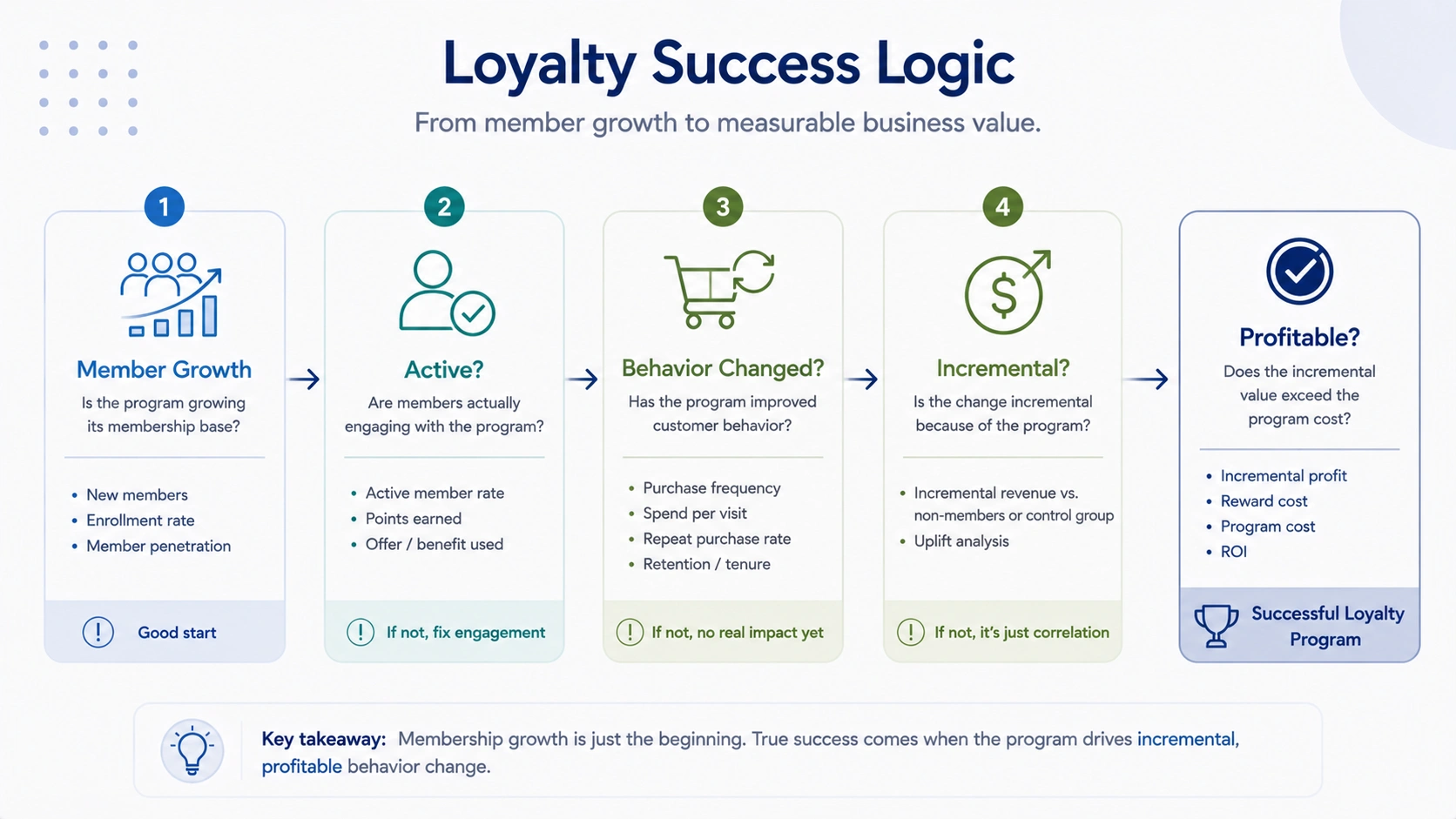
A Loyalty Program should therefore be measured as a journey from Enrollment → Activity → Purchase → Repeat Behavior → Incremental Value, rather than stopping at Member Count.
Membership Growth shows program reach, not necessarily stronger loyalty
A growing member base is useful evidence that more customers are enrolling in the program.
It does not yet tell you whether those members:
1. Become Active
2. Purchase more frequently
3. Spend more
4. Stay with the brand longer
5. Create behavior that would not have happened without the Program
6. Generate more value than the Rewards and Program cost
The key distinctions are:
Enrollment ≠ Engagement ≠ Loyalty ≠ Incremental Profit
A Loyalty Program should ultimately be judged by behavioral change and business value, not only by the size of its database.
What does Membership Growth tell you, and what does it not tell you?
Member growth answers: Is Program Reach and Enrollment increasing?
It does not automatically answer:
- Are members actually using the Program?
- Are they purchasing more frequently?
- Are they spending more?
- Are they staying longer?
- Did the Program cause those behavioral changes?
- Does the additional value exceed Reward and Program Costs?
McKinsey recommends distinguishing between groups such as enrolled, active and redeemer members, noting that Member Count or Member Spend alone can hide major differences in engagement. A dashboard showing only: Total Members = 500,000 therefore tells us relatively little about loyalty itself.
First, separate Total Members from Active Members
A Loyalty database can include customers who:
Enrolled but never used the Program
Joined for a first-purchase discount
Have not purchased for a year
Earn Points but never Redeem
Purchase regularly and use benefits actively
These customers should not all be treated as equally engaged.
Starbucks provides a useful example of definition discipline because it reports 90-day active members, rather than only cumulative membership. In Q1 FY2026, Starbucks reported 35.5 million 90-day active Rewards members in the U.S.
An SME can define an Active Member in a way appropriate to its category, for example:
- At least one Purchase in the last 90 days
- At least two Transactions in six months
- A Point earn or redemption within the period
- Login, Booking or Usage appropriate to the business model
What matters is using a consistent definition over time.
If Active Members increase, is the Program successful?
Not necessarily.
Active Members could increase while Sales barely move, or while Margins decline because Rewards become more expensive.
A useful evaluation separates at least four layers.
1. Enrollment
How many people join?
Measures include:
- New Members
- Enrollment Rate
- Member Penetration
These measure Reach.
2. Engagement
Do enrolled members actually use the Program?
Measures include:
- Active Member Rate
- Earn Rate
- Redemption Rate
- Offer Activation
- App / Program Usage
These measure participation.
3. Customer Behavior
Does behavior improve after joining?
Measures include:
- Purchase Frequency
- Repeat Purchase Rate
- Average Order Value
- Retention
- Churn
Salesforce lists Customer Retention, Repeat Purchase, Customer Lifetime Value, Program Engagement and Redemption among useful Loyalty Program measures.
4. Business Economics
Does the behavioral improvement create more value than it costs?
Measures can include:
- Incremental Revenue
- Incremental Gross Profit
- Reward Cost
- Discount Cost
- Operating Cost
- Contribution Margin
- Program ROI
This is the layer that connects loyalty activity to business value.

Does higher Repeat Purchase prove stronger Loyalty?
Not automatically.
Repeat Purchase is stronger behavioral evidence than Membership, but it can have several explanations.
Customers may return because of:
- Promotions
- Point expiration
- Convenience
- Location
- Limited alternatives
- Contracts
- Switching Costs
- Natural category repurchase cycles
Therefore: Repeat Purchase does not automatically equal Emotional Loyalty.
And: Returning Customer does not automatically equal Loyal Customer.
Salesforce describes Customer Loyalty more broadly than repeat transactions alone, including ongoing commitment, trust and the tendency to choose the brand over alternatives. A business does not have to measure emotional loyalty in every program, but it should avoid asking Repeat Purchase to prove more than the metric can support.
The major measurement problem: Members may already be your best customers
Suppose:
Members purchase three times per month
Non-members purchase 1.5 times per month
It may look as though the Loyalty Program doubled Frequency.
But another explanation is possible:
Customers who already buy frequently may be more likely to enroll.
This is a Selection Effect.
A simple Member vs. Non-member comparison therefore does not establish incremental Program Impact.
The real question is: “How much would these customers have purchased if they had not joined the Program?”
That unobserved alternative is the Counterfactual.
How can you estimate the incremental impact of a Loyalty Program?
Different methods provide different levels of evidence.
Before vs. After Enrollment
Compare: Three months before joining vs. Three months after joining
This is simple, but Seasonality, Promotions and Regression to the Mean can affect the result.
Cohort Comparison
Compare cohorts joining at different times or customer groups with similar characteristics.
This is stronger than a simple Before–After view but can still contain Selection Bias.
Matched Comparison
Match Members and Non-members with similar pre-period behavior, such as:
Purchase Frequency
Spend
Tenure
Channel
Customer Segment
Then compare later changes. This can reduce some bias, but it is not equivalent to Random Assignment.
Controlled Experiment
Where practical, use Treatment and Control Groups to measure specific Loyalty interventions.
For example:
Group A receives a Bonus Point offer
Group B does not
Then compare Incremental Purchase or Margin.
The stronger the claim that the Program caused behavioral change, the stronger the measurement design should be.
Redemption Rate matters, but it is easy to misread
Some programs treat Redemption mainly as a cost because redeemed Points create Reward Expense. But Redemption is also an Engagement signal.
McKinsey argues that focusing only on Membership or Point Accrual can miss important behavior and highlights redeemers as a particularly engaged group.
A high Redemption Rate is not always positive, however, if:
Reward Cost is excessive.
Customers purchase only when Rewards are available.
Margin falls materially
Rewards subsidize purchases that would have happened anyway
So evaluate: Redemption + Incremental Behavior + Economics together.
Be careful when “Breakage looks good”
Breakage refers to Points or Rewards that expire or go unused.
Financially, Breakage can reduce loyalty-program liabilities.
From an engagement perspective, however, it may indicate that:
Members forgot about the Program
Rewards are unattractive
Thresholds are too difficult
Redemption is inconvenient
Members are inactive
McKinsey cautions that relying on Breakage to improve Program Economics can mask lost engagement opportunities, particularly among valuable customer segments.
Low Reward Cost because nobody Redeems should therefore not automatically be celebrated.
Starbucks: Why Member Count is only part of the story
Starbucks Rewards provides a useful public example of layered measurement.
In Q1 FY2025, Starbucks reported 34.6 million 90-day active U.S. members, while Rewards member spend represented 60% of tender dollars at U.S. company-operated stores during that quarter.
By Q1 FY2026, active members had reached 35.5 million, and Starbucks reported that Rewards drove nearly 60% of U.S. company-operated revenue in fiscal 2025.
The public evidence supports:
FACT: Starbucks Rewards has a very large active member base and members account for a substantial share of U.S. company-operated revenue.
It does not by itself establish:
“Starbucks Rewards caused nearly 60% of revenue that would not otherwise have occurred.”
Member Revenue and Incremental Revenue are different concepts.
This distinction is critical:
Revenue from Members ≠ Revenue caused by Membership
What should a Loyalty Program dashboard include?
A Marketing / CRM / Management view can be structured in five layers.
Reach
- Total Members
- New Members
- Member Penetration
Activity
- Active Members
- Active Member Rate
- Earn / Redeem Activity
Behavior
- Purchase Frequency
- Average Order Value
- Repeat Purchase
- Retention / Churn
Incrementality
- Incremental Orders
- Incremental Revenue
- Incremental Margin
- Lift vs. Comparison Group
Economics
- Reward Cost
- Discount Cost
- Program Cost
- Contribution Margin
- Program ROI
Not every measure needs to sit on the first dashboard screen, but the measurement system should allow the team to move from Membership Growth to economic impact.
Example: Membership +30%, but the Program may not be improving
Suppose:
Members +30%
Active Member Rate 60% → 42%
Purchase Frequency stable
Average Order Value stable
Reward Cost +35%
Incremental Revenue: not yet measured
What can we say?
FACT: Enrollment increased rapidly while Active Rate declined and core behavioral measures did not improve.
What can we not yet say?
“The Program failed.”
We still need to know:
Are the new members still in their onboarding period?
Is the measurement period too short?
Is there incremental revenue?
What is the Program's actual objective?
BEE INTERPRETATION: Membership Growth can create an overly positive picture when Engagement and Economics are not reviewed alongside it.
Define the Program Objective before choosing the KPI
Different Loyalty Programs solve different problems.
If the objective is Repeat Purchase
Track:
Repeat Purchase Rate
Purchase Frequency
Time to Next Purchase
If the objective is Retention
Track:
Retention Rate
Churn
Active Member Cohorts
If the objective is Higher Spend
Track:
AOV
Spend per Member
Margin per Member
If the objective is Customer Data
Track:
Member Identification Rate
Profile Completion
Consent / Permission
Usable First-party Data
If the objective is Profit
Track:
Incremental Contribution
Reward Cost
Program Operating Cost
ROI
Program Success should therefore be defined by the problem the Program was built to solve, not by whichever KPI looks most impressive.
A practical measurement structure: Member → Behavior → Incremental Value
An SME without an advanced CRM stack can start with a simple table:

Then add one question: “Which of these changes do we have evidence were created incrementally by the Program?”
A metric improving after Program Launch is a temporal association.
Seasonality, Promotions, Customer Mix, Channel changes and comparison groups still need to be considered.
Seven questions before declaring a Loyalty Program successful
- Are Active Members growing along with total Membership?
- Are members purchasing more frequently or returning more often?
- How much has behavior changed from Baseline?
- Is there a credible Comparison that helps separate Program Effect from Selection Effect?
- Is additional Sales truly Incremental, or would it have happened anyway?
- What are the Reward and Program Costs?
- After costs, does the Program create Incremental Profit or the value defined by its objective?
If you can answer only the first question, you know the Program is growing.
You do not yet know whether it is succeeding.
The takeaway: A Loyalty Program should not win simply because more people joined
Membership is an important metric. It should not be the final KPI.
A stronger sequence is: Did they join?
→ Did they become Active?
→ Did they engage?
→ Did they purchase more or return more often?
→ Did the Program create that change incrementally?
→ Did the additional value exceed the cost?
Keep the distinctions clear:
Member ≠ Active Member
Repeat Purchase ≠ Loyalty automatically
Member Spend ≠ Incremental Spend
Program Revenue ≠ Program-caused Revenue
So before celebrating 20% or 30% Membership Growth, add one question to the Management Review:
“How differently would these customers behave if the Loyalty Program did not exist?”
That question shifts Loyalty Measurement from counting people who joined to evaluating whether the Program actually changed behavior and created additional business value.

Membership growth shows that a Loyalty Program is expanding its Reach or Enrollment. It does not prove that the program is causing customers to purchase more frequently, stay longer or generate more profit. A stronger evaluation separates Enrollment, Active Members, Engagement, Purchase Frequency, Retention, Incremental Revenue and Program Economics, ideally using comparisons that help distinguish program impact from the behavior of customers who were already loyal.
Sources
- Starbucks Coffee Company. Starbucks Unveils Reimagined Loyalty Program (29 January 2026) — 35.5 million 90-day active U.S. Rewards members.
- Starbucks Coffee Company. Starbucks Is Back, Turning Momentum Into Long-Term, Sustainable Growth (29 January 2026) — Rewards contribution to U.S. company-operated revenue.
- Starbucks Coffee Company. Q1 Fiscal Year 2025 Results and Digital IR Dashboard — active-member and member-spend metrics.
- McKinsey & Company. Next in loyalty: Eight levers to turn customers into fans — Enrolled, Active and Redeemer segmentation and Breakage.
- Salesforce. What is a Loyalty Program? — Retention, Repeat Purchase, CLV, Engagement and Redemption metrics.
- Salesforce. The Retailer’s Guide to Customer Loyalty — incremental behavior and ROI considerations.


.png)
.png)
.png)