.png)


.png)
.png)
Many organizations already have a Customer Journey Map but still struggle to answer: “What should we do next?”
The problem is often that the Journey is treated as a picture of Touchpoints, Social Media → Website → Store → Purchase → Service without connecting those Touchpoints to Customer Goals, Pain Points, Behaviors and Business Metrics.
A Journey that supports growth needs to answer more than: “Where does the customer interact with us?”
It should help explain:
What is the customer trying to accomplish?
Where do they stop, hesitate or experience unnecessary effort?
Where might the experience be reducing Conversion, Retention or Customer Value?
And if the business can improve only one area first, which opportunity deserves priority?
A useful Journey should lead to an Opportunity and an Action, not stop at a diagram
A Customer Journey represents the experiences and Touchpoints a customer has with a business from initial awareness through purchase, usage and post-purchase interactions. Journey Mapping can help businesses identify Customer Needs, Pain Points and gaps between channels or departments.
A Pain Point alone, however, is not automatically a Growth Opportunity. The business still needs to determine whether it affects Behavior or Business Outcomes—for example, whether customers abandon Checkout, fail to make a Second Purchase, create repeated Service Cost or reveal an unmet Need that could support Cross-sell.
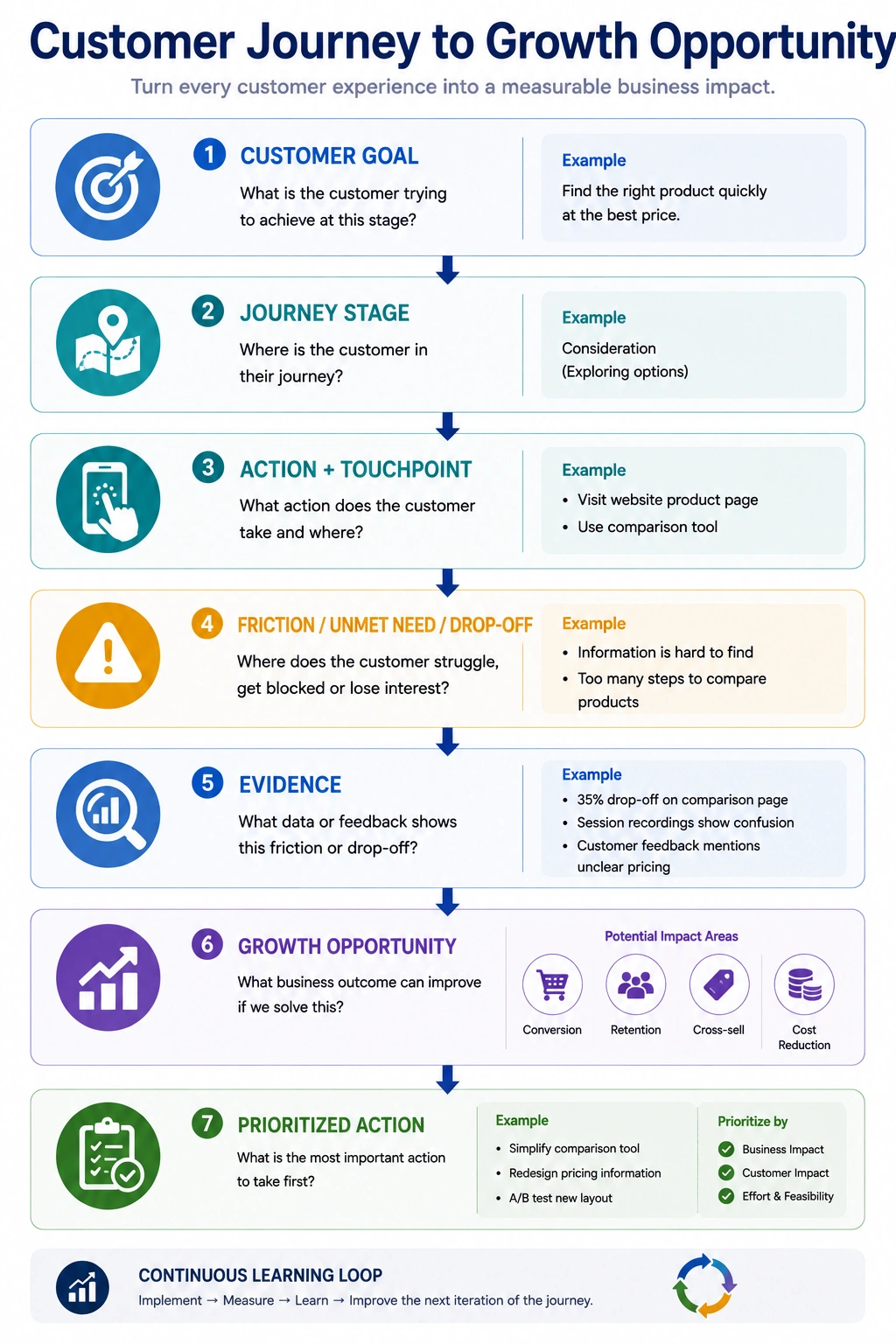
A practical sequence is: Journey → Friction / Need → Evidence → Business Impact → Priority → Action → Measurement
A Customer Journey is not the same as a Funnel or a list of Touchpoints
A Funnel usually describes movement between stages such as Awareness → Consideration → Purchase.
A Customer Journey is broader. It considers what the customer does, thinks, experiences and encounters across multiple Touchpoints, including what happens after the purchase.
Salesforce describes Customer Journey Mapping as a visual representation of customer interactions across the relationship and highlights its use for identifying Pain Points and opportunities to improve the experience.
A useful Journey therefore includes:
- Customer Goal
- Journey Stage
- Customer Action
- Touchpoint / Channel
- Question or Expectation
- Pain Point / Friction
- Available Evidence
- Business Metric
- Opportunity
Growth Opportunities often appear where the Customer Goal and the Business Process do not align
Suppose the customer wants to: “Compare Packages quickly.”
The Website, however, organizes information around the company's internal Product Structure.
The customer must visit several pages, call Sales and wait for a Quotation.
From the company's perspective, each Touchpoint may be functioning.
The Website loads.
Sales calls back.
The Quotation is sent.
From the customer's perspective, the Journey still involves substantial friction.
The Growth Opportunity may therefore be reducing Customer Effort rather than increasing Traffic.
This is why a Journey should start with the Customer Goal, not the Department Process.
Opportunity 1: Find Drop-off that is reducing Conversion
Journey analysis can help locate where a Conversion Problem occurs before the business concludes that it needs more Marketing.
Example: Ad → Product Page → Add to Cart → Checkout → Payment
If Traffic increases while Checkout Completion falls, investigate:
Payment Methods
Shipping Fees
Delivery Dates
Form Complexity
Login Requirements
Promotion Codes
Technical Errors
The question changes from: “How do we attract more visitors?”
to: “Why are people who already arrived failing to complete this stage?”
Journey Mapping can help reveal process gaps and friction across Touchpoints and support improvements in task completion.
Opportunity 2: Identify the First-to-Second Purchase Gap
Many businesses measure Customer Acquisition carefully but stop analyzing the Journey after the First Purchase.
A broader Journey might look like: First Purchase → Delivery → First Use → Support → Reorder
Potential problems include:
Customers do not know how to use the Product.
They do not know when to reorder.
There is no Onboarding.
A Service Failure is not recovered effectively.
There is no Reminder at the relevant time.
A Retention Opportunity can therefore begin much earlier than the moment a customer appears ready to Churn.
It may begin immediately after the First Purchase.
Opportunity 3: Find Unmet Needs that support Cross-sell or Upsell
Customer Journeys are not only useful for finding problems.
They can also reveal jobs customers still need to complete.
For example, a B2B customer uses Service A and repeatedly needs to:
Export data
Reformat files
Send them to Finance
A recurring pattern may indicate an opportunity for:
An additional Feature
A Premium Package
An Integration
An Advisory Service
A useful Cross-sell question is therefore not: “What else do we want to sell?”
It is: “What does the customer still need to accomplish after using the current Product?”
McKinsey's Customer Lifecycle approach spans Acquisition, Upsell / Cross-sell, Loyalty and Retention and emphasizes understanding customer behaviors and needs to determine the right objectives and interactions.
Opportunity 4: Find Service Friction that is increasing Cost-to-Serve
Not every Growth Opportunity needs to come from additional Revenue.
Reducing Customer Effort and Operational Friction can also create value.
For example:
A customer calls to check an Order.
The agent opens three systems.
The customer is transferred twice.
One request takes 15 minutes.
The Journey reveals Customer Friction.
Operational Data can show:
Contact Volume
Handling Time
Repeat Contact
Escalation
Cost per Contact
The opportunity may be:
Self-service Tracking
Better Notifications
A Single Customer View
Process Redesign
Growth can therefore come from both Revenue Opportunity and Efficiency Opportunity
The most frequently mentioned Pain Point is not automatically the highest priority
Suppose Journey Research finds:
Pain Point A appears 45 times.
Pain Point B appears 12 times.
A should not automatically come first.
Pain Point B may be less frequent but more likely to:
Cause Cancellation
Create Payment Failure
Create Safety Risk
Generate substantial Service Cost
Affect High-value Customers
Prioritize using dimensions such as:
Frequency
Severity
Customer Impact
Business Impact
Feasibility
Evidence Strength
A Journey Map identifies where to look.
It does not automatically assign the correct priority.
A Journey Map without customer evidence is still a Hypothesis Map
An internal Workshop can be useful for building an initial Journey.
But if the entire Map comes from employee opinions, it represents:
An Internal Hypothesis of the Customer Journey not yet A Verified Customer Journey
Stronger Journey work can combine:
Customer Interviews
Surveys
Web / App Analytics
CRM
Transaction Data
Complaint Data
Contact Center Data
Usability Research
Sales Feedback
Salesforce recommends grounding Journey Mapping in what customers actually do and combining analytical and anecdotal evidence when understanding Touchpoints and Experience.
Avoid using one Journey to represent every customer
New and existing customers may follow different paths.
A B2B Buyer and an End User may have different needs.
Promotion-driven and Full-price Customers may behave differently.
Digital-first and Offline-first customers may also take different routes.
When everyone is forced into a single Journey, the result can become a path that no actual customer follows.
Create separate Journeys when differences materially affect:
Need
Decision Process
Channel
Barrier
Experience
Business Action
Salesforce notes that businesses may need multiple Journey Maps for different scenarios and customer types.
Connect every Journey Stage to measurable Metrics
For example:
Discovery
Possible Metrics: Qualified Traffic, Awareness, Search-to-Visit
Consideration
Possible Metrics: Product Comparison, Leads, Demo Requests, Add to Cart
Purchase
Possible Metrics: Conversion Rate, Payment Success, Drop-off
Onboarding
Possible Metrics: Activation, First Successful Use
Usage
Possible Metrics: Frequency, Critical Event Completion, Support Contact
Repeat / Renewal
Possible Metrics: Second Purchase, Retention, Renewal, Churn
Advocacy
Possible Metrics: Referral Behavior, Recommendation
The right Metrics depend on the Business Model.
There is no universal Customer Journey KPI set.
High Journey Satisfaction does not automatically mean the Journey is a Growth Driver
Suppose one Touchpoint has a Satisfaction Score of 9/10.
That demonstrates strong Experience Performance.
It does not automatically prove that the Touchpoint drives:
Retention
Spend
Conversion
Referral
Another Touchpoint scoring 7/10 may matter more if almost every customer must pass through it before Purchase.
Keep two concepts separate: Experience Performance and Business Importance
McKinsey's Journey Diagnostics approach explicitly considers Journey Importance, Performance and potential Financial Impact when prioritizing CX opportunities rather than relying on Satisfaction alone.
Example: Customers sign up but do not return
Business Problem:
New Customers are growing, but Retention is weak.
A Dashboard may tell you:
Month 1 Retention is low.
A Journey view asks:
Before Sign-up → What did customers expect?
Sign-up → What Promise did we make?
After Sign-up → What must they do to receive Value?
First Use → Where do they struggle?
After First Use → Do they know the Next Step?
Support → Are issues resolved effectively?
The business may discover that Acquisition is not the main problem.
The real issue may be:
Time-to-Value is too long.
The opportunity changes from: Increase Media Spend to Improve Onboarding
That is how the Journey changes a Growth Decision.
Example: Sales says customers frequently ask for Discounts
The team may conclude: “The Price is too high.”
Journey Research may show that before asking for a Discount, customers:
Cannot compare Packages
Do not understand the differences
Cannot see the ROI
Need to justify the purchase internally
The Discount Request may therefore be a Symptom.
Possible underlying issues may include:
Value Communication
Package Design
Sales Enablement
Decision Support
Journey analysis helps examine what happened before the visible Pain Point.
Use this Framework to turn the Journey into Growth Priorities
- Define the Business Question
Are you trying to improve Conversion, Retention, Cross-sell or Efficiency? - Define the Customer and Scenario
Who is trying to accomplish what? - Map the Current Journey
Map what actually happens, not the Ideal Process. - Add Customer Evidence
Need, Question, Expectation, Pain Point and Emotion. - Add Behavioral and Business Data
Conversion, Drop-off, Frequency, Retention, Revenue and Cost-to-Serve. - Identify Opportunities
Where is there Friction, Unmet Need or Missing Value? - Prioritize
Use Customer Impact × Business Impact × Evidence Strength × Feasibility. - Test and Measure
Define the Metric before changing the Journey and verify whether the intervention actually improves the outcome.
The takeaway: Customer Journey creates growth value when it becomes a map of Decision Opportunities, not only a map of experiences
Customer Journey Mapping helps businesses look across Touchpoints and identify Customer Needs, Pain Points and Process Gaps that can be difficult to see when departments analyze only their own interactions.
But the Journey Map alone does not establish:
How many customers experience a Pain Point
Which Pain Point causes Churn
Which Touchpoint creates Revenue
Which improvement will deliver the highest ROI
A growth-oriented Journey therefore connects:
Customer Goal → Experience → Behavior → Business Outcome
Then asks:
Where do customers drop out?
Where is unnecessary effort created?
Which Need is still unmet?
Where is the business losing Revenue or creating avoidable Cost?
Which opportunity has enough evidence to test next?
A useful Customer Journey should not end as a set of Post-it Notes on a wall.
It should end with a Priority, an Action and a Metric that can show whether the change improved the experience and the business outcome.

Customer Journey becomes useful for growth when Customer Goals, Touchpoints, Pain Points and Behaviors are connected to Business Outcomes such as Conversion, Repeat Purchase, Retention, Cost-to-Serve and Cross-sell. A Journey Map can indicate where the business should investigate, but it does not prove that a Pain Point causes a business outcome. Stronger prioritization combines Journey Evidence with Behavioral Data, Customer Feedback and Business Metrics to identify opportunities with both Customer Impact and Business Impact.
Sources
- Salesforce. Customer Journey Mapping: A Complete Guide. Defines Customer Journey Mapping and discusses its use for understanding Touchpoints, Pain Points and opportunities to improve Customer Experience.
- Salesforce. What Are Customer Journeys? Describes the Customer Journey from Awareness through Post-purchase and emphasizes grounding optimization in data and actual customer behavior.
- Salesforce. Optimize Customer Journey Mapping. Connects Journey Mapping with objectives such as Customer Acquisition, Usage Frequency, Task Completion and Service Efficiency.
- McKinsey & Company. Customer Lifecycle Management. Describes the Customer Lifecycle from Acquisition through Upsell, Cross-sell, Loyalty and Retention, linking customer needs and behavior to Growth Objectives.
- McKinsey & Company. Experience Accelerator. Describes assessing Customer Journeys through Importance, Performance and potential Financial Impact to prioritize CX opportunities.


.png)
.png)
.png)