.png)

.png)
.png)

Before entering a new market, SMEs often already have substantial information.
They may know the population of an area, have read an Industry Report, reviewed competitors, examined public business data and followed category trends.
That evidence is valuable because it reduces uncertainty.
The problem begins when: “This market looks attractive”
is treated as equivalent to: “We should enter this market.”
Those are different conclusions.
A market can be large and growing while customers still reject your Proposition, Price, Channel or Product. Unit Economics may also make entry unattractive even when Demand exists.
Secondary Research is therefore an efficient first layer of evidence. Whether it is sufficient depends on the decision being made.
Secondary Research can tell you whether a market looks attractive. It may not tell you whether customers will choose you.
Secondary Research uses information that already exists, including Government Statistics, Industry Reports, Trade Data, Company Reports, Competitor Information and Published Research.
It is highly useful during the early stages of Market Entry because it can answer questions about Market Size, Growth, Demographics, Competition and Market Barriers without requiring a new study for every question.
The U.S. International Trade Administration recommends beginning international Market Research with Trade Data and Country or Industry Reports to assess Market Size, Demand Trends, Competition and Market Conditions. It also notes that Secondary Research is relatively inexpensive but may sometimes be outdated or too broad for a company's specific question.
The better question is therefore not: “Is Secondary Research good enough?”
It is: “Which critical assumptions for this decision remain unanswered?”
What is Secondary Research, and what does it answer well?
Secondary Research uses information that has already been collected or published rather than collecting new data directly from the Target Market.
Examples include:
- Government Statistics
- Census and Economic Data
- Industry Reports
- Trade Statistics
- Academic Research
- Company Annual Reports
- Public Competitor Information
- Published Prices
- Business Registration Data
- Search and Digital Trend Data
In Thailand, the National Statistical Office publishes business and service survey data covering the structure and operating characteristics of establishments, while DBD DataWarehouse+ provides business registration and geographic information that can support analysis of local business activity.
Secondary Research is well suited to questions such as:
- How large is the market?
- Is the Category growing?
- Who are the major competitors?
- Where is business activity concentrated?
- What Entry Barriers exist?
- What Price Range is visible?
- What does the Market Structure look like?
Secondary Research is particularly useful for Market Screening
If an SME is deciding which three markets to study further from a list of ten, Secondary Research may be sufficient for the first round.
The U.S. International Trade Administration recommends using data on Market Size, Growth, Demand, Competition and Market Conditions to identify stronger Potential Markets before committing further resources.
For a smaller business, this can significantly reduce Research Cost.
Instead of running Surveys in every market, the business can use existing information to:
- Eliminate weak markets
- Rank stronger opportunities
- dentify Critical Assumptions
- Select one or two markets for deeper validation
Secondary Research is not simply a weaker version of Primary Research.
It answers a different class of questions.
Problems begin when Market-level Data is used to answer Customer-level questions
Suppose Secondary Research shows:
The Category grew 12%
Household numbers are increasing
Competition appears limited
That may support the conclusion that the Market Opportunity deserves attention.
It does not yet answer:
Will customers choose our Brand?
Do they understand our Proposition?
Is our Price acceptable?
What prevents Trial?
Which Channel will actually generate Purchase?
This is the distinction between: Market Attractiveness
and: Product-Market Fit for your specific business
The U.S. Small Business Administration notes that existing sources are useful for general and quantifiable questions such as Industry Trends, Demographics and Income, while direct research is better suited to questions specific to a business and its customers.

A newly published report does not necessarily contain new data
Always separate:
Publication Date
Data Collection Period
Fieldwork Period
Reference Period
A report released in 2026 may still rely mainly on 2024 data.
That gap can matter in a fast-changing Category.
The U.S. International Trade Administration cautions that Secondary Statistics for some markets may be several years old or too broad to be useful for a company's specific needs.
Before using a figure, ask:
When was the underlying data actually generated?
What changed after that period?
Check Definitions and Denominators before comparing different sources
Report A says: Market Size = 5 billion baht
Report B says: Market Size = 8 billion baht
One does not have to be wrong.
Possible reasons include:
One includes only Retail Sales
The other includes B2B
One covers only the Formal Market
The other estimates Informal Sales
Different Geography
Different Category Definition
Different Tax Treatment
Different Year
Before building a Forecast from Secondary Research, check:
- Definition
- Population
- Geography
- Period
- Currency
- Base or Denominator
- Methodology
A precise-looking number is not necessarily decision-useful if its Definition does not match the Business Question.
Search Data and Social Data can indicate interest, but they do not automatically establish Demand
A business may observe rising Search Interest or Social Mentions and conclude:
“There is strong Demand.”
These measures are better treated as signals of Interest or Conversation.
They are not direct measures of Purchase.
Search Interest ≠ Sales
Social Mentions ≠ Market Size
Page Views ≠ Purchase Intent
Follower Growth ≠ Customer Growth
Digital Secondary Data can help identify a Hypothesis or Direction, but a high-investment Market Entry Decision usually benefits from evidence closer to actual behavior.
Competitor presence proves market activity, not necessarily space for your business
Many competitors may indicate:
Existing Demand
but it may also indicate:
Market Saturation
Price Pressure
High Customer Acquisition Cost
Low Margin
Few competitors may indicate:
Opportunity
or: Insufficient Demand
The SBA recommends evaluating Market Share, competitor Strengths and Weaknesses, Entry Opportunities, Barriers and Indirect Competitors rather than simply counting businesses in the category.
Competitor Count is evidence.
It is not a Market Entry Decision by itself.
When can Secondary Research be enough?
Secondary Research may be enough when the decision is:
- Low cost
- Reversible
- Primarily a Screening Decision
- Not dependent on deep Customer Motivation
- Supported by relevant Behavioral Data already available
Examples include:
Selecting three provinces for further research
Removing countries with insufficient Market Size
Screening markets with unacceptable Regulatory Barriers
Building an early Market Size Estimate
Choosing which competitors to Benchmark
In these cases, the objective is to narrow the field. It is not yet a full investment commitment.
When should you add Primary Research?
Consider Primary Research when important uncertainties involve questions such as:
- Does the Target Customer genuinely have this Need?
- Is the Need strong enough to change Behavior?
- Is the Proposition understood?
- hat is the likely Willingness to Pay?
- Which Channel do customers actually use?
- Who makes the Purchase Decision?
- What prevents Trial?
- Does the Product need Localization?
Primary Research may include:
Customer Interviews
Surveys
Partner or Distributor Interviews
Retailer Interviews
Usability Tests
Concept Tests
Pricing Research
The U.S. International Trade Administration describes Primary Research as information collected directly from a market through Interviews, Surveys and contact with representatives or Potential Buyers, with the advantage that it can be tailored to company-specific questions.
Primary Research may still be insufficient when the decision depends on actual behavior
Suppose Interviews produce: “This sounds interesting.”
A Survey finds:
70% are interested in trying it. That does not mean: 70% will purchase.
As Investment Risk increases, the evidence should move closer to behavior through options such as:
Landing Page Tests
Demo Requests
Waitlists
Pre-orders
Paid Pilots
Pop-up Stores
Limited Geographic Launches
Actual Sales Tests
A useful distinction is:
Stated Interest → Useful Signal
Actual Commitment → Stronger Behavioral Evidence
Example: Opening a store in a new province
Secondary Research can help examine:
Population
Income Proxies
Business Density
Competitors
Location Patterns
Rent Levels
Traffic Proxies
Category Trends
In Thailand, DBD DataWarehouse, can support analysis of registered businesses and geographic business activity, while NSO business statistics provide broader structural context.
Before signing a long lease, however, the business may still need to know:
Does the Target Customer actually visit this area?
Does the Proposition solve a relevant Need?
Is the Price acceptable?
How is the offer different from Alternatives?
When does actual Purchase occur?
A Booth, Pop-up or Delivery-only Pilot may reduce more uncertainty than another long Desk Research report.
Use Secondary Research to build Hypotheses, not unjustified confidence
For example
FACT: The number of registered businesses in this Category has increased in the area.
BEE INTERPRETATION: Business activity or competitive interest may be increasing.
HYPOTHESIS: Customer Demand may be growing and there may still be space for our Proposition.
UNKNOWN: Business Registration Data alone does not establish actual Customer Demand, Profitability or attainable Market Share.
This distinction prevents a common leap from: “We have data.” to: “We are ready to invest.”
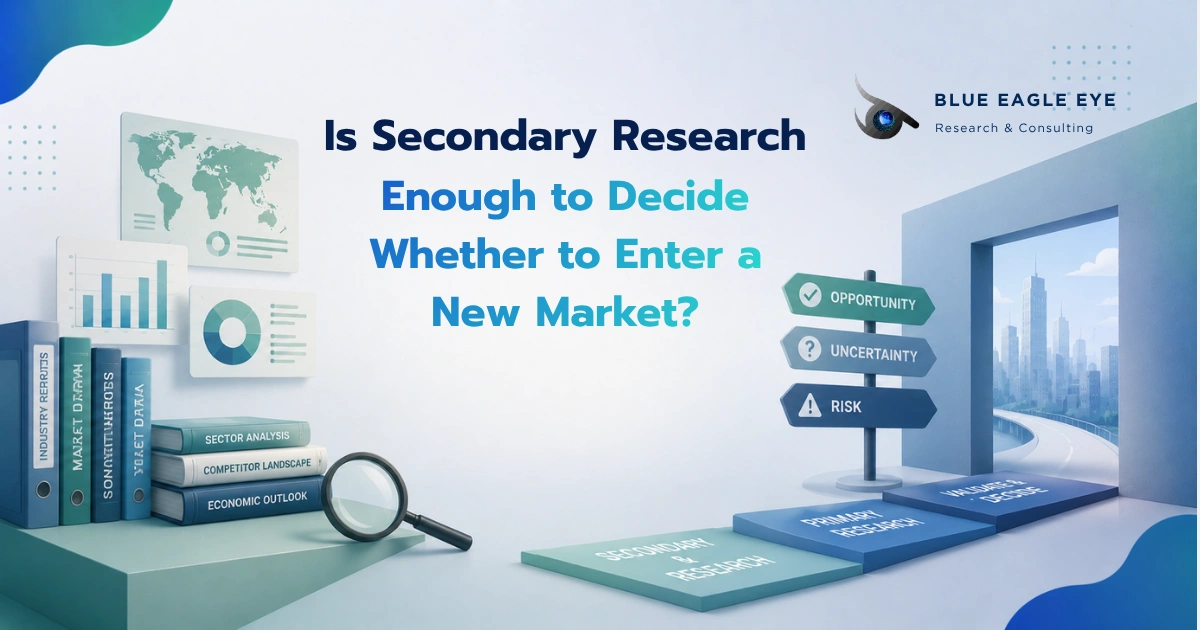
A practical SME Framework: Desk Research → Decision Gap → Direct Evidence → Test
- Define the Decision
Are you considering a new Store, Category, Province or Country? - Use Secondary Research
Assess Market Size, Growth, Competition, Customer Structure, Regulation and preliminary Economics. - Identify Decision Gaps
Which unanswered assumptions could materially change the decision? - Choose the Smallest Useful Primary Research
A large Survey is not always necessary. Interviews, Partner Checks or a Concept Test may be sufficient. - Move toward Behavioral Evidence
If the investment remains significant, use a Pilot, Pre-order or Market Test where feasible. - Define Go / Revise / Stop
Set the Decision Rule before making the larger commitment.
The takeaway: Secondary Research may be enough to answer “Should we study this market further?” It is often not enough to answer “Should we fully enter now?”
Secondary Research is an efficient starting point because it can reveal Market Size, Trends, Competition, Demographics and Market Conditions with less time and cost than collecting new data.
Its limitations are equally important.
The information may be:
Too broad
Outdated
Defined differently from your business
Poorly matched to your Target Customer
Unable to predict behavior under your specific Product, Price and Proposition
A practical SME sequence is:
Secondary Research → Screen
Primary Research → Understand and Measure
Market Test → Observe Behavior
A good Market Entry Decision does not require knowing everything before acting.
It requires knowing which assumptions matter most, what evidence currently supports them, and whether that evidence is strong enough for the level of risk you are about to take.

Secondary Research can be sufficient for Market Screening, understanding Market Structure, estimating Size and Trends, identifying Competitors and defining assumptions that need further testing. It is usually less sufficient for proving that a specific Target Customer will choose your Product at your intended Price, Proposition and Channel. As the decision becomes more expensive or difficult to reverse, the business should add evidence closer to actual customer behavior through Interviews, Surveys, Partner Research, Landing Page Tests, Pre-orders or a Limited Market Pilot.
Sources
- U.S. International Trade Administration. Conducting Market Research. Explains the use of Trade Data and Secondary Research for Market Size, Demand, Competition and Market Conditions, and the role of Primary Research in answering company-specific questions with Potential Buyers.
- U.S. International Trade Administration. Methods of Market Research. Notes that Secondary Research is relatively inexpensive and useful for focusing Market Opportunity, while some sources may be outdated or too broad for specific decisions.
- U.S. Small Business Administration. Plan Your Business. Distinguishes existing sources used for general trends and demographic questions from direct Customer Research used for business-specific questions.
- Thailand National Statistical Office. The 2024 Business Trade and Services Survey. Provides structural and operational information on Trade and Service establishments in Thailand.
- Department of Business Development. DBD DataWarehouse+. Provides registered business, geographic and business opportunity information that can support Market Screening in Thailand.

.png)
.png)
.png)