.png)

.png)
.png)

Major business decisions often begin with statements such as:
“This location should work.”
“Customers will probably accept the new price.”
“Hiring another salesperson should increase growth.”
“Younger customers should like this product.”
There is nothing unusual about having these beliefs. Every decision is built on assumptions.
The risk begins when an assumption is treated like a fact without first making clear what must be true for the decision to make sense.
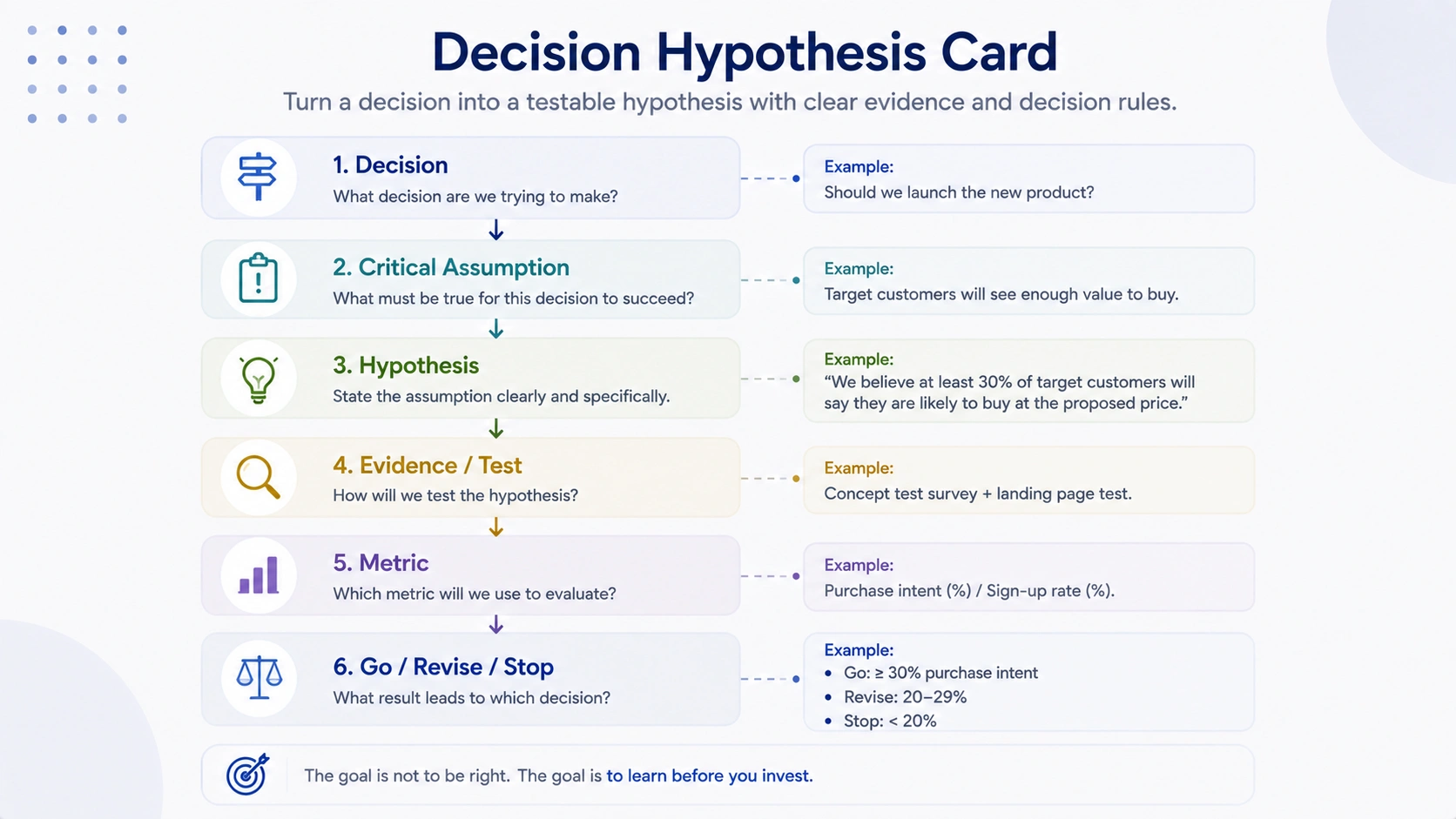
Writing a hypothesis turns “we think this will work” into something that can be tested with evidence before more money, time and resources are committed.
A good hypothesis tells you what evidence you need before deciding
A Business Hypothesis should be more specific than “Customers will like it” or “This location should perform well.”
It should answer:
1. What do we believe?
2. Which customer or situation does it apply to?
3. What should we observe if the assumption is true?
4. Which Metric or Evidence will test it?
5. What result would lead us to Go, Revise or Stop?
For example, instead of saying: “Customers will probably accept a higher price.”
write something closer to: “We believe existing customers in Segment A will maintain purchase volume within an economically acceptable range after a 5% price increase because the product has limited substitutes.”
The next step is to test the assumption, not search only for information that confirms it.
What is a Business Hypothesis?
In a business context, a hypothesis is an important assumption behind a decision that can be examined using evidence.
Strategyzer defines business hypotheses as assumptions underlying a Value Proposition, Business Model or Strategy, the things that would need to be true for an idea to work.
Consider: “This new location should perform well.”
That is too vague to test. Break it down:
- There are enough target customers in the area.
- Those customers have a relevant need.
- The price is acceptable.
- Available traffic can convert into customers.
- Expected Sales can support the Fixed Costs.
Now there are several assumptions that can be tested separately.
Start with the Decision, not the Research Method
Do not begin with: “What Survey should we run?”
Start with: “What decision are we trying to make?”
For example:
Decision: Should we open a second location?
Then ask: What would we have to be wrong about for this decision to fail?
Possible uncertainties include:
Demand
Average Spend
Repeat Visits
Rental Economics
Cannibalization from the existing store
BEE's research principle starts with Decision and Uncertainty before Hypothesis, Evidence and Method.
This prevents Research from becoming a large collection of information with no clear connection to the decision.
What should a good hypothesis contain?
A practical structure is:
We believe [who/what] will [show a behavior or outcome] under [specific conditions] because [an assumption or rationale].
Then add: We will assess this using [Metric / Evidence], and the result will be sufficient for the next decision if [Threshold / Decision Rule].
Strategyzer's Test Card uses a similar sequence: state what needs to be true, determine how to test it, specify what will be measured, and define the success threshold before the experiment.
From vague assumptions to testable hypotheses
Example 1: Opening a new location
Too vague: “This is a good location.”
Better: “We believe office workers within one kilometre have sufficient demand for grab-and-go lunch to support the minimum Sales required by this location.”
Now define:
- Who exactly is the target?
- What counts as Demand?
- What is Minimum Sales?
- Could a Pop-up or Delivery-only Pilot test the assumption?
Example 2: Raising prices
Too vague: “Customers should be okay with the increase.”
Better: “We believe a 5% price increase on Product A will not reduce Unit Sales enough to lower total Gross Profit below its current level.”
The team now knows it must examine:
Price
Units
Gross Profit
and possibly Customer Segments
Example 3: Launching a new product
Too vague: “Younger consumers will like it.”
Better: “We believe customers aged 25–34 who purchase this category at least monthly will find Benefit X relevant and show stronger Purchase Intent than for the current concept.”
If the investment depends on actual demand, a later Behavioral Test may still be necessary because Purchase Intent is not Actual Purchase.
Avoid hypotheses that can never be wrong
Consider: “Customers want a better service.” What does “better” mean?
If the result disappoints, the team can always explain afterwards:
It was not good enough
Customers did not understand it
The timing was wrong
Marketing was insufficient
That makes the assumption difficult to invalidate.
Strategyzer recommends hypotheses that are testable, precise and discrete, so teams can identify evidence that supports or contradicts them.
A useful test is: “What result would make us admit that this assumption may be wrong?”
If there is no answer, the hypothesis needs more work.
Do not put several assumptions into one hypothesis
Consider: “We believe customers will love the new product because it is affordable, easy to use and beautifully designed, so they will buy again.”
This contains at least four assumptions:
- Liking
- Price
- Ease of Use
- Repeat Purchase
If the test fails, the team will not know which assumption was wrong. Separate them:
- The target customer finds the Concept relevant.
- The target customer perceives Value at THB 499.
- New users can begin using the product without assistance.
- First-time buyers make a Repeat Purchase within the defined period.
One hypothesis should ideally isolate one important uncertainty.

A hypothesis does not always need to claim “because”
Including a rationale can reveal the team's logic, but it can also accidentally turn an untested explanation into a causal claim.
For example: “Customers will repurchase because delivery is faster.”
If Delivery Speed has not been established as a driver, a more disciplined version would be: “We hypothesize that Delivery Speed may contribute to Repeat Purchase and expect customers receiving delivery within 24 hours to show a higher Repeat Purchase Rate than a comparable group.”
The appropriate Analysis or Experiment can then test the relationship.
A hypothesis is something to investigate, not a fact written in future tense.
Which hypothesis should you test first?
A business may have dozens of assumptions. You do not need to test them all at once.
Start with a Critical Assumption, one that could seriously weaken the decision or business idea if it is wrong.
Strategyzer recommends identifying and testing the most critical assumptions before investing heavily in building the solution.
A simple prioritization uses two questions:
Impact if wrong - How damaging would it be?
Evidence today - How much credible evidence do we already have?
An assumption with: High Impact + Low Evidence
deserves early attention. Before signing a three-year lease, for example, Demand usually deserves more evidence than the final logo color.
The evidence must match the hypothesis
Suppose the hypothesis is: “Customers are willing to pay THB 599.”
and the evidence is: “80% said the concept looks interesting.”
The evidence does not directly test the hypothesis.
Liking does not measure Willingness to Pay.
Likewise:
Search Volume is not Sales
Purchase Intent is not Actual Purchase
Social Comments are not Population Demand
Strategyzer distinguishes lighter evidence based on what customers say from stronger evidence based on what customers actually do, particularly under more realistic conditions.
The hypothesis should determine what evidence is needed.
Should you define a threshold before seeing the result?
For material decisions, usually yes.
Suppose a team runs a Landing Page Test and, after seeing a 2% Conversion Rate, says: “Two percent seems pretty good.”
The risk is that the success criterion is being adjusted to fit the observed result.
A stronger design would state:
Hypothesis: The target segment will pay for the Pilot.
Metric: Paid Conversion Rate.
Decision Rule: If Conversion ≥ X while CAC ≤ Y → proceed to the larger test.
The threshold should be informed by:
- Unit Economics
- Historical Baselines
- Relevant Benchmarks
- Minimum Viable Outcome
- Cost and risk of the next investment
Strategyzer's Test Card similarly asks teams to define what success looks like before the test.
Decision Rules do not have to be only Pass or Fail
Business evidence is rarely perfectly binary.
BEE Academy uses a Go / Revise / Stop approach for connecting Market Research with action.
Go
The evidence is sufficient to justify the next investment step. This does not mean the idea has been proven with certainty.
Revise
There is evidence for the underlying opportunity, but the Segment, Offer, Price or Channel needs adjustment.
Stop
A critical assumption receives insufficient support, and the expected value of continuing does not justify the risk.
Test More
The available evidence is too weak or contradictory to support Go or Stop.
This turns experiments into learning rather than a contest over whether the original idea was “right.”
Full example: Before opening a new location
Suppose an SME is considering a new store in an office district.
Decision: Sign the lease or not?
Critical Uncertainty: Is weekday lunch Demand sufficient?
Hypothesis:
“We believe office workers within an 800-metre radius have sufficient demand for a THB 159–189 Lunch Set to generate at least 80 Paid Orders per weekday.”
Evidence:
Run a Delivery / Pop-up test for 3–4 weeks in the area.
Metrics:
Paid Orders
Average Order Value
Repeat Orders
Contribution Margin
Customer Acquisition Cost
Decision Rule:
Go if Demand and Economics clear the required minimum.
Revise if Demand exists but Price or Channel does not work.
Stop if Paid Demand remains weak under appropriate test conditions.
The vague question “Is this a good location?” has now become something that can be investigated with evidence.
More examples: Weak vs. stronger hypotheses
“Customers like the new product.”
Better: “Customers in Segment A will rate the new Concept as more relevant than the current Concept and reach the defined Purchase Intent threshold.”
“This promotion will improve Sales.”
Better: “Promotion A will generate higher Incremental Gross Profit than the no-promotion baseline during the test period.”
“Hiring more salespeople will increase Revenue.”
Better: “Additional Sales coverage in Segment X will increase Qualified Opportunities per month, with incremental Pipeline Contribution exceeding the cost of additional Sales Capacity.”
Each version makes clearer what should be measured next.
Seven questions before running Research or an Experiment
Before writing a Questionnaire, conducting Interviews or building a Dashboard, ask:
- What Decision are we trying to make?
- Which Assumption would matter most if it were wrong?
- Is the Hypothesis specific and testable?
- What type of Evidence actually tests it?
- Which Metric will assess the result?
- What Threshold or Decision Rule will we use?
- If the evidence disappoints us, are we genuinely willing to Revise or Stop?
The final question matters. Research creates limited value when new evidence has no realistic chance of changing the decision.
The takeaway: A good hypothesis is not designed to make you look right
Writing a hypothesis before a major business decision does not remove uncertainty.
It exposes it. Instead of saying: “We think this will work.”
ask: “What must be true for this idea to work?”
Then ask: What evidence should we observe if it is true?
How will we test it?
What will we measure?
What result would lead to Go, Revise or Stop?
The best Business Hypothesis is not the most sophisticated sentence.
It is the one that helps a team know what evidence to collect, and remain willing to change the decision when the evidence does not support what they originally believed.

A useful Business Hypothesis should state what you believe, for whom, under what conditions, what evidence you expect to observe, and what result would lead to Go, Revise or Stop. The purpose is not to predict correctly. It is to make a critical assumption explicit enough to test before committing more money, time and resources.
Sources
- Strategyzer. Validate Your Ideas with the Test Card — Hypothesis, Test, Metric and success-threshold framework.
- Strategyzer. nnovation Process: Formulating Strong Hypotheses — testable, precise and discrete hypotheses.
- Strategyzer. How to Test Your Idea: Start With the Most Critical Hypotheses — prioritizing critical assumptions.
- Strategyzer. Business Testing: Is Your Hypothesis Really Validated? — evidence strength and what customers say versus do.

.png)
.png)
.png)