.png)

.png)
.png)

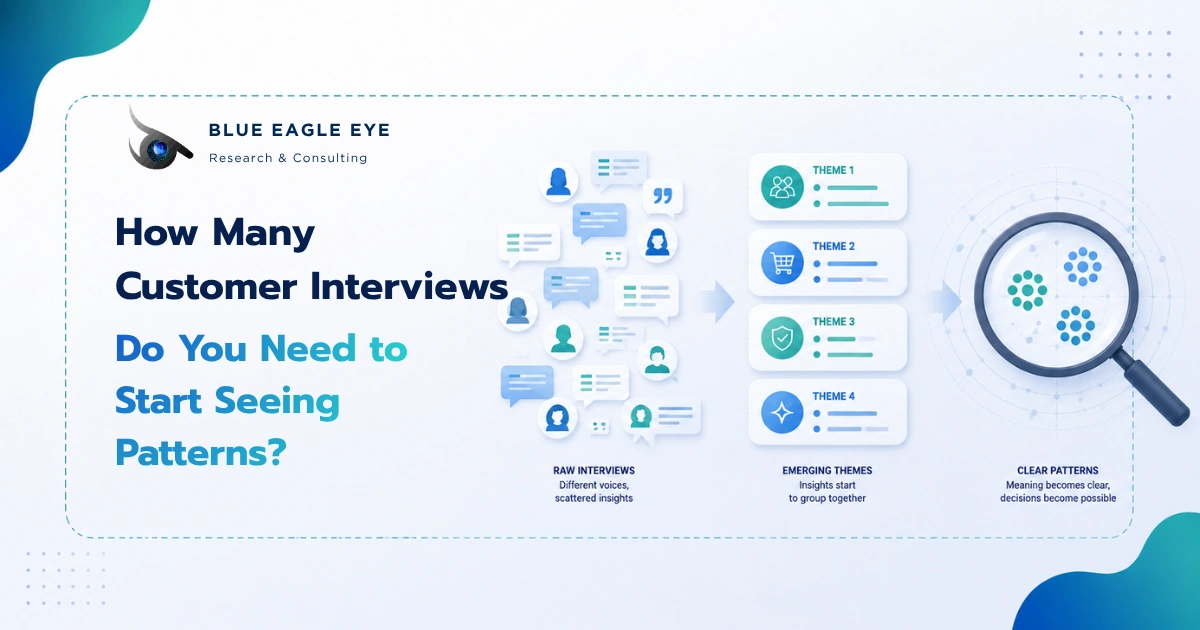
“How many customers should we interview?” is often one of the first questions an SME asks when planning Customer Interviews.
Are five enough?
What about ten?
Do we need twenty or thirty?
A more useful answer than a single number is: It depends on what you are trying to understand and how different the customers are from one another.
If you are studying a narrowly defined problem among a highly similar group, recurring patterns may appear relatively quickly.
If the business serves several Segments, Usage Contexts or customer types, interviewing ten people in total may provide very little coverage of each group even if some answers already sound repetitive.
Starting to see a pattern is not the same as having enough evidence
In Qualitative Research, recurring themes may begin to appear during the first few Customer Interviews. That does not necessarily mean data collection should stop.
The number of interviews required depends on at least four factors:
1. How broad or narrow is the Research Question?
2. How similar or diverse are the customers?
3. How much relevant information does each Interview provide?
4. Are new interviews still revealing important Themes, Exceptions or Differences?
For narrowly defined studies with relatively homogeneous populations, empirical reviews have often reported saturation around 9–17 interviews. This range is useful for planning, but it should not be applied automatically to every segment or research question.
There is no magic number for Qualitative Interviews
Qualitative Research does not determine Sample Size in the same way as a Survey.
Quantitative Sample Size is often related to estimation, precision, comparisons and Statistical Power.
Qualitative Interviews serve different purposes, including:
- Understanding Context
- Exploring Motivation
- Learning customer language
- Identifying Patterns and Differences
- Discovering tensions and unexpected issues
The key question is therefore not: “How many people do we need to represent the population?” It is: “Do we have enough relevant information to understand the important patterns and differences for this decision?”
This aligns with BEE's research principle that Qualitative Research is particularly useful for understanding context, meaning, motivation and language rather than estimating population proportions.
What does research say about the number of interviews?
A well-known study by Guest, Bunce and Johnson analysed 60 In-depth Interviews and found that, within that particular dataset, saturation occurred within the first 12 interviews, while basic elements of major themes were already present by around six interviews. The result came from a specific Study Design and Population and should not be interpreted as a universal six- or twelve-interview rule.
A later systematic review by Hennink & Kaiser examined empirical studies of saturation and found that many relatively homogeneous studies with narrowly defined objectives reached saturation at around 9–17 interviews.
This range can therefore be useful as a planning reference in some studies. It should not become: “Qualitative Research always needs 12 interviews.” Different questions and sample structures require different designs.
“Seeing a pattern” is not the same as “reaching saturation”
These ideas should be separated.
Starting to see patterns
You may begin hearing recurring themes such as:
- Price
- Convenience
- Lack of confidence
- A difficult process
after five or six interviews. That is useful. It does not necessarily mean you understand how those themes vary across all relevant customer types.
Saturation
Saturation is commonly used to describe a point at which additional data collection is no longer producing important new themes or information for the analysis.
However, the term itself has several definitions and is applied inconsistently across qualitative methodologies.
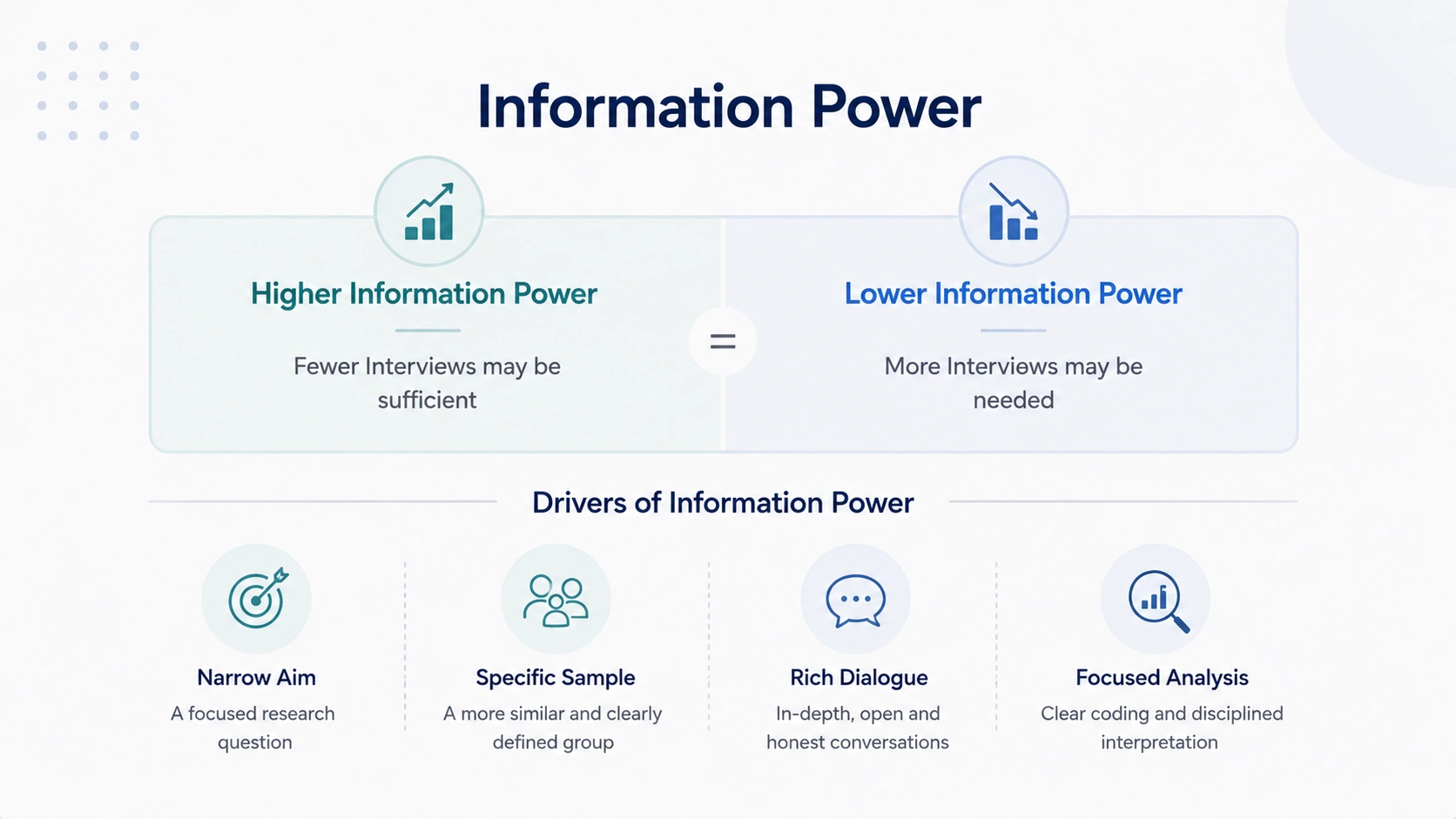
Malterud and colleagues therefore proposed Information Power as another way to reason about Sample Size. The principle is that a sample containing more information relevant to the research question may require fewer participants than a broad, less specific sample.
How does Information Power help determine Sample Size?
Information Power asks: How much relevant information does each participant contribute to the Research Question? Malterud and colleagues identify five considerations.
1. Study Aim
A narrow question such as: “Why do customers who used our delivery service at least three times stop ordering?”
may require fewer interviews than: “How do Thai consumers choose food?”
2. Sample Specificity
If participants closely match the target, for example, customers who Churned within the last 30 days, each participant is likely to contribute highly relevant evidence. A broader mix of very different customers may require more interviews to capture meaningful differences.
3. Established Theory
A study supported by a useful existing framework may be more focused. A highly exploratory study in a poorly understood area may require broader data collection.
4. Quality of Dialogue
A rich Interview in which the participant provides detailed experiences and the Interviewer probes effectively creates more information than a superficial interview with short answers. Ten deep interviews are not equivalent to ten shallow interviews.
5. Analysis Strategy
A deep exploration of a narrowly defined experience requires a different Sample structure from a study intended to compare several customer segments.
What if you have several Customer Segments?
This is where simple total Sample Size can become misleading. Suppose you plan 12 interviews across:
- New Customers
- Loyal Customers
- Churned Customers
If you interview four people in each group, you do not really have “12 interviews per pattern.” You have only four observations in each customer context. If the Business Question depends on comparing those groups, Sample Size needs to be considered at the Segment or comparison level, not just as Total N. The same applies when comparing:
B2B vs. B2C
Bangkok vs. Upcountry
Heavy Users vs. Light Users
Customers vs. Non-customers
The more meaningful comparisons the study needs, the larger the total number of interviews is likely to become.
So where should an SME start?
If you need a number for planning time and budget, use waves of interviews rather than fixing the final Sample Size on day one.
Wave 1: 5–6 Interviews
Use the first interviews to identify Initial Themes, customer language, unexpected issues and weaknesses in the Discussion Guide. Then ask:
- Which themes are already recurring?
- What surprised us?
- Did we recruit the right people?
- Which questions need to change?
Wave 2: Add another 4–6 Interviews
Check whether the same themes persist and deliberately look for Negative Cases or Different Perspectives. Ask:
- Are important new themes still emerging?
- Are patterns becoming stable?
- Are there meaningful differences between Segments or Contexts?
Wave 3: Continue only where evidence is still insufficient
Add more interviews when:
- Important new Themes continue to appear
- Key Segments have too little coverage
- Contradictory findings remain unexplained
- The decision is high-risk and needs additional confidence
- Earlier interviews were not sufficiently rich
This makes Sample Size an adaptive research decision rather than a number purchased in advance.
Do not stop simply because people start repeating the same words
Repeated language can be a useful signal. Before stopping, ask: Are we hearing the same answers because we are interviewing the same type of customer?
Imagine the first six participants are all Heavy Users and all say Convenience is important. The theme may look saturated. But if the business decision concerns why Light Users fail to return, interviewing six additional Heavy Users will not fill that missing perspective. This is why Sampling Strategy matters as much as Sample Size.
How can ten interviews be more useful than thirty?
More participants do not automatically improve insight if the wrong people are recruited. Define recruitment criteria from the Business Question. For example:
Business Question: Why do first-time buyers fail to make a second purchase? A high-Information-Power sample might be: Customers who made their first purchase within the past three months but did not make a second purchase within the expected repurchase window rather than: “Men and women aged 20–50 who are familiar with the category.” The first group is more directly relevant to the decision.
Patterns from interviews are not population percentages
Suppose you interview 12 customers and eight mention Price as a barrier. You should not automatically report: “67% of customers consider Price a problem.” if the study uses a Purposive Qualitative Sample. The study was not designed to estimate a population proportion.
A more defensible statement is: “Price emerged as a recurring barrier across interviews, although this study does not estimate how common the barrier is in the full customer population.”
If the business needs to estimate the percentage of customers affected by the Price barrier, the Qualitative finding can inform a subsequent Survey with an appropriate Quantitative Sample. This is one way Qualitative and Quantitative Research work well together.
How do you know when to stop interviewing?
Use six questions:
- Are the major Themes recurring?
- Are new interviews still adding important Themes?
- Have all critical Segments been adequately covered?
- Are there unresolved contradictions or Negative Cases?
- Is the evidence rich enough to answer the Business Question?
- Would five additional interviews have a realistic chance of changing the decision materially?
The final question is particularly important in business research. The objective is not to collect the maximum amount of information. It is to collect enough relevant evidence to support the decision.

Example: Ten interviews may be enough for one question and insufficient for another
Case A: Narrow question
Business Question: “Why do customers cancel a Subscription within the first month?”
Recruitment: Customers with the same clearly defined behavior.
Ten to twelve rich interviews may begin to provide useful recurring patterns because both the Aim and Sample Specificity are high.
Case B: Broad question with several segments
Business Question: “How do Thai consumers choose healthcare services?”
The study wants to compare:
Generation
Income
Bangkok / Upcountry
Existing User / Non-user
Ten interviews across all these groups may provide very little coverage of each subgroup. The same Sample Size can therefore be adequate or inadequate depending on the Research Design.
The takeaway: Do not ask only “How many?” Ask whether new interviews are still changing what you understand
If you need an initial planning range, empirical research suggests that relatively narrow qualitative studies with fairly homogeneous populations can often reach saturation with modest Sample Sizes. One systematic review found a range of approximately 9–17 interviews across many such studies. The more important questions are:
How focused is the Research Question?
How closely do participants match the decision?
How many Segments must be compared?
How rich are the Interviews?
Are new Interviews still adding Themes or Exceptions?
For SMEs, a practical approach is to begin in waves for example, conduct 5–6 interviews, analyse what is emerging, then add another 4–6 where evidence is still missing.
The objective of Customer Interviews is not to reach a predetermined headcount. It is to gather enough relevant and diverse evidence to understand the patterns, differences and unknowns that matter for the business decision.

There is no universal number of interviews that is sufficient for every qualitative study. Patterns may begin to appear after only a few interviews, but adequacy depends on how focused the research question is, how similar or diverse the participants are, the quality of the interviews, and whether additional interviews continue to reveal important new themes or differences. For relatively narrow studies with fairly homogeneous populations, empirical reviews have often found saturation around 9–17 interviews, but this should be treated as a planning reference rather than a fixed rule.
Sources
- Hennink, M. & Kaiser, B.N. (2022). Sample sizes for saturation in qualitative research: A systematic review of empirical tests. Social Science & Medicine, 292, 114523.
- Guest, G., Bunce, A. & Johnson, L. (2006). How Many Interviews Are Enough? An Experiment with Data Saturation and Variability. Field Methods, 18(1), 59–82.
- Malterud, K., Siersma, V.D. & Guassora, A.D. (2016). Sample Size in Qualitative Interview Studies: Guided by Information Power. Qualitative Health Research, 26(13), 1753–1760.


.png)
.png)
.png)