.png)

.png)
.png)

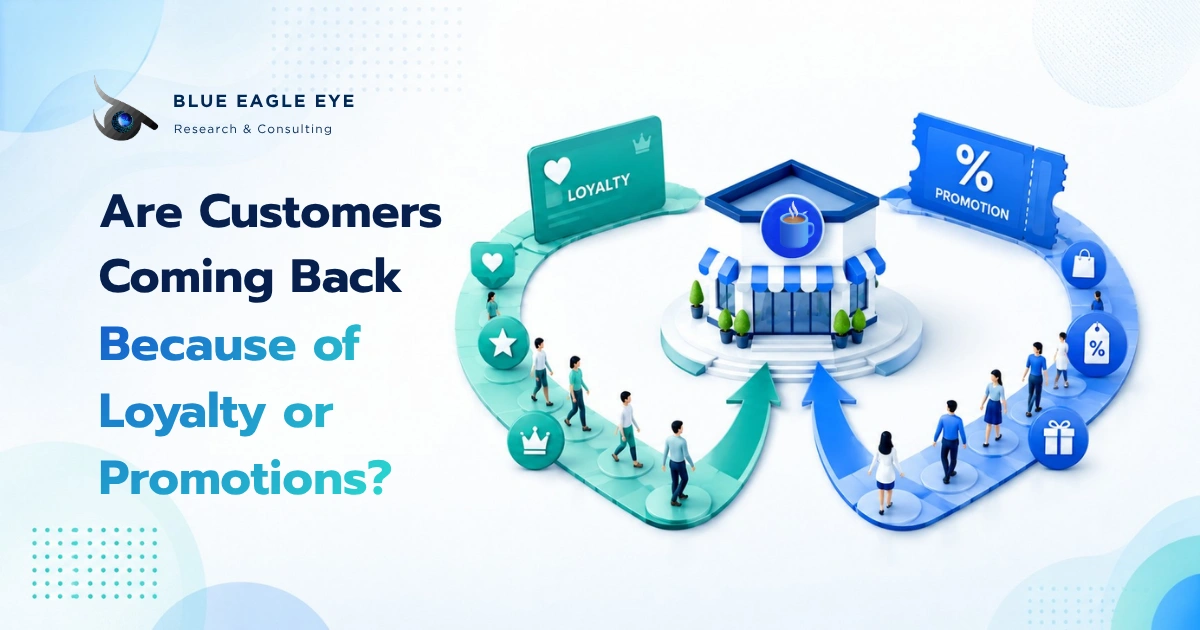
A customer who purchases five times within three months may look highly loyal.
But the interpretation changes if all five purchases happened on days when the customer received a Coupon or Member Discount.
Repeat Purchase is observable behavior.
Loyalty is broader. It may involve Brand Preference, commitment, Habit or a willingness to continue choosing a Brand even when an immediate incentive is absent.
Marketing research has long shown that Repeat Purchase can have different underlying drivers. Liu-Thompkins and Tam distinguish repeat behavior driven by Attitudinal Loyalty from behavior driven by Habit and contextual cues. Research on Price Promotions also shows that Promotion Buyers can differ systematically from other buyers, creating Selection Effects when businesses interpret post-promotion Repeat Rates.
The same Repeat Purchase can come from very different customer relationships
Two customers can purchase equally often for completely different reasons.
One may consistently prefer the Brand.
Another may buy only when a Discount is available.
Instead of looking only at Repeat Purchase Rate, examine:
1. Whether the customer buys without a Promotion
2. How Purchase Frequency changes during and after Promotions
3. Whether Basket Size and Margin improve
4. Whether the customer returns after the incentive disappears
5. How customers receiving an Offer behave compared with those who do not receive one
6. Whether the customer was already a frequent buyer before joining the Loyalty Program
The central question is not simply “Did the customer return?”
It is: “Would the customer have returned without the Promotion?”
First, separate Repeat Purchase from Loyalty
Repeat Purchase simply means that a customer buys again.
The reasons may include:
- Genuine Brand Preference
- Strong Product-Market fit for that customer
- Habit
- Convenience
- Lack of attractive Alternatives
- Switching Costs
- Points
- Coupons
- Waiting for Discounts
Therefore:
Repeat Purchase = what the customer did
Loyalty = one Possible Driver of that behavior
Promotion = another Possible Driver
This is why Repeat Rate alone cannot tell you whether customers “love the Brand” or “love the Discount.”
Research published in the Journal of Marketing shows that repeat behavior can arise from both Attitudinal Loyalty and Habit, reinforcing the point that observed purchases alone do not reveal the full motivation.
Promotions can increase Repeat Purchase without necessarily creating Loyalty
Promotions can be valuable.
They may:
- Bring customers back sooner
- Increase Basket Size
- Reactivate inactive customers
- Encourage Product Trial
- Increase Loyalty Program Engagement
McKinsey describes Targeted Promotions as tools that can support multiple Customer Lifecycle objectives, including Acquisition, Retention, Repeat Purchase and Churn Prevention. In observed retailer cases, Targeted Offers have also produced Incremental Sales and Margin improvements.
But Promotion Effects vary by customer.
Some customers purchase only when discounted.
Some would have purchased anyway.
Some buy earlier but do not increase long-term demand.
Others purchase more and continue returning after the incentive ends.
That is why Redemption alone is not enough.
The important question is Incrementality.
The most important question is: “Would the customer have purchased without the Promotion?”
Suppose a business sends a 100-baht Coupon to 1,000 customers.
Two hundred customers redeem it and make a purchase.
It may be tempting to report: “The Coupon generated 200 Orders.”
But perhaps 150 of those customers were going to purchase anyway.
If so, only part of the observed activity may be genuinely incremental.
Therefore: Promotion Redemption ≠ Incremental Purchase
An Incremental Purchase is a purchase that occurred because of the Promotion and likely would not have occurred otherwise.
This is a Counterfactual question: “What would these customers have done if they had not received the Offer?”
Start simply: Compare behavior before, during and after the Promotion
Even without a full experiment, an SME can begin with Transaction Data.
For each Customer Segment, examine three periods.
Before Promotion:
- Purchase Frequency
- Average Basket
- Days Between Purchases
- Full-price Purchase Rate
During Promotion:
- Redemption
- Orders
- Basket Size
- Discount Cost
After Promotion:
- Purchase Frequency
- Days to Next Purchase
- Full-price Purchase
- Retention
If purchasing rises only during the Promotion and immediately returns to baseline afterward, the pattern may indicate Promotion Response more than stronger Loyalty.
If customers continue purchasing without Offers and maintain higher Frequency, that provides more interesting evidence of a potentially stronger relationship.
However, a simple Before-After comparison still does not prove Causation because Seasonality, Product Launches, Competitor Activity and other factors may change at the same time.

Use Full-price Purchase to identify Promotion Dependency
One particularly useful metric is: Full-price Purchase Rate
Ask: “What percentage of this customer’s purchases happened without a Discount or Reward?”
Compare: Customer A
8 purchases
7 Full-price
1 Promotion Purchase
Customer B
8 purchases
1 Full-price
7 Promotion Purchases
Both customers have identical Repeat Purchase counts.
Their dependence on Price Incentives is very different.
Customer B may show greater Promotion Dependency.
That still does not prove Customer A is loyal and Customer B is not, because motivation cannot be fully inferred from Transaction Data alone.
But they clearly deserve different analysis.
Do not assume higher Member spending means the Loyalty Program caused it
Suppose:
Members purchase 6 times per year
Non-members purchase 3 times per year
It appears that joining the Loyalty Program doubled Purchase Frequency.
But another explanation is possible.
Customers who already purchased frequently may have been more likely to join the Program.
That is a Selection Effect.
The causal direction may partly be: Frequent Buyer → Joins Program
rather than entirely: Joins Program → Becomes Frequent Buyer
McKinsey argues that loyalty and pricing programs require rigorous analysis of Incrementality rather than relying on membership status as evidence of program impact.
A Promotion Buyer is not automatically a Deal Seeker
Another common mistake is: “This customer used a Coupon, so they are not loyal.”
Research covering Price Promotions in 18 consumer-goods categories across the UK and USA found that, on average, 77% of Promotion Buyers had purchased the Brand at least once within their previous five Category Purchases, compared with 81% among normal-price buyers.
This suggests that many Promotion Buyers are already Brand Buyers.
Promotion and Loyalty can coexist.
The answer is not always: Loyalty or Promotion?
It can be: The customer already prefers the Brand, and the Promotion changes Purchase Timing or Basket Size.
Purchase Timing matters because Promotions can pull future Sales forward
Suppose a customer normally purchases every 30 days.
On Day 20, a Coupon arrives and the customer purchases early.
This month’s Sales increase.
But the next purchase shifts from Day 30 to Day 50.
Across 60 days, total demand may barely change.
The Promotion created: Purchase Acceleration
rather than: Incremental Demand
That is why businesses should monitor: Days Between Purchases
not only: Orders During Promotion
Promotion analysis needs a post-campaign window to distinguish genuinely additional demand from shifted timing.
Look at Frequency and Basket Size together
Promotions can change behavior in different ways.
Pattern 1: Higher Frequency, same Basket Size
Pattern 2: Same Frequency, larger Basket
Pattern 3: Earlier Purchase, no increase in long-term demand
Pattern 4: More purchases only in discounted Products
Pattern 5: More purchases across additional Categories
A useful Promotion or Loyalty analysis should therefore include:
- Purchase Frequency
- Average Order Value / Basket Size
- Full-price Purchase
- Repeat Interval
- Category Breadth
- Gross Margin
Revenue Growth does not automatically mean better economics.
Include Margin, or “customers coming back” may create Sales without creating Value
Imagine a Promotion produces: Sales +15%
That looks positive.
But:
Discount Cost rises 20%
Gross Margin falls
Post-promotion purchasing returns to baseline
The campaign may have generated Revenue without generating Incremental Profit.
McKinsey warns that disconnected loyalty, pricing and Promotion strategies can create Nonincremental Promotions and inefficient Margin investment.
A better KPI is therefore: Incremental Margin
not only: Promotion Revenue
Promotion Effects can vary significantly by Customer Segment
Avoid sending the same Coupon to everyone and evaluating only the average result.
Useful segments include:
Loyal / Frequent Buyers
They already purchase regularly.
Promotions may increase Basket Size but can also subsidize purchases that would have happened anyway.
Occasional Buyers
Promotions may increase Frequency or shorten the Purchase Cycle.
Lapsed Customers
Offers may trigger Reactivation.
The important question is whether those customers keep buying afterward.
Deal-sensitive Customers
They respond strongly to Promotions but show weak Full-price Purchase.
Watch Margin and Promotion Dependency.
New Customers
Promotions may encourage Trial.
The important signal is whether the second and third purchases occur without repeated Discounts.
McKinsey recommends using Promotion Propensity and Customer Lifecycle Stage to design Targeted Offers instead of applying identical Promotions across the customer base.

For stronger evidence, use a Holdout Group
The most direct way to evaluate whether a Promotion creates Incremental Effect is to create a comparison.
Example: Eligible Customers = 2,000
Random assignment: Test Group = 1,000 customers receive a Coupon
Holdout Group = 1,000 customers receive no Coupon
After 30 days:
Test Purchase Rate = 32%
Holdout Purchase Rate = 27%
Observed Lift = 5 percentage points
When Randomization and execution are appropriate, this difference gets much closer to estimating the Promotion’s Incremental Effect than looking only at the Test Group.
Then continue measuring:
- Incremental Revenue
- Incremental Margin
- Post-promotion Retention
- Repeat Purchase after the Offer ends
- Differences across Customer Segments
A 2026 study using randomized Coupon assignment among nearly 130,000 supermarket customers applied this causal logic to investigate effects on Churn and Customer Lifetime Value, finding that effects differed by customers’ pre-existing engagement.
Do not stop at the first purchase after the Promotion, look for persistent behavior
If the objective is Loyalty, the important event is not simply:
Customer redeemed an Offer
It is: What happened next?
Example A:
Month 0 Customer receives Coupon
Month 1 Purchases with Coupon
Month 2 Purchases Full-price
Month 3 Purchases Full-price again
Month 4 Still active
Example B:
Month 0 Customer receives Coupon
Month 1 Purchases with Coupon
Months 2–4 No purchase
Both customers generated the same initial Promotion Transaction.
The longer-term behavior is very different.
A large-scale loyalty-program field experiment involving 95,532 customers tracked behavior before, during and after the intervention, illustrating why post-intervention behavior matters when evaluating whether program effects persist.
Surveys can answer questions Transaction Data cannot
Transaction Data tells you:
What customers bought
When they bought
How often they bought
Whether they used a Promotion
It cannot fully reveal motivation.
Surveys or Interviews can ask:
- What is the main reason you returned?
- Would you still choose this Brand without a Discount?
- Which Alternatives did you consider?
- Why did you choose this Brand instead?
- How important was Price?
- Would you still consider the Brand if the Price increased slightly?
These are Stated Attitudes and Stated Intentions, so they should not replace observed behavior.
A stronger approach combines: Behavior Data + Customer Feedback
rather than choosing one or the other.
Loyalty does not mean customers stop caring about Price
Loyal customers can still respond to Promotions.
Many Loyalty Programs are deliberately designed to increase Engagement, Purchase Frequency or Basket Size through Incentives.
McKinsey reports that stronger Loyalty Programs can increase Revenue among customers who redeem points by increasing Purchase Frequency, Basket Size or both. It also notes that many established programs fail to create the intended value.
Using a Promotion therefore does not cancel out Loyalty.
The more useful question is: Did the Promotion increase behavior above the customer’s baseline? or Did the business simply give a Discount on behavior that was already likely to happen?
Example: Two segments both increase Repeat Purchase by 20%, but the meaning is different
After a campaign:
Segment A
Repeat Purchase +20%
Full-price Purchase +18%
Purchase Interval becomes shorter
90-day Retention improves
Segment B
Repeat Purchase +20%
Very high Coupon Redemption
No improvement in Full-price Purchase
Repeat Purchase returns to baseline after Coupons stop
Both segments show:
Repeat Purchase +20%
But the evidence tells different stories.
Segment A: There are stronger signals of an improved ongoing customer relationship.
Segment B: The Promotion appears to be the dominant trigger.
It would still be premature to claim that Loyalty caused Segment A’s increase without additional evidence, but its Loyalty Signal is stronger than Segment B’s.
What should a simple SME Dashboard track?
With basic Transaction Data, start with:
- Repeat Purchase Rate
- Purchase Frequency
- Days Between Purchases
- Full-price Purchase Rate
- Promotion Redemption Rate
- Average Order Value
- Gross Margin per Customer
- Post-promotion Retention
- Reactivation Rate
- Promotion Dependency
If experiments are possible, add:
- Incremental Purchase Rate
- Incremental Revenue
- Incremental Margin
The Dashboard does not need to be complicated.
It needs to separate: “Customers purchased”
from: “Customers purchased more because of the Intervention.”
Eight questions before calling customers “loyal”
- Do they purchase when no Promotion is available?
- Were they already frequent buyers before joining the Program?
- Do they return after the Promotion ends?
- Does Full-price Purchase increase?
- How does the Purchase Interval change?
- Did Retention improve, or only campaign-period Orders?
- How does the Promotion group compare with a Holdout Group?
- After Discount and other Costs, is Incremental Margin positive?
If these questions remain unanswered, a more accurate statement is: “Repeat Purchase increased.”
rather than: “Customer Loyalty increased.”
The takeaway: Do not ask only whether customers returned. Ask whether they would have returned without the Discount.
Repeat Purchase is a useful signal.
It is not proof of Loyalty by itself.
Customers may return because of Brand Preference, Habit, Convenience or Promotion, and several factors can operate together.
For an SME, start by examining: Before Promotion → During Promotion → After Promotion
Track:
Full-price Purchase
Purchase Frequency
Retention
Margin
and Promotion Dependency
If stronger causal evidence is needed, add a Holdout or Experiment to estimate Incremental Effect.
The final question is therefore not: “Did the customer come back?”
It is: “Would this customer still have purchased without the Promotion, and if they returned, what made them choose us?”
Separating those two questions helps the business understand whether Promotion spending is creating new Customer Value or merely discounting purchases that were likely to happen anyway.

Repeat Purchase does not automatically equal Loyalty. Customers may return because of Brand Preference, Habit, Convenience or a compelling Promotion. To separate Loyalty from Promotion Effect, examine behavior before, during and after the Promotion, including Full-price Purchase, Purchase Frequency, Retention and Promotion Dependency. Where possible, use a Control or Holdout Group to estimate Incremental Effect.
Sources
- Liu-Thompkins, Y. & Tam, L. Not All Repeat Customers Are the Same: Designing Effective Cross-Selling Promotion on the Basis of Attitudinal Loyalty and Habit. Journal of Marketing, 2013. Repeat Purchase can be driven by both Attitudinal Loyalty and Habit.
- McKinsey & Company. Next in loyalty: Eight levers to turn customers into fans. Discussion of Purchase Frequency, Basket Size, Redemption and Loyalty Program value creation.
- McKinsey & Company. How loyalty programs can deliver greater value. Discussion of Incrementality, Pricing, Loyalty and Nonincremental Promotion risk.
- McKinsey & Company. The next frontier of personalized marketing. Promotion Propensity, Customer Lifecycle segmentation, A/B Testing and Incremental Sales from Targeted Promotions.
- Journal of Consumer Marketing. Price promotions: examining the buyer mix and subsequent changes in purchase loyalty. Analysis across 18 consumer-goods categories showing that many Promotion Buyers were already Brand Buyers.
- Neslin, S. A. & Shoemaker, R. W. An Alternative Explanation for Lower Repeat Rates after Promotion Purchases. Journal of Marketing Research, 1989. Explains how Selection Effects can distort interpretation of post-promotion Repeat Rates.
- Journal of Retailing and Consumer Services, 2026. The effects of coupon redemption on customer lifetime value and spillovers. Randomized Coupon assignment among nearly 130,000 customers to estimate causal effects on Churn and Customer Lifetime Value.
- Marketing Science. Enduring Effects of Goal Achievement and Failure Within Customer Loyalty Programs. Large-scale field experiment involving 95,532 loyalty customers and behavior observed before, during and after the intervention.

.png)
.png)
.png)