.png)


.png)
.png)

Market Research used to be difficult for many SMEs because of limited time, people and budget.
Generative AI has changed some of that. It can help search for information, compare competitors, summarize long reports, prepare Interview Questions and process large volumes of Customer Feedback much faster.
The opportunity is real.
So are the risks.
AI can produce convincing text while using incorrect sources, overstating evidence, making calculation errors or mixing Facts with Interpretation. OECD research highlights the productivity potential of Generative AI while also warning about hallucinated outputs and overreliance without adequate checking. Its effectiveness depends on the task and on effective human–AI collaboration.
The useful question for an SME is therefore not simply: “Can AI do Market Research for us?”
It is: “Which parts can AI accelerate, and which parts still require human accountability for the evidence?”
Use AI to reduce repetitive research work, not to outsource judgment
AI is particularly useful for Market Research tasks involving searching, structuring, comparing, summarizing, categorizing and drafting.
SMEs can use AI to support:
1. Secondary Research and Market Scanning
2. Competitor Research
3. Hypothesis and Research Question drafting
4. Interview Guide and Questionnaire drafting
5. Customer Interview and Feedback summarization
6. Initial Thematic Coding
7. Data exploration and analytical questioning
8. Insight and report drafting
AI output should still be treated as draft or analytical support rather than evidence in itself, especially when the research affects investment, pricing, customers or strategy.
First, separate “doing Research” from “asking AI”
Typing: “Is the healthy coffee market growing in Thailand?”
into an AI tool is not, by itself, Market Research.
AI may help generate Search Keywords, structure the question or summarize sources. The evidence still needs to come from sources that can be examined, such as:
- Government Data
- Industry Reports
- Company Filings
- Platform Data
- Surveys
- Customer Interviews
- Sales Data
- Experiments
AI-generated text is not a Primary Source. AI's role is to help move from a Business Question toward evidence more efficiently—not to convert generated text into evidence.
1. Use AI for Secondary Research and Market Scanning
This is one of the highest-value starting points for an SME. AI can help:
- Break a Business Question into research areas
- Generate Thai and English Search Keywords
- Organize Sources
- Summarize long documents
- Compare reports
- Build timelines
- Identify missing information
For example, instead of asking: “What is happening in Thailand's Pet Food market?”
ask AI to build a Research Map covering:
Market Size
Growth
Customer Segments
Price Ranges
Distribution Channels
Competitors
Consumer Trends
Regulation
Unknowns
Then find and verify appropriate sources for each area.
What humans still need to check
For every material claim, ask:
Who published it?
When was it published?
What period does the data cover?
Which geography?
Who was sampled?
How is the market defined?
Two reports can both describe “Market Size” while including different products in the category. AI should not merge such numbers without checking the definitions.
2. Use AI for Competitor Research, but not to define the entire competitive set
AI can collect and organize public information such as:
- Products Prices
- Positioning
- Channels
- Promotions
- Features
- Review Themes
- Brand Claims
It can turn this into a comparison table quickly. But competitor information can be incomplete or outdated.
Prices vary by channel. Promotions are temporary. Local competitors may be missed.
And a direct competitor may not be the alternative customers actually consider.
After an AI-generated competitor scan, ask customers: “What do you choose when you do not choose us?”
The answer might be another category, a DIY solution, or simply not buying anything.
3. Use AI to explore Search Trends, but do not equate Search with Demand
AI can generate keywords and help compare Search Terms or Topics. The underlying data still needs correct interpretation.
Google states that Google Trends uses sampled, normalized search data scaled from 0 to 100. It is not a scientific poll, and a spike in Search Interest does not mean a topic is necessarily popular or commercially successful.
Therefore:
Search Interest ≠ Sales
Search Growth ≠ Market Growth
Search Volume ≠ Purchase Demand
AI can help find the signal. Humans still need to judge what that signal means.
4. Use AI to draft Hypotheses and Research Questions
AI is useful for turning a broad problem such as: “Why are Sales declining?” into possible hypotheses:
- Are New Customers declining?
- Has Purchase Frequency fallen?
- Is Average Order Value lower?
- Has Price affected Demand?
- Has Channel Mix changed?
The team can then select the hypotheses that are plausible and decision-relevant.
Do not generate dozens of hypotheses and treat them as equally likely.
A useful structure is: Decision → Uncertainty → Hypothesis → Evidence → Test
This is also the research logic used in BEE Research Knowledge.
5. Use AI to draft an Interview Guide or Questionnaire
AI can produce a fast First Draft of:
- nterview Questions
- Probes
- Survey Questions
- Scales
- Response Options
- Screeners
- Question Flow
This is useful for brainstorming what might be missing. But an AI-written Questionnaire should not go directly into fieldwork.
Review it for:
- Leading Questions
- Double-barrelled Questions
- Ambiguous Wording
- Missing Response Options
- Scale Balance
- Order Effects
- Recall Period
- Definitions
- Respondent Burden
AI may understand common survey structures. It does not automatically understand your customer's exact context.
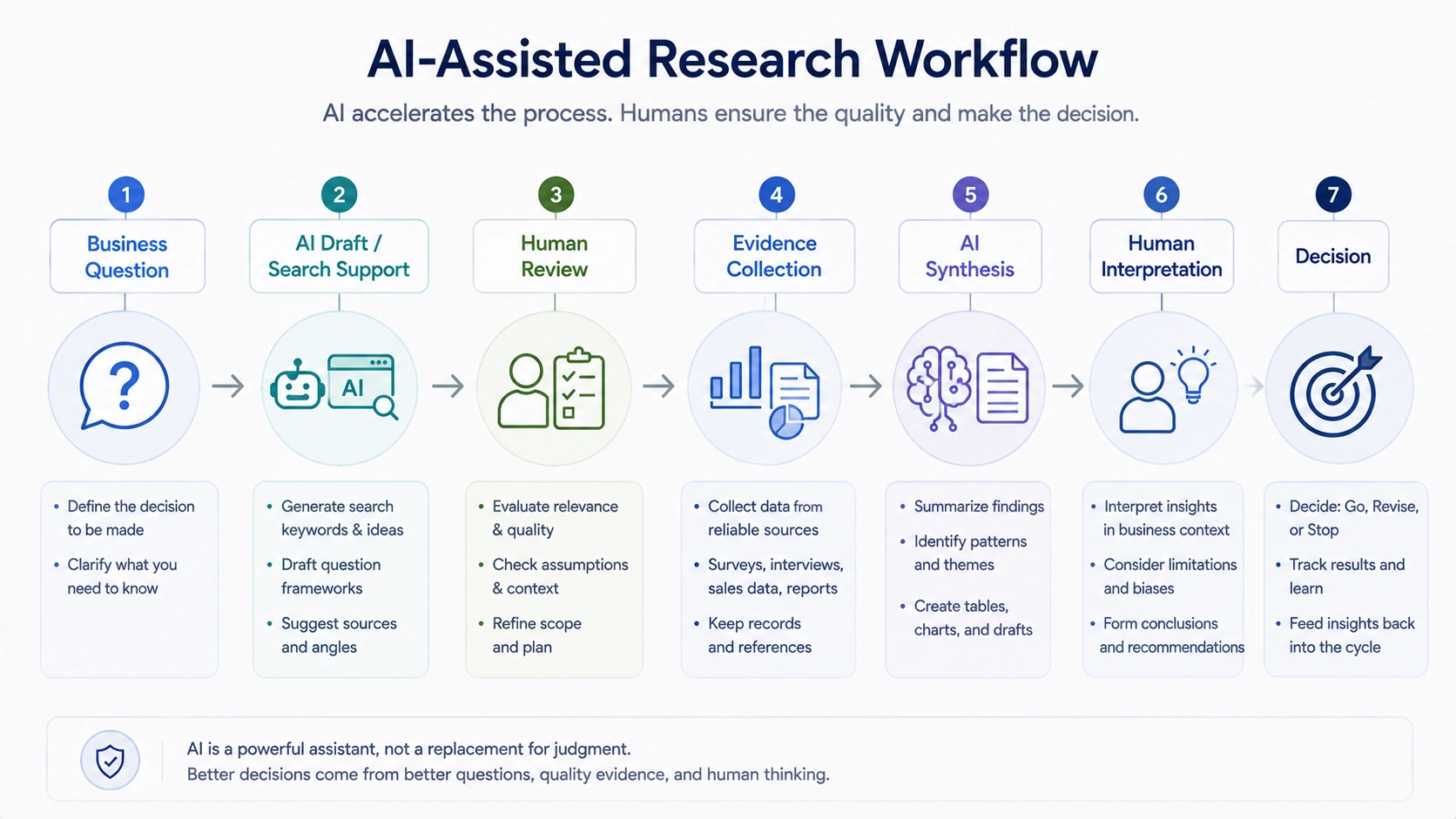
6. Use AI to summarize Customer Interviews
After 10–20 Customer Interviews, a large amount of work goes into reading Transcripts and identifying recurring Themes.
AI can help:
- Summarize Interviews
- Extract potential Quotes
- Identify recurring Topics
- Compare participants
- Create Initial Codes
- Find contradictions
- Organize feedback by Journey Stage
This can free the Researcher to spend more time on Interpretation. But summarization removes detail.
Tone, hesitation, Context and Exceptions can disappear.
Return to the Raw Transcript for:
- Important Claims
- Surprising Themes
- Quotes intended for publication
- Contradictory evidence
- Conclusions affecting major decisions
7. Use AI for Open-ended Coding, but retain logic around the Codebook
For Surveys containing hundreds or thousands of comments, AI can accelerate Thematic Coding.
Qualtrics, for example, provides AI-powered text analytics that identifies Themes and generates summaries from Open-ended Feedback. Its 2026 guidance also makes an important point: processing comments faster is only a start; deciding what deserves action still requires context. A stronger process is:
- Have a human read an initial sample.
- Build an Initial Codebook.
- Let AI assist with Coding.
- Review a random sample.
- Inspect ambiguous Themes.
- Refine the Codebook.
- Re-run where necessary.
Do not assume that the most frequently mentioned theme is automatically the strongest business driver.
Frequency ≠ Importance
Mention ≠ Cause
8. Use AI for Data Analysis support, but verify calculations
AI can help:
- Explain formulas
- Generate Code
- Check Data Structure
- Find Missing Values
- Suggest Cross-tabs
- Draft calculations
- Explain Charts
- Generate questions from observed Patterns
But if AI reports: “Sales increased by 23.7%” calculate it again from the actual data.
If it concludes: “Price caused the Sales decline” ask whether the data and Research Design actually support a causal conclusion.
OECD evidence emphasizes that Generative AI's usefulness depends on the specific task and on human expertise, while hallucination and uncritical reliance remain important risks.
9. Use AI to develop possible Insights—but separate FACT from Interpretation
Suppose AI reports: “Delivery is the most frequently mentioned complaint, so Logistics should be the top investment priority.”
That statement contains two layers.
FACT: Delivery is frequently mentioned in the Dataset.
INTERPRETATION: Delivery should receive the highest investment priority.
The second conclusion still requires context:
- Which customers mention it?
- How severe is the problem?
- Is it associated with Churn?
- How many customers experience it?
- What would it cost to fix?
- Is another issue more important despite fewer mentions?
AI can generate Candidate Insights. Business implications still require judgment.
10. Use AI to draft Research Reports and presentations
After the evidence and analysis have been checked, AI is useful for:
- Executive Summaries
- Headlines
- Chart Commentary
- Report Structure
- Management Versions
- Plain-language Explanations
- Thai / English Drafts
- FAQs
This is relatively low-risk when the approved evidence is supplied to the model.
A good practice is to ask AI to draft only from verified inputs. Do not let it silently add external “background” to a Research Report without separating that information from the study's findings.
What should an SME not delegate entirely to AI?
At least six areas require human accountability.
Source Verification
AI can cite the wrong source, an outdated source or even a source that does not exist.
Sampling
AI cannot turn a Convenience Sample into a Representative Sample by writing a better explanation.
Validity
A professionally written question can still fail to measure the intended construct.
Privacy
Customer Data, Transcripts and internal business information should only be used with tools whose data handling is appropriate for the information involved.
ESOMAR recommends that buyers of AI-based research services examine issues such as Data Protection, training data, model design, bias, human oversight and accountability.
Interpretation
AI can identify an Association without establishing Causality.
Final Decision
AI does not carry accountability for the investment, customers, employees or reputation affected by the decision. Humans do.
Where should an SME start?
You do not need to build a sophisticated AI research system.
Start with tasks that are: Time-consuming + repetitive + relatively easy to verify
Good starting points
- Report summarization
- Search Keyword generation
- Competitor information structuring
- Interview Guide drafting
- Interview summarization
- Feedback Theme organization
Intermediate use
- Open-ended Coding
- Questionnaire drafting
- Data-cleaning assistance
- Cross-tab suggestions
- Insight synthesis
Require stronger QA
- Statistical Analysis
- Forecasting
- Market Size estimation
- Pricing recommendation
- Causal Interpretation
- Strategic Recommendation
The closer AI output gets to a high-value decision, the stronger the Verification should become.
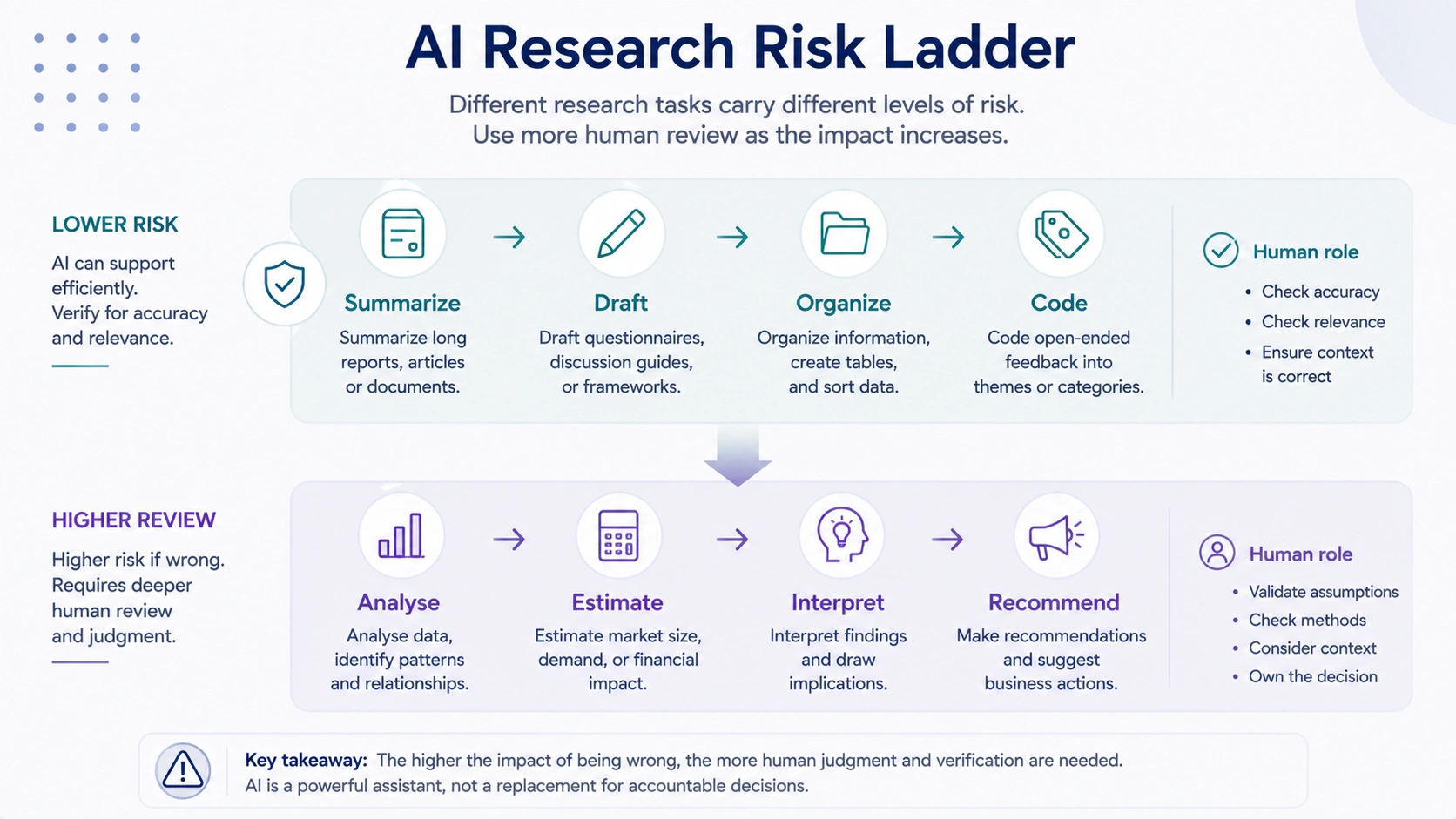
Eight checks before using AI output in a business decision
Before taking AI output into a decision meeting, ask:
- Can we open and verify the Source?
- What are the Event Date, Publication Date and Data Period?
- Are the Definitions consistent?
- Who are the Sample and Target Population?
- Did AI calculate from real data or generate a number without evidence?
- Which statements are Facts and which are Interpretations?
- What Alternative Explanations or Limitations exist?
- What happens if the AI output is wrong?
The final question should determine the level of QA.
Using AI to summarize an article for Keyword ideas may be relatively low-risk.
Using it to support a multimillion-baht investment requires much stronger evidence and verification.
The takeaway: Use AI to make Research faster—not to lower the standard of Research
AI creates real opportunities for SMEs by lowering some of the time and resource barriers to Market Research.
Use AI to: Search → Structure → Summarize → Draft → Code → Analyse → Communicate
Keep humans accountable for: Verify → Validate → Interpret → Protect Privacy → Decide
The question is no longer: “Can AI do Market Research?”
It can support many parts of it. The more important question is: “Do we know which parts are AI-generated output, which parts are evidence, and who is responsible for checking whether the conclusion is justified?”
Used well, AI can make Market Research faster and more accessible for SMEs.Better Research still depends on familiar fundamentals:
the right question, appropriate evidence, source verification, disciplined interpretation and a clear decision.

AI can reduce the time required for many Market Research tasks—from search and information structuring to research-instrument drafting, Customer Feedback coding, analysis support and report drafting. But AI does not make evidence reliable automatically. Humans still need to verify Sources, Definitions, Samples, Methods, Calculations, Context, Privacy and Interpretation before using research outputs for decisions.
Sources
- ESOMAR. Artificial Intelligence for Market Research — ethical and effective AI use in market research.
- ESOMAR. Compliance and Innovation Trends 2025 — AI adoption, governance, bias and data-protection issues.
- ESOMAR. 20 Questions to Help Buyers of AI-Based Services for Market Research and Insights — due diligence for AI research services.
- OECD. The Effects of Generative AI on Productivity, Innovation and Entrepreneurship — productivity, human expertise and hallucination risks.
- Google. FAQ about Google Trends data — sampling, normalization and limits of Search Interest.
- Qualtrics. Insights Explorer and Using Unstructured Data Analysis to Understand Customer Feedback — AI-assisted text analytics and the role of contextual interpretation.

.png)
.png)
.png)