.png)

.png)
.png)

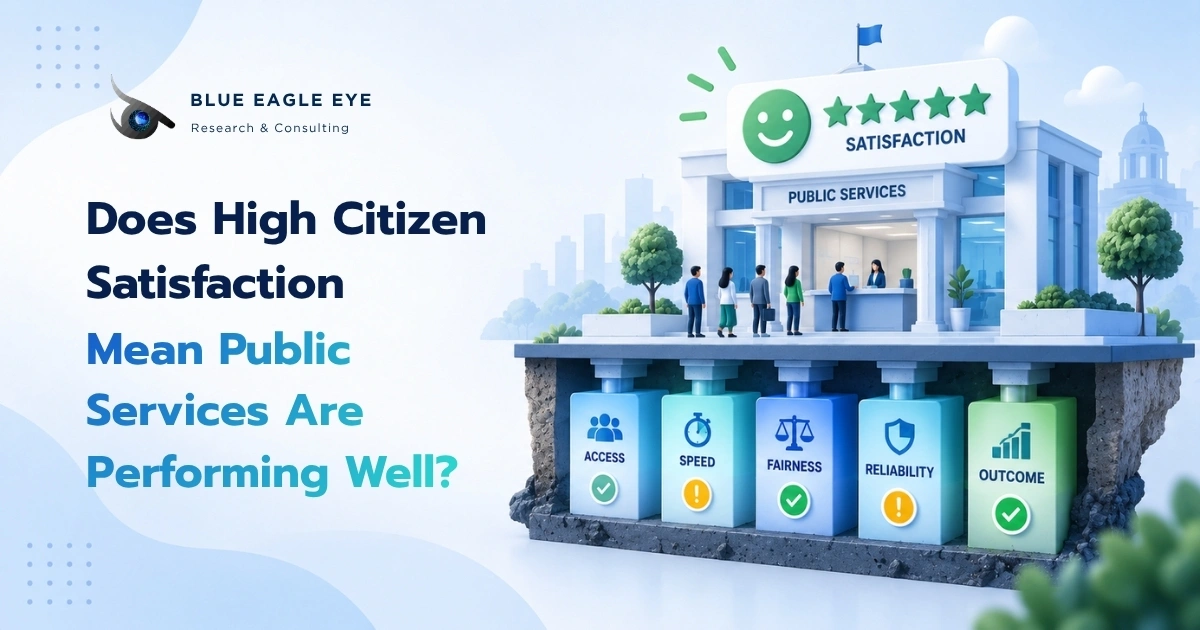
The short answer is: it is a positive sign, but it is not enough to reach that conclusion.
Satisfaction tells us how citizens perceive or evaluate an experience. It does not automatically tell us whether everyone who needs the service can access it, whether the process is efficient, whether the original problem has been solved, or whether a programme has achieved its intended outcome.
The OECD describes satisfaction with public services as a useful diagnostic of citizens’ perceptions and experiences. It also notes that satisfaction can be influenced by expectations, past experiences, and personal characteristics. That makes satisfaction useful evidence, but not a complete performance measure on its own.
High satisfaction is good news, but not the whole answer
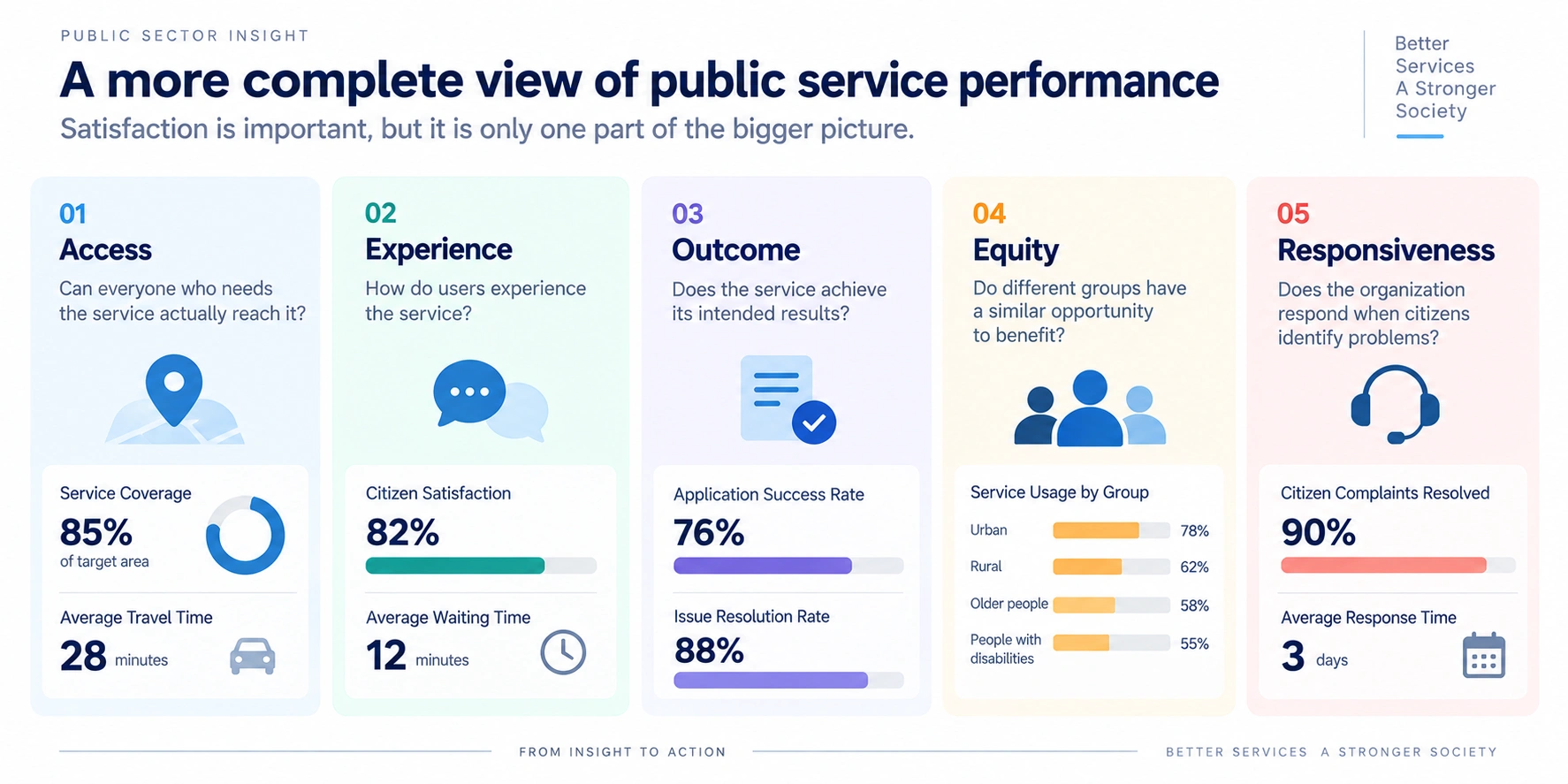
Satisfaction helps show how citizens evaluate a service orexperience, but it can also be influenced by expectations, previousexperiences, and respondent characteristics. It should therefore not be used asa substitute for every dimension of service performance. Before deciding that aservice is “good,” examine at least five questions: Who can actually access it?Is the process easy and responsive? Does the service achieve its intendedoutcomes? Are some groups having a very different experience? And does theorganisation respond when citizens identify problems?
What does satisfaction measure, and what does it not measure?
Satisfaction is primarily a perception metric. It records how users evaluate an experience at a particular point in time. A survey may ask about overall satisfaction or specific aspects such as staff courtesy, waiting time, ease of process, information clarity, or convenience.
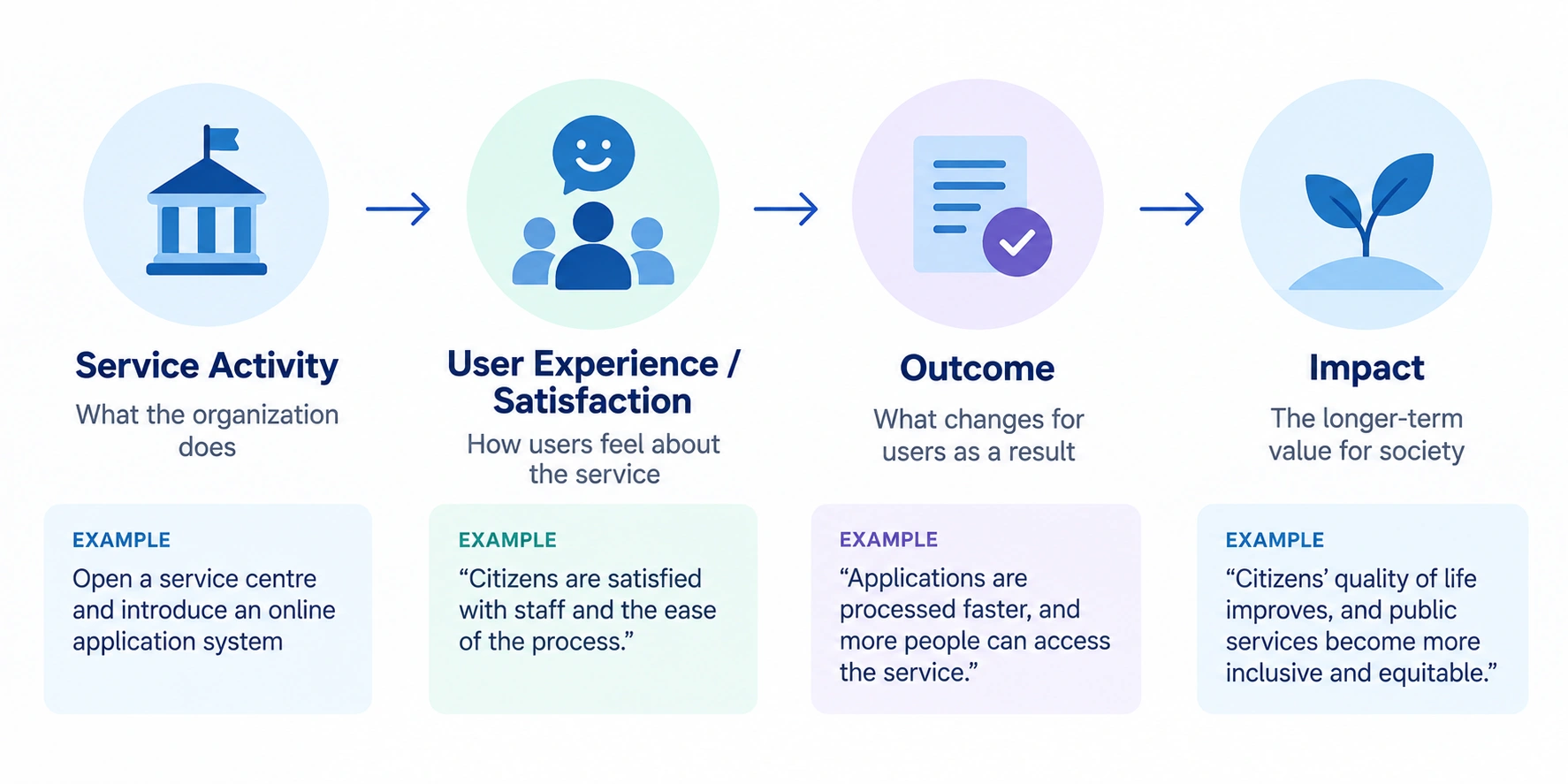
The important distinction is that Satisfaction is not automatically the same as overall Service Quality. Satisfaction is not an Outcome, and it is not Social Impact.
For example, a citizen may be highly satisfied with the staff at a service centre while still having to complete unnecessary paperwork. Another citizen living in a remote area may not be able to access the service at all. If the survey is administered only to people who successfully reached the service centre, the second citizen may never appear in the satisfaction score.
This is why “Is the score high?” should usually be followed by “High for what, measured among whom, and whose experience is missing?”
What can a high satisfaction score hide?
1. The survey may include only people who successfully accessed the service
An exit survey at a government service centre can provide useful information about people who reached and used the service. It cannot, by itself, explain the experience of people who never made it through the door.
Older citizens, people with disabilities, people in remote areas, people without reliable digital access, or people who are unaware that the service exists may face some of the largest barriers while remaining outside the survey sample.
Before interpreting a percentage, check the Population and Sample behind it.
2. Expectations can influence satisfaction
People evaluate services against expectations and previous experiences. Two groups receiving similar services may therefore report different levels of satisfaction, while two services with different operational performance may receive similar satisfaction scores.
The OECD notes that public service satisfaction can be affected by expectations, past service experiences, and individual characteristics. Comparisons across locations or time periods should therefore be interpreted with the relevant context.
3. A strong average can hide weak experiences among important groups
Imagine a service with an overall satisfaction rate of 85%. The total figure appears strong. But segmentation might reveal 90% satisfaction among urban users and only 60% among users in remote locations.
The overall number is not necessarily wrong. It is simply incomplete if the policy objective includes equitable access and experience.
Breaking results down by geography, age, service channel, user type, or relevant accessibility characteristics can reveal decision-relevant patterns that the total average cannot show.
4. Citizens can like the experience without achieving the intended outcome
Consider a skills training programme. Participants may be highly satisfied with the trainer, venue, and course content. If the programme objective is to improve employment opportunities, however, satisfaction alone cannot demonstrate whether that objective was achieved.
Satisfaction describes Experience. Employment, income change, or application of the new skills may represent Outcomes that need separate measurement.
Output, Experience, Outcome, and Impact should not be treated as interchangeable concepts.
Does that mean satisfaction is not important?
Satisfaction remains important. The issue is how the metric is used.
The OECD Survey on Drivers of Trust in Public Institutions 2024, based on 2023 data across 30 OECD countries, reported that among people with relevant recent service experience, 66% were satisfied with administrative services, 57% with education, and 52% with healthcare. The OECD also found that day-to-day experiences with public institutions are associated with trust, while perceptions of governments’ ability to handle complex policy issues can look quite different.
The distinction matters. “I am satisfied with the service I received” and “I believe the overall system is working well” are not the same question.
In Government at a Glance: Southeast Asia 2025, the OECD and Asian Development Bank similarly describe public service satisfaction as useful for understanding citizens’ experiences while noting that satisfaction reflects factors such as accessibility, responsiveness, quality, expectations, and previous experiences.
Which KPIs should be reviewed alongside satisfaction?
Instead of asking only “What is our Satisfaction score?”, build a set of indicators that answer different decision questions.
1. Access: Can the intended population reach the service?
- Coverage among the intended population
- Time, distance, cost, or administrative barriers
- Digital accessibility and alternative channels for people unable to use online services
2. Experience: What happens once people enter the service?
- Satisfaction
- Waiting time
- Ease of process
- Clarity of information
- Fairness and treatment
The OECD identifies speed, ease of delivery, fairness, and responsiveness to feedback as important aspects of citizens’ experiences with public services, beyond the overall satisfaction score.
3. Outcome: Did the service solve the problem it was designed to address?
The correct metric depends on the objective. Did eligible citizens receive the intended benefit? Was the issue resolved on first contact? Did programme participants apply what they learned? Did the target condition improve?
These are different questions from whether people enjoyed or appreciated the service experience.
4. Equity: Are different groups receiving similar experiences and outcomes?
Do not rely only on the Total Score. Examine meaningful gaps by location, age, service channel, user type, or groups facing specific access barriers where appropriate.
5. Responsiveness: What happens after citizens identify a problem?
In the OECD Trust Survey, only 39% on average believed that public services would improve following complaints or that public agencies would adopt innovative ideas to improve services. This highlights an important distinction between collecting feedback and demonstrating that feedback leads to change.
Ask these six questions before celebrating a high satisfaction score
- What exactly does the score measure: staff, process, channel, or the overall service?
- Who answered the survey, and who had little or no chance of entering the sample?
- When was the fieldwork conducted, and were there events that may have influenced the results?
- Does the total score hide major differences between locations or citizen groups?
- Does the experience score align with operational KPIs and actual outcomes?
- If one area receives a low score, do we know whether it is a meaningful driver of the outcome before deciding to prioritise it?
The final question is particularly important. The lowest score is not automatically the highest-priority improvement area. Prioritisation should consider the size of the problem, how many people are affected, its relationship with the outcome that matters, and the feasibility of improvement.
What can SME owners and entrepreneurs learn from this?
Although this article uses public services as the example, the KPI lesson applies directly to business.
High Customer Satisfaction does not guarantee Repeat Purchase. A high NPS is not the same as Retention. A strong service rating does not automatically mean that Sales will grow.
For an SME or entrepreneur, the better question is not simply “Is our customer score good?” but “Which decision is this metric helping us make?”
If the decision concerns sales, Satisfaction may need to be analysed alongside Conversion, Repeat Purchase, Basket Size, Complaints, Churn, or other behavioural data relevant to the business model. If the decision concerns service improvement, the business may need to understand which touchpoints or experience factors are associated with the behaviours or outcomes it wants to change.
That is the difference between having KPIs and using KPIs for decision-making.
The takeaway: Satisfaction is a starting point, not a final verdict
High citizen satisfaction should be treated as positive evidence about citizens’ experiences or perceptions. It should not be treated as proof that a public service has no remaining problems.
Before concluding that a service is performing well, examine who can access it, what happens during the experience, whether intended outcomes are being achieved, whether results differ across groups, and whether the organisation responds effectively when citizens identify problems.
The same principle applies to any organisation: one KPI should not become a proxy for a more complex reality than the metric was designed to measure.
Good data should do more than tell us whether a score looks good. It should help us decide what to do next.

High satisfaction is positive evidence about citizens’ perceptions or experiences, but it should not be treated as a complete measure of service quality, accessibility, fairness, outcomes, or social impact. Better evaluation combines satisfaction with multiple KPIs and examines differences across relevant citizen groups.
Sources
- OECD. OECD Survey on Drivers of Trust in Public Institutions – 2024 Results. Survey data from 2023 across 30 OECD countries.
- OECD. Trust in day-to-day interactions with public institutions, OECD Survey on Drivers of Trust in Public Institutions – 2024 Results.
- OECD and Asian Development Bank. Government at a Glance: Southeast Asia 2025, Satisfaction with public services. Published 11 December 2025.

.webp)
.png)
.png)
.png)