.png)

.webp)
.png)
.png)

The short answer is: participant numbers alone are not enough to reach that conclusion.
High participation is valuable information. It can show that a programme has achieved a certain level of reach or attracted substantial interest. But the meaning of “success” depends on what the programme was designed to achieve in the first place.
The OECD defines Effectiveness in terms of the extent to which an intervention achieves, or is expected to achieve, its objectives and results, including differences in results across groups. Participation can therefore be one important result, but it is not necessarily the final result if the programme was designed to create a deeper change.
High participation is a good sign, but not proof of programme success
Participant numbers show how many people a programme attracted or reached. Success, however, depends on the programme objective. If the goal is learning, measure whether knowledge or skills improved. If the goal is behaviour change, examine whether behaviour actually changed. If the goal is Impact, assess whether the observed change can reasonably be linked to the programme and whether other factors could explain the result.
Before asking how many people participated, ask what the programme was supposed to change
Imagine a digital skills programme for 1,000 small business owners. It attracts 1,200 participants.
If the target was “at least 1,000 participants,” the programme clearly exceeded that target.
But if the programme objective was “to help small businesses use digital tools to improve sales,” the figure of 1,200 does not answer the main question.
We still need to know whether participants learned new skills, whether they used those skills after the programme, and whether relevant business outcomes changed.
This is why a useful KPI system starts with the Programme Objective or Business Question, rather than with whichever number is easiest to collect.
What is the difference between Participation, Output, Outcome and Impact?
Keeping these concepts separate helps organisations avoid making claims that go beyond the available evidence.
Participation or Reach: Who did the programme reach?
Registrations, attendance, service users and people reached by an activity can indicate the programme’s Reach.
This matters. A programme that cannot reach its intended population is unlikely to create the intended downstream results.
But Reach does not mean that participants have already received the intended benefit.
Output: What did the programme deliver?
Outputs are the direct products of programme activities, such as the number of training sessions delivered, participants completing a course, information packs distributed, or people receiving a service.
The CDC describes Outputs as products of programme activities and gives examples such as community members completing training. Outcomes, by contrast, describe expected changes that can occur in the short, intermediate and longer term. The CDC also notes that Outcomes can be harder to measure, but programmes are encouraged not to focus only on Outputs when the evaluation question concerns change.
Outcome: What changed after participation?
An Outcome is a change in people, groups or systems that the programme is intended to influence.
For a training programme, a short-term Outcome might be improved knowledge or skills. An intermediate Outcome might be applying those skills in practice. A later Outcome could involve productivity, income or quality of life, depending on the programme objective.
“1,200 people completed the course” and “800 participants were using the new skill three months later” are therefore different levels of evidence answering different questions.
Impact: Did the programme cause the change?
This is a more demanding question.
The CDC distinguishes Outcome Evaluation from Impact Evaluation. Outcome Evaluation examines the extent to which intended Outcomes were achieved but does not, on its own, establish causality. Impact Evaluation seeks to compare outcomes with and without the programme to assess whether the intervention caused the observed change.
If participants’ income rises after a programme, we can report that a change occurred. We should not automatically state that the programme “caused” the increase unless the evaluation design provides adequate evidence and considers other explanations such as market conditions, seasonality, promotions or wider economic changes.
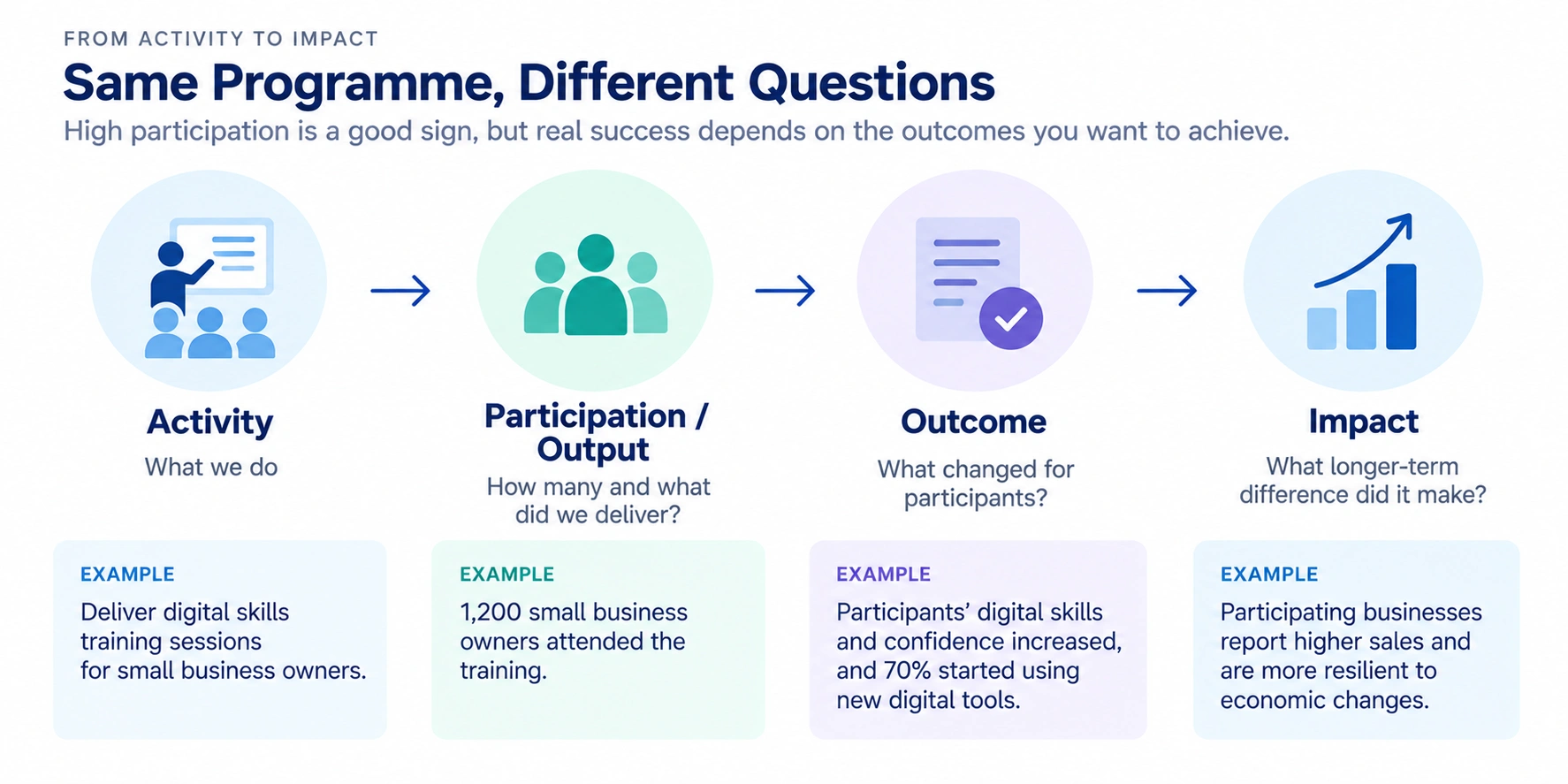
High participation can be a success, but only if we know what kind of success we are measuring
Participant numbers are not bad KPIs.
The problem begins when they are used to answer a question they were never designed to answer.
If the objective of a public information initiative is to increase reach or exposure, Participation and Reach may be central KPIs.
If the objective is to improve skills, behaviour, health, income or quality of life, however, participation is one condition for success rather than the final result.
The OECD uses six evaluation criteria for interventions: Relevance, Coherence, Effectiveness, Efficiency, Impact and Sustainability. This reinforces an important point: asking whether a programme is “good” or “successful” is broader than asking how many people took part.
The same programme can look very different depending on which KPI you read
Suppose an employment skills programme targets 500 participants and eventually reaches 800.
The programme can accurately report that participation was 60% above target.
It cannot yet conclude that it was successful in improving employment outcomes.
To answer that question, the organisation may need additional measures such as:
- Number and percentage completing the programme
- Change in knowledge or skills before and after participation
- Number applying the skills in real settings
- Employment, income or business outcomes relevant to the stated objective
- Differences in outcomes by location, age or participant group
- Cost per meaningful Outcome achieved
Adding these indicators changes a dashboard from an activity report into a decision tool.
Do not look only at how many people participated. Look at who participated
A total of 10,000 participants may look impressive. But if a programme was designed to support people who face access barriers and most participants were people who already had easy access, success in volume may not equal success in targeting or equity.
The OECD’s Effectiveness criterion explicitly includes consideration of differential results across groups rather than relying only on aggregate results.
Useful questions include:
- Did participants match the intended Target Population?
- Did the groups expected to benefit most actually reach the programme?
- Did participation and Outcomes differ across relevant groups or locations?
- Were some groups more likely to drop out before completion?
Sometimes the real problem is not “too few participants.” It is “the people we most needed to reach were not participating.”
How can KPIs show whether a programme is actually moving toward its objective?
A practical approach is to organise measures along a Results Chain rather than trying to summarise success with one number.
1. Start with the Objective
Ask what problem the programme is intended to address and who is expected to benefit.
A clear Objective makes it easier to identify which evidence will matter for the eventual decision.
2. Define Outputs that show whether implementation is on track
Examples include number of activities, participants, Completion Rate or Coverage.
These indicators are particularly useful for monitoring programme implementation.
3. Define Outcomes that represent meaningful change
Examples might include improved knowledge, application of skills, behaviour change, increased service access or reduction of a targeted problem.
Select Outcomes because they are connected to the objective, not simply because they are easy to measure.
4. Specify the right Timing
Some Outcomes can be observed immediately. Others may require three months, six months or longer.
A survey conducted immediately after an activity may be suitable for measuring Satisfaction or certain Learning Outcomes, but not for demonstrating long-term behaviour change.
5. Decide in advance what counts as success
CDC evaluation guidance recommends defining the standard or level of performance required for a programme to be considered successful and identifying what evidence will be used to judge performance.
Where possible, this is stronger than seeing the result first and deciding afterwards that the number “looks good.”
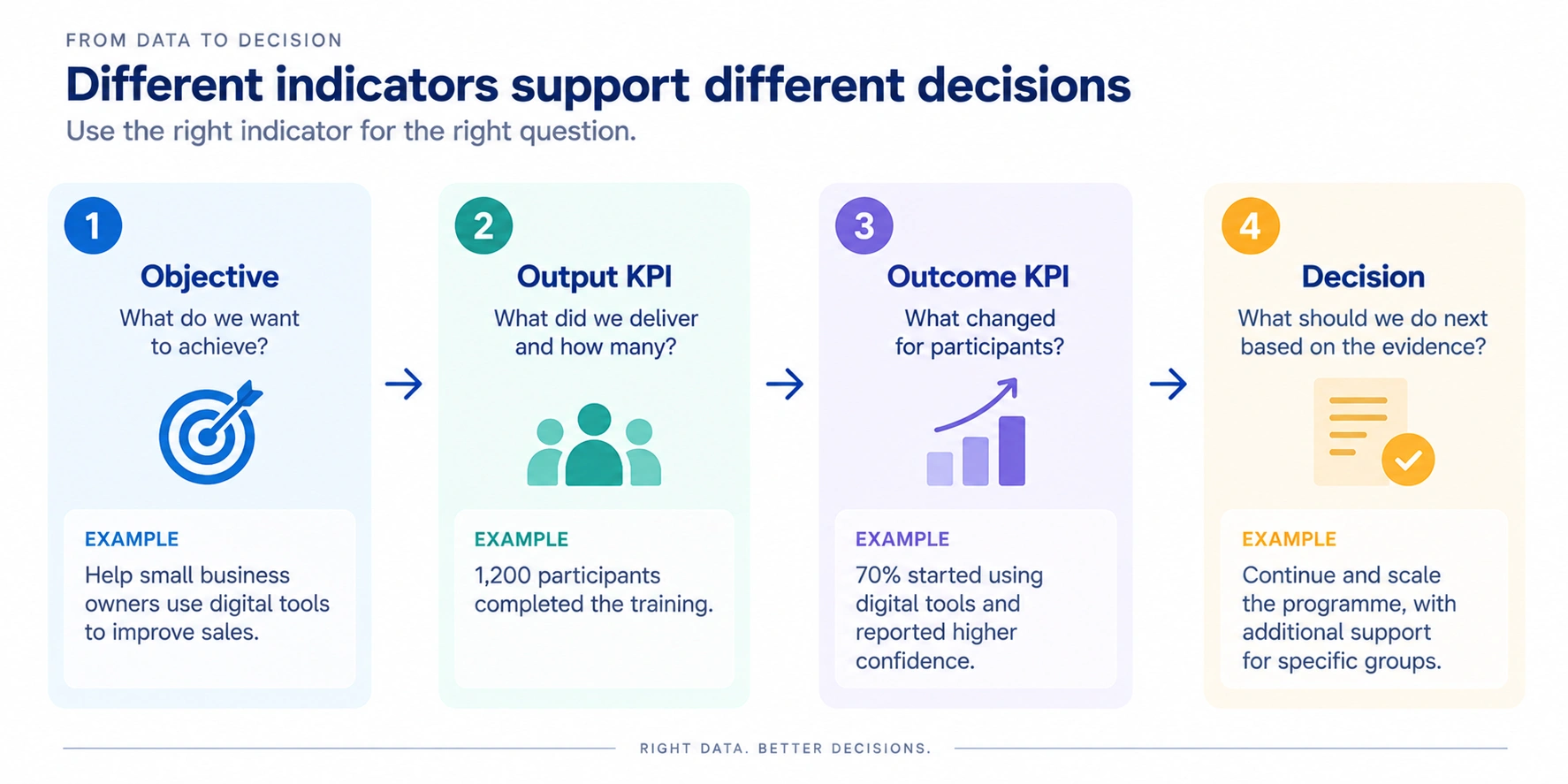
Monitoring and Evaluation are not the same thing
Tracking monthly participant numbers is useful and can be an important part of Monitoring.
Evaluation asks broader questions: How was the programme implemented? What changed? For whom? Why? And were the results worth the resources used?
The UK government’s Magenta Book, updated in May 2026, defines Evaluation as a systematic assessment of an intervention’s design, implementation and outcomes. It identifies Process, Impact and Value for Money as major types of evaluation needed to understand whether an intervention worked, how, why, for whom and at what cost.
A dashboard that tracks Participation well may therefore be sufficient for some Monitoring decisions. A decision to expand, redesign or discontinue a programme may require stronger Evaluation Evidence.
Ask these six questions before calling a programme successful
- What was the programme actually designed to achieve?
- Is participant volume the final target, or only one step in the Results Chain?
- Are participants the people the programme intended to reach?
- What Outcomes happened after participation, and have they been measured at an appropriate time?
- If change occurred, what other factors could plausibly explain the result?
- Is the available evidence sufficient for the next decision, such as expanding, redesigning, investing more, or stopping the programme?
These questions shift evaluation from “How much did we do?” to “Did what we did create the result we intended?”
The same principle applies to business
Businesses face the same measurement problem.
High store traffic does not mean Sales are strong if Conversion is low.
Many free-trial registrations do not prove Product success if Activation and Retention remain weak.
A large number of Leads does not make Marketing effective if those Leads do not become valuable customers.
High Webinar attendance does not prove the Webinar achieved its intended Business Outcome.
Activity and Volume Metrics remain useful. They simply need to connect to the Outcome the business is trying to create.
For SME owners and managers, a useful question is not only “Did this number increase?” but “Where does this number sit on the path toward the result we actually want?”
The takeaway: High participation tells us that a programme reached people, not necessarily what it changed
High participation is good evidence when Reach or Participation is the intended measure. It should not automatically be used as a substitute for Outcome or Impact.
A meaningful programme evaluation starts with the objective, separates Outputs from Outcomes, checks whether results are reaching the intended groups, and avoids claiming that a programme “caused” a change when the evidence does not support a causal conclusion.
A useful KPI does more than make a report look positive. It helps decision-makers understand what to do next.

Participant numbers are useful measures of Reach or Output, but programme success should be assessed against its intended objectives. If the objective is to create change, Outcome evidence is needed. If an organisation wants to claim Impact, it also needs sufficient evidence to examine whether the observed change is attributable to the programme rather than simply occurring at the same time.
Sources
- OECD. Evaluation Criteria. Relevance, Coherence, Effectiveness, Efficiency, Impact and Sustainability.
- OECD. Applying Evaluation Criteria Thoughtfully. Guidance on Effectiveness, achievement of objectives and differential results across groups.
- OECD. Glossary of Key Terms in Evaluation and Results-Based Management for Sustainable Development, Second Edition. Published 27 June 2023.
- U.S. Centers for Disease Control and Prevention. CDC Program Evaluation Framework, 2024. Published September 2024.
- HM Treasury and Evaluation Task Force. The Magenta Book: Central Government Guidance on Evaluation. Updated 15 May 2026.

.png)
.png)
.png)