.png)

.png)
.png)

“TikTok made this brand successful” is an appealing story, particularly when Viral Videos, Creator mentions, rising Search Interest and Sales Growth all appear at roughly the same time.
And TikTok can create real business impact. TikTok for Business presents evidence of the platform’s role across Brand Discovery, Product Research and Purchase, while some campaigns using Conversion Lift or Sales Lift studies have measured Incremental Sales attributable to TikTok exposure.
But neither observation proves that every brand growing after a viral moment grew because of TikTok.
The more useful question is: if TikTok had not been there, would the brand still have grown, and by how much?
Article Content
Sales growth after a viral moment is an important signal, but it is not yet proof of Causation
TikTok can play a meaningful role in Brand Discovery, Product Research and Purchase. But when a brand goes viral and Sales increase, the first thing we know is that the events occurred together, not that one fully caused the other.
Separate the question into three levels:
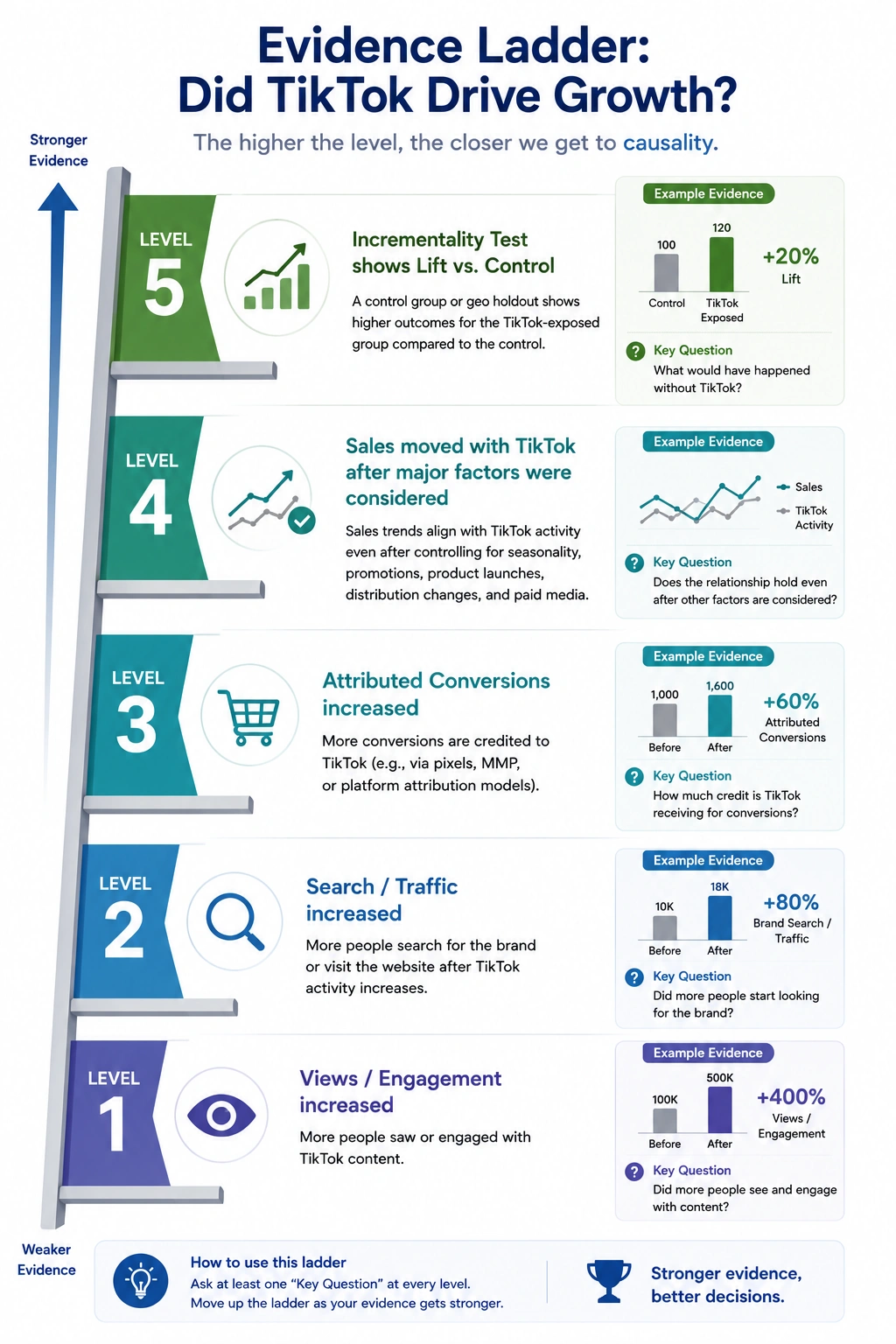
1. Correlation: Did TikTok Activity and Sales move together?
2. Attribution: How much Conversion Credit does the measurement system assign to TikTok?
3. Incrementality: What outcomes would not have happened without TikTok?
The third question gets closest to Causality because it asks about the Counterfactual: what would have happened without TikTok?
First, separate “grew with TikTok” from “grew because of TikTok”
Imagine a brand reports:
- TikTok Views +500%
- Brand Search +120%
- Website Traffic +80%
- Sales +40%
This is an interesting pattern and deserves investigation.
It does not yet establish: “TikTok caused a 40% increase in Sales.”
During the same period, the brand may also have:
- TikTok Views +500%
- Brand Search +120%
- Website Traffic +80%
- Sales +40%
This is an interesting pattern and deserves investigation.
It does not yet establish: “TikTok caused a 40% increase in Sales.”
During the same period, the brand may also have:
- Launched a new Product
- Expanded Retail Distribution
- Been featured by a major Creator
- Reduced Prices
- Increased Paid Media
- Benefited from competitor stock-outs
- Experienced Category Growth
- Entered a seasonal peak
The initial evidence therefore shows Association or Correlation, not automatic Causation.
Why TikTok is still a reasonable Growth Hypothesis
Being careful about Causality does not mean assuming TikTok has no effect.
TikTok reports that, in its 2024 Commerce Landscape Study conducted with Ipsos, three in four shoppers on TikTok agreed that the platform helps them discover new brands. TikTok also presents research connecting the platform with activities across the path from Discovery to Purchase.
The hypothesis: “TikTok contributes to Demand Generation
or Customer Acquisition” is therefore reasonable.
The mistake is moving from: “TikTok can influence Demand” to: “All observed growth was caused by TikTok.”
Those claims require different levels of evidence.
The problem with Success Stories: We start after we already know who won
Imagine 100 brands use TikTok.
Five go viral and grow rapidly.
Those five are the brands most likely to become Case Studies.
But what happened to the other 95?
When cases are selected because we already know they succeeded, Selection Bias or Survivorship Bias becomes a risk.
We observe: Successful Brand → TikTok
and may unconsciously reverse it into: TikTok → Successful Brand
What we really need to know is how brands exposed to the strategy performed relative to a credible comparison or Counterfactual.
Success Stories are still useful.
They are particularly useful for generating Hypotheses.
They are much weaker when treated as standalone proof of Causation.
Viral attention can be a Cause—but it can also be an Effect of a brand already gaining momentum
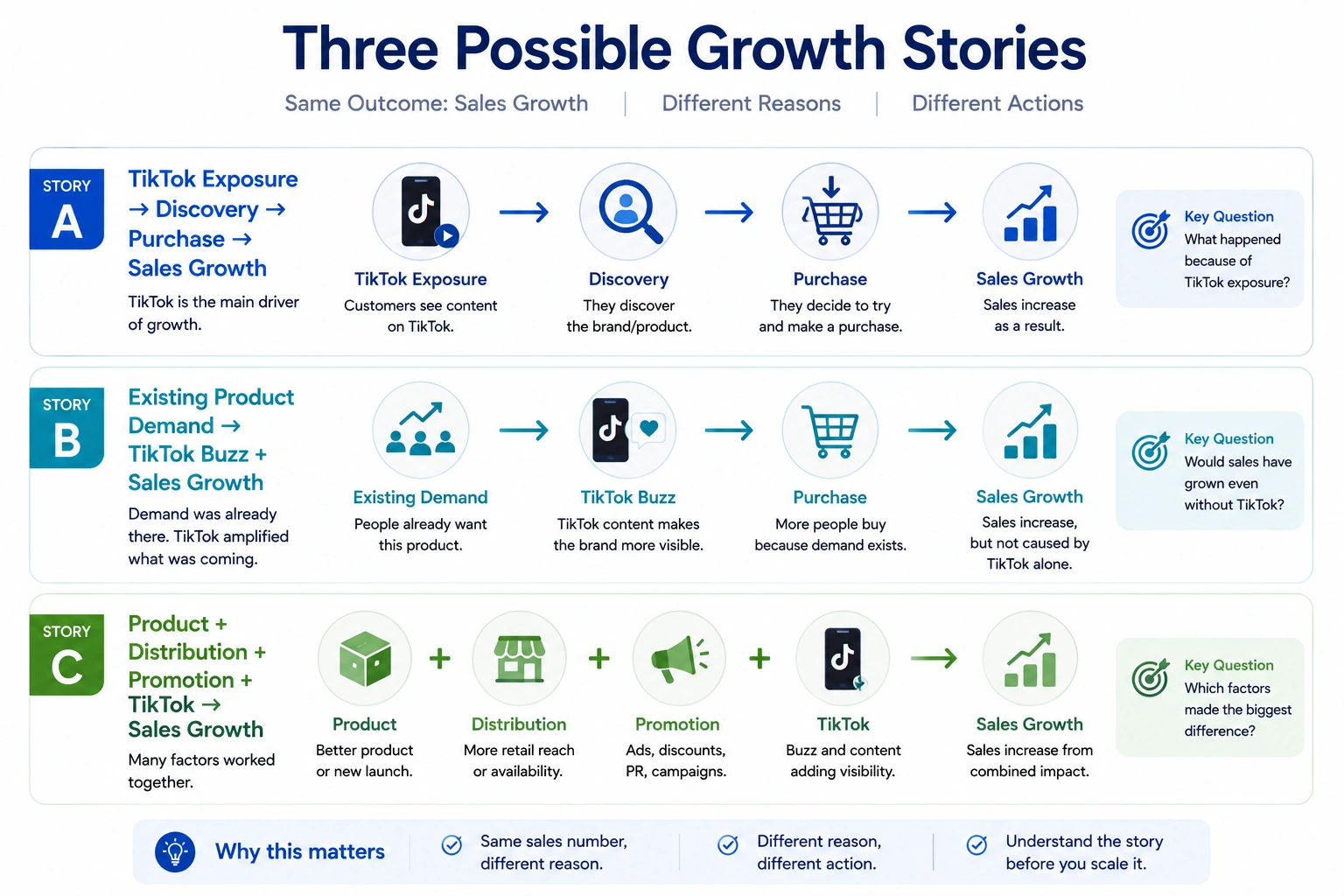
Consider another possible sequence.
A Product begins gaining traction because of Product Quality, Distribution or Word of Mouth.
More customers discuss it.
Creators notice it.
TikTok Views rise.
Sales continue to grow.
Looking only at the later period could suggest: TikTok Views ↑ → Sales ↑
while the actual process may look more like: Product Demand ↑ → Customer Conversation ↑ → TikTok Content ↑ → Sales ↑
TikTok may then amplify that momentum further.
In this case, TikTok is not irrelevant.
Its role may be closer to an Amplifier than the Original Cause.
That is why Temporal Order, what changed first, matters.
Correlation, Attribution and Incrementality are not the same thing
These three concepts help teams discuss Marketing Effectiveness more precisely.
Correlation: Did two things move together?
For example, TikTok Views rose while Sales increased.
This is useful for identifying Signals and generating Hypotheses.
Alternative Explanations can still exist.
Attribution: Which touchpoint receives credit for the Conversion?
A Customer might: See TikTok → Search Google → Visit Website → Purchase
A Last-click model may give the Conversion Credit to Search.
Another Attribution model may distribute Credit across multiple Touchpoints.
Attribution therefore helps describe and assign Credit across the Customer Journey, but it does not perfectly answer the Counterfactual question: would the Conversion have occurred without TikTok?
Google explicitly distinguishes Standard Attributed Conversions from Incremental Conversions. Its Conversion Lift methodology compares an experiment group exposed to advertising with a control group to estimate additional Conversions caused by the advertising.
Incrementality: What would not have happened without TikTok?
This gets closer to the causal question: “How many Sales would we have generated without the TikTok campaign?”
The difference between the observed outcome and the estimated outcome without the campaign is the Incremental Effect.
Google describes Incrementality as measuring the uplift attributable to advertising and recommends combining it with Attribution and Marketing Mix Modeling where appropriate.
Is there evidence that TikTok can generate Incremental Sales?
Yes, in specific campaigns and markets.
Torrid, for example, used a TikTok Conversion Lift Study comparing Conversion Behavior between Test and Control Groups over a four-week campaign.
TikTok reports that the study measured approximately 4% Purchase Lift and an Incremental ROAS of about 2.4x.
In another case, Coca-Cola worked with LiveRamp on a Sales Lift Study that compared markets exposed to a TikTok campaign with comparison markets. TikTok reports a 6.9% Incremental Increase in Brand Sales during the campaign period.
These cases provide stronger evidence of Incrementality than simply observing: “Views increased and Sales increased.”
They attempt to estimate a Counterfactual.
However, they still require careful interpretation. They are TikTok-published Case Studies, and results from individual campaigns should not become benchmarks or guarantees for Thai SMEs. TikTok itself states in its case materials that past performance does not guarantee or predict future performance.
What international Case Studies still cannot tell a Thai SME
Even when an overseas campaign demonstrates Incremental Lift, it does not tell you whether:
- Your Category will respond in the same way
- Thai Customers will behave similarly
- Organic Content will perform like Paid Campaigns
- The same Creator Strategy will work
- An SME-level Budget will generate sufficient Reach
- Your TikTok Shop, Marketplace, Retail and Website journey behaves like the case
- Economics remain attractive after Media, Creator Fees, Discounts and Fulfillment Costs
The transferable lesson is: “TikTok can create measurable Incremental Business Impact, and that impact can be tested.”
Not: “Use TikTok and your business will grow like this case.”
Rising Search after a viral moment is still not the same as Sales
Another common pattern is:
TikTok Viral → Google Search increases
This is useful evidence.
It may indicate Brand Interest or Product Research.
But Search Interest is not Purchase.
People may Search because they:
- Intend to buy
- Want to understand the Brand
- Want Reviews
- Are comparing Prices
- Are following a news story or trend
- Simply want to know why something went viral
Search Lift can therefore be an Intermediate Outcome.
If the Business Question is whether TikTok generated Sales, the analysis must continue into Conversion or Transaction Data.
SMEs do not need enterprise-level Measurement to start thinking more causally
Strong causal evidence may require Experiments or advanced measurement.
But an SME can improve its analysis immediately.
Start with a timeline and record weekly:
- TikTok Posts / Spend / Reach
- Creator Activity
- Brand Search
- Website Traffic
- New Customers
- Conversion Rate
- Orders
- Revenue
- Promotions
- Distribution Changes
- Stock Availability
- Major Competitor Activity
Then ask where the growth began and what else changed at the same time.
This does not prove Causation.
It reduces the risk of constructing a story from memory after the result is already known.
Where possible, create a Comparison
Suppose the business operates across several markets and can introduce a campaign in selected areas first.
It may be possible to compare: Areas receiving increased TikTok Activity
with Similar areas without the increased Activity
Another approach is to test campaigns across selected periods while trying to keep Price, Promotion and Distribution reasonably comparable.
The key idea is to create evidence for the question: “What would we expect to happen without this Intervention?”
GeoLift applies this principle. In one TikTok case, Waldo’s activated a branding campaign in selected regions and compared performance with control areas to estimate Incremental Orders.
For SMEs, the comparison must still be designed carefully. If Test and Comparison markets differ substantially, the measured difference may reflect Market Context rather than TikTok.
Seven questions before saying “TikTok drove the growth”
- Did Sales Growth begin after TikTok Activity increased?
- Was Growth stronger for Products or Customer Segments more exposed to the activity?
- Did Price, Promotion, Distribution or Product Launches change at the same time?
- Did Brand Search, Website Traffic and New Customer Acquisition change in a plausible sequence?
- Which Attribution rule is giving TikTok Credit?
- Is there a Comparison Group, Holdout or Incrementality Test?
- Can we estimate how many Sales would probably have happened without TikTok?
If questions 6 and 7 remain unanswered, be careful with: “TikTok caused the growth.”
A more evidence-calibrated statement might be: “TikTok Activity increased during the same period as Sales Growth, with supporting signals from Search and New Customer Acquisition. An Incrementality Test would be needed to estimate the portion specifically caused by TikTok.”
A good Business Case should also explain what remains unknown
When reviewing a brand that grew through Social Media, separate the story into four evidence levels.
FACT: How much did TikTok Views, Sales, Search or Distribution change, and when?
BEE INTERPRETATION: TikTok may have played a role in Discovery, Demand Generation or Amplification.
HYPOTHESIS: TikTok Exposure was one Driver of Incremental Sales.
UNKNOWN: What would Sales have been without TikTok? How much Growth came from other factors? What was the return after all relevant Costs?
Stating what remains UNKNOWN does not weaken the Case Study.
It clarifies how far the evidence can support the conclusion, and what should be tested next.
The lesson for SMEs: Do not copy the Viral Formula; copy the way the claim is tested
When a famous brand succeeds on TikTok, it is tempting to focus on:
Which music it used
How often it posted
Which Creators it hired
How long the Videos were
More useful questions are:
What Business Problem was the Brand trying to solve?
Where did TikTok sit in the Customer Journey?
Which Metric moved first?
What evidence suggests Customer Behavior changed?
Which Alternative Explanations remained?
How was Incremental Impact measured?
Content Formats can be copied.
Market Context, Product, Customer and Timing cannot.
The takeaway: TikTok can be a real Growth Driver, but “because of” requires more evidence than “after”
Current evidence supports TikTok's role in Brand Discovery and Purchase Journeys, and some campaign-level Incrementality Studies have detected Sales Lift associated with TikTok advertising.
So it would be equally simplistic to dismiss TikTok as a Vanity Channel.
But: Viral + Sales Growth
does not automatically equal:
TikTok caused Sales Growth.
For an SME, the more useful question is not simply: “Did this famous brand grow because of TikTok?”
It is: “If TikTok had not been used, which outcomes would probably have happened anyway—and which were genuinely incremental?”
That shift moves the discussion away from explaining Success Stories after the fact and toward Marketing Measurement that can support better decisions about Budget, Channels and Growth.

TikTok can influence Brand Discovery, Product Research and Purchase, and some Incrementality Studies have measured genuine Sales Lift from TikTok campaigns. But rising Views, Viral Content and Sales at the same time do not prove that TikTok caused the growth. Businesses should separate Correlation, Attribution and Incrementality, while checking Alternative Explanations such as Distribution, Promotion, Product Demand, Creator Activity, Seasonality and other marketing channels.
Sources
- TikTok for Business. Commerce on TikTok. Evidence on Brand Discovery and the path from Discovery to Purchase.
- TikTok for Business. Torrid Conversion Lift Study. Test-control measurement of Purchase Lift and Incremental ROAS.
- TikTok for Business. Coca-Cola Sales Lift Study. LiveRamp-supported comparison used to estimate Incremental Sales.
- TikTok for Business. Waldo’s GeoLift. Controlled geographic comparison used to estimate Incremental Orders.
- Google Ads Help. Conversion Lift. Distinction between Attributed and Incremental Conversions and experiment-control measurement.
- Think with Google. Full-funnel Media Strategy Measurement. Framework combining Attribution, Incrementality and Marketing Mix Modeling.


.png)
.png)
.png)