.png)


.png)
.png)

Imagine two customers.
Customer A spends 1 million baht per year.
Customer B spends 700,000 baht.
Based on Revenue alone, Customer A appears more valuable.
Now suppose Customer A buys mainly during Promotions, requires urgent deliveries, generates frequent Returns, consumes significant Sales and Support time, and has recently reduced purchasing.
Customer B buys consistently, generates stronger Margin, requires relatively little Support and has potential to adopt additional Products.
The answer to: “Which customer deserves more investment?” is no longer obvious.
This is why Customer Value should not be reduced to spending alone.
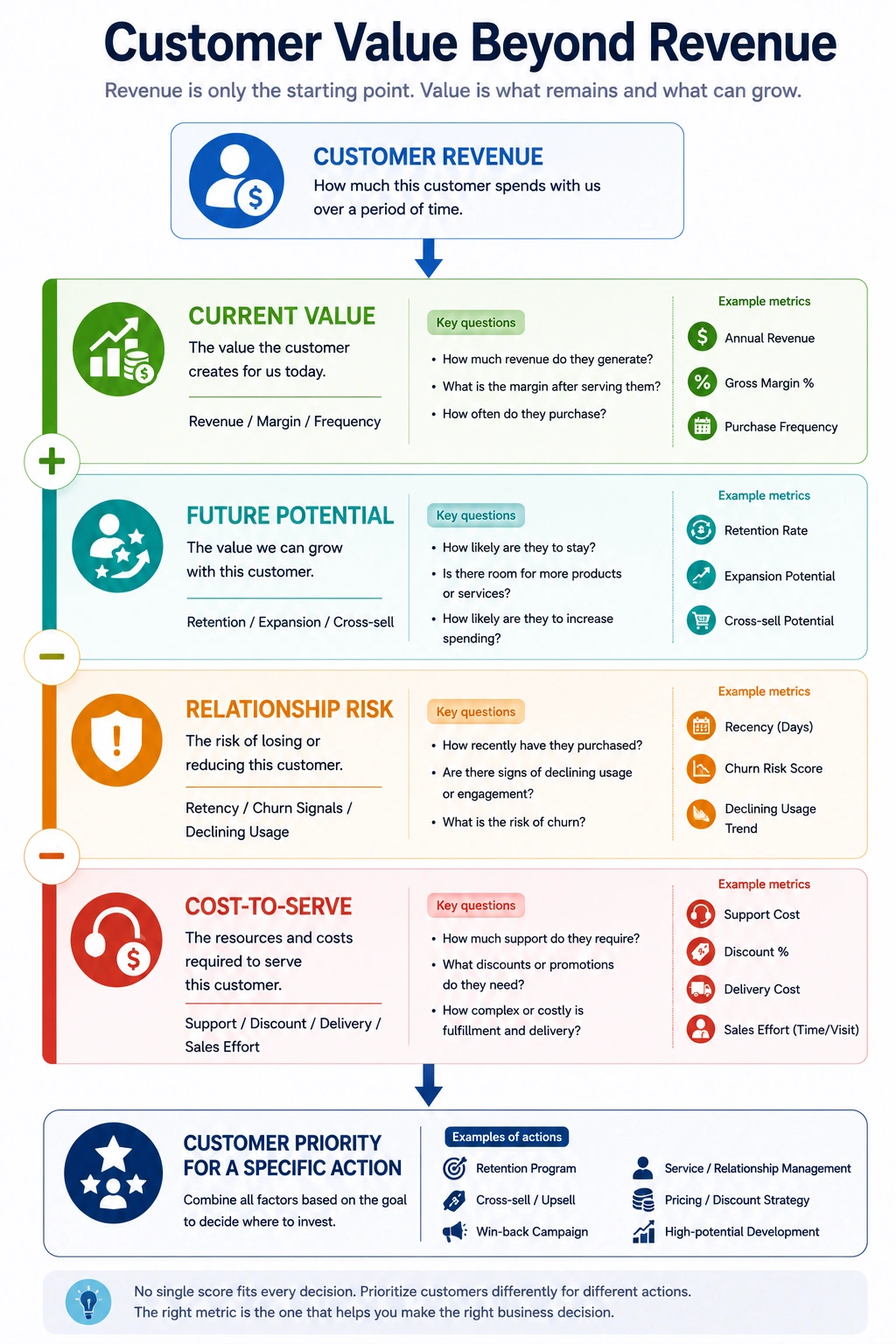
A stronger Customer Prioritization approach separates Current Revenue from Profitability, Relationship Health and Future Potential before deciding where to invest Retention, Cross-sell, Service or Marketing resources.
The customer generating the most Revenue may not be the customer generating the most Value
Ranking customers only by spending tells you who generates the most Revenue. It does not tell you who generates the most Profit, who is likely to stay longer, or who requires unusually high resources to serve.
Customer Lifetime Value, or CLV, extends the view beyond current-period spending. Salesforce describes CLV approaches that consider revenue across the customer relationship together with Cost-to-Serve, helping businesses distinguish high Revenue from stronger long-term financial Value.
The more useful question is therefore not: “Who spends the most?”
It is: “Which Customer Segment deserves more resources for the Business Action we are trying to take?”
Spending tells you Current Revenue, not total Customer Value
Revenue matters. But it answers only: “How much does this customer buy from us?”
It does not answer:
- How much Margin do we retain?
- What is the Cost-to-Serve?
- Is the customer a repeat buyer or a one-time big spender?
- Did they purchase recently?
- Are they likely to Retain or Churn?
- Is there room for Expansion or Cross-sell?
- Is spending dependent on heavy Promotions?
Salesforce notes that Revenue is only part of the CLV picture. Understanding customer value also requires considering the resources required to Acquire, Onboard and Support the customer, because some high-revenue accounts consume substantial internal resources and generate weaker overall profitability.
Therefore: High Revenue ≠ High Profit
and: High Revenue ≠ High Future Value automatically
A high-revenue customer can still be a Profit Drain
A large customer may also require:
Heavy Discounts
Frequent small Orders
Special Delivery
High Return Rates
Extensive Support
Customization
Long Payment Terms
Frequent Sales Visits
Those costs are invisible when customers are ranked only by Revenue.
McKinsey emphasizes the importance of understanding Total Cost-to-Serve when assessing Customer Profitability, including costs that may be hidden when functions optimize their own metrics independently.
Harvard Business Review has similarly described Profit Segmentation in which high-revenue customers can fall into either high-profit or low-profit / loss-making groups depending on their economics and Cost-to-Serve.
Before increasing investment in Top Spenders, ask: “How much Value remains after the resources required to serve this relationship?”
Revenue and Margin should be treated separately
Consider:
Customer A
Revenue = 1,000,000 baht
Gross Margin = 15%
Customer B
Revenue = 700,000 baht
Gross Margin = 35%
Before considering other costs, Customer A generates 150,000 baht of Gross Margin.
Customer B generates 245,000 baht.
If Sales ranks customers only by Revenue, A may appear more important.
If the decision is: “Where should we invest to protect Profit?”
the answer may change.
Revenue has not become irrelevant.
The Business Question has changed the Metric that matters.
Look beyond Monetary Value to Recency and Frequency
Two customers can have similar total spending while having very different relationships.
Customer A:
Spent 100,000 baht 11 months ago and has not returned.
Customer B:
Spends around 10,000 baht regularly.
Their cumulative spend may be similar.
Their Behavioral Signals are not.
RFM Analysis considers:
Recency = How recently did the customer purchase?
Frequency = How often do they purchase?
Monetary = How much do they spend?
Salesforce Commerce combines RFM with measures such as Active, At-risk and Churned Customers, Purchase Frequency and Lifetime Value to provide a broader view of Customer Behavior.
For SMEs, RFM is a practical starting point because it can often be built from existing Transaction Data.
But RFM is still not the complete answer because Monetary Value alone does not capture Margin or Future Potential.
A lower-spending customer today may have higher Future Potential
Consider a software business.
Customer A already uses the largest Package.
Customer B has only recently adopted a smaller Package, but:
The business is expanding.
User numbers are growing.
Usage is increasing.
More Features are being adopted.
Additional Products match emerging Needs.
Based on Current Revenue, A is more valuable.
For the question: “Where is the Expansion Potential?”
B may deserve more attention.
Customer Lifetime Value extends the view beyond current transactions toward the value of the ongoing relationship. Salesforce's Customer Lifetime Score, for example, combines factors including Spend, Tenure, Retention Probability, Expansion Potential and Cost-to-Serve when estimating long-term value.
Relationship Risk can change which customers deserve attention
Suppose two segments generate similar Margin.
Group A buys consistently and purchased last week.
Group B used to purchase frequently but has been inactive for five months.
If the objective is Retention, resources may not need to be distributed equally.
Group B has a stronger Relationship Risk signal.
But the opposite mistake is also possible: High Churn Risk ≠ Always worth saving
If a customer has:
Low Margin
High Cost-to-Serve
Low Future Potential
heavy Retention Discounts may destroy value rather than protect it.
Retention Priority should therefore consider: Customer Value × Risk
not Risk alone.
New customers should not be labelled Low Value simply because they have spent less
Historical Revenue naturally disadvantages new customers.
A first-time buyer will have:
Low Frequency
Low Lifetime Spend
because:
The relationship is still young.
That does not automatically imply low potential.
Separate: Low Current Value
from: Low Future Potential
A new customer showing Early Behavior similar to existing High-value Customers may deserve investment in Onboarding or Second Purchase even when historical spending remains low.
Promotion-driven spending can exaggerate apparent Customer Value
Suppose one segment has high Purchase Frequency.
But 80% of its Orders occur during Promotions.
Before calling the segment “Loyal,” examine:
Full-price Purchases
Promotion Dependency
Margin
Post-promotion Behavior
Repeat Purchase without Incentives
Promotion-driven Repeat Purchase can generate Revenue without establishing either strong Loyalty or strong Profitability.
Therefore: Repeat Purchase ≠ Loyalty automatically
and: High Spend ≠ High Profitability automatically
The right customer to prioritize depends on the Action
There is no universal Customer Priority List for every use case.
For Retention: Consider Value + Churn Risk.
For Cross-sell: Consider Current Relationship + Unmet Need + Product Fit + Expansion Potential.
For Sales Efficiency: Compare Revenue / Margin Potential with Sales Effort.
For Service Recovery: Consider Severity + Customer Impact + Relationship Value, while handling Safety, Fairness and other obligations outside a purely commercial ranking.
For Automation: Consider customers with relatively standardized Needs and high repetitive Cost-to-Serve.
The useful question is therefore not:“Who are our Best Customers?”
It is: “Who should receive priority for this particular Action?”
Start with four dimensions of Customer Value
Businesses without advanced Customer Analytics can begin with four dimensions.
- Current Value
What Revenue, Margin and Purchase Frequency does the customer generate today? - Future Potential
What is the opportunity for Retention, Expansion, Cross-sell or additional Share of Wallet? - Relationship Risk
Are there signs of Churn, declining Frequency, complaints or reduced Engagement? - Cost-to-Serve
How much Sales, Service, Discount, Delivery or Operational Resource does the relationship require?
This is not a standardized mathematical formula that should automatically be summed into one score.
It is a Decision Checklist designed to prevent Revenue from becoming the only dimension of Customer Priority.
SMEs can start with Transaction Data
A sophisticated CRM is not required to begin.
At minimum, capture:
- Customer ID
- Purchase Date
- Transaction Value
- Product / Category
- Discount
Where available, add:
- Gross Margin
- Acquisition Source
- Support Contacts
- Returns
- Delivery Cost
- Promotion Usage
- Customer Status
Then calculate:
Recency
Frequency
Monetary Value
Average Order Value
Gross Margin Contribution
Repeat Purchase
As the data improves, add:
Retention
Churn Risk
Customer Lifetime Value
Future Potential
Cost-to-Serve
There is little benefit in beginning with Predictive CLV or an AI Model before Customer IDs and Transaction Definitions are reliable.
Example: Top Spender does not necessarily mean Top Priority
Consider three segments.
Group A: Big Spenders
High Revenue, but heavy Discounts, high Cost-to-Serve and declining Purchase Frequency.
Group B: Stable Customers
Moderate Revenue, healthy Margin, consistent purchasing and low Support needs.
Group C: Emerging Customers
Low Revenue today, but rapidly increasing Frequency and strong Cross-sell Potential.
Ask: “Who generates the highest Current Revenue?”
Answer: A.
Ask: “Who provides stable Profitability?”
Possibly B.
Ask: “Where is the strongest Growth Potential?”
Possibly C.
The same Customer Data can therefore produce different priorities depending on the Business Question.
Customer Segmentation becomes valuable when it changes Action, not merely when it gives segments names.
Be careful with one Customer Score used for every decision
Organizations sometimes create: Customer Value Score = 87
and use the same score for:
Marketing
Sales
Service
Retention
Promotion
But those teams are solving different problems.
The best Cross-sell candidate may not have the highest Churn Risk.
The highest-revenue customer may not need another Discount.
A customer using substantial Support may still be valuable if the Support demand reflects a Product Problem the business itself needs to solve.
A Customer Score should support a Decision.
It should not replace all business judgment.
Use Customer Lifetime Value carefully
CLV is valuable because it attempts to estimate Customer Value across the relationship rather than relying only on current transactions.
But CLV is still an Estimate.
Its result depends on assumptions about:
Customer Lifespan
Retention
Future Spending
Margin
Discount Rates
Future Cost-to-Serve
If the Business Model or customer behavior changes, the prediction may change as well.
CLV should therefore not be interpreted as: “The exact value of this customer.”
It is better understood as: “An estimate used to compare relationships and allocate resources under a defined set of assumptions.”
A practical Framework for deciding which Customer Segment deserves investment
- Define the Action
Is the investment intended for Retention, Cross-sell, Service, Promotion or Acquisition? - Measure Current Value
Review Revenue, Margin, Frequency and Recency. - Estimate Future Potential
Is there a realistic opportunity to Retain, Expand or Cross-sell? - Check Relationship Risk
Are there signs of Churn or declining behavior? - Add Cost-to-Serve
How much resource is required to create the Value? - Segment Customers
Do not rely only on Averages or a Top Spender list. - Match the Action to the Segment
What Offer, Service Level or Treatment is appropriate for each grou - Measure Incremental Outcome
After investing, did Retention, Margin, Purchase Frequency or Customer Value actually improve?
The takeaway: Your biggest-spending customers deserve closer understanding, not automatically the biggest investment
Customer spending is an important signal.
But ranking customers only by spending can lead a business to:
Overinvest in High-revenue / Low-profit Customers
Ignore stable customers with stronger Margins
Miss Emerging Customers with high Future Potential
Discount customers who would have purchased anyway
Spend heavily retaining relationships with excessive Cost-to-Serve
Customer Value therefore needs to go beyond Monetary Value.
A useful framework is: Current Value + Future Potential + Relationship Risk + Cost-to-Serve
Then ask: “Priority for which Action?” instead of only: “Who spends the most?”
The highest-value customer may not be the person generating the most Revenue this month.
It may be the customer who creates sustainable Margin, has a strong probability of continuing the relationship, has room to grow, and can be served with sound Economics.

A high-spending customer is a High Revenue Customer, but not necessarily a High Value Customer. Revenue alone does not capture Margin, Cost-to-Serve, Retention, Future Potential or Promotion Dependency. A more useful approach considers Current Value, Future Potential, Relationship Risk and Cost-to-Serve, then prioritizes customers according to the specific Business Action. There should not be one universal Customer Ranking for every decision.
Sources
- Salesforce. The Complete 2026 Guide to Customer Lifetime Value. Explains why Revenue is only part of Customer Value and why CLV should also consider the costs required to Acquire, Onboard and Support customers.
- Salesforce Help. Customer Lifetime Score. Describes long-term customer financial value using Spend, Tenure, Retention Probability, Expansion Potential and Cost-to-Serve.
Salesforce Commerce. Shopper Intelligence Analytics Dashboard. Uses RFM, Purchase Frequency, Active / At-risk / Churned Customer status and Lifetime Value to analyze Customer Behavior. - McKinsey & Company. A Path Toward Healthy, Sustainable Growth in E-commerce. Highlights the importance of Total Cost-to-Serve when understanding Customer Profitability and commercial decisions.
- Harvard Business Review. How to Create a Winning Post-Pandemic Business Model. Discusses Profit Segmentation and why High-revenue Customers can be either highly profitable or low-profit / loss-making depending on customer economics and Cost-to-Serve.


.png)
.png)
.png)