.png)

.png)
.png)

Ask AI to write a Questionnaire for Customer Satisfaction, Brand Research or Product Testing, and within seconds it can produce a polished set of questions, rating scales and neatly organized sections.
That is a genuine advantage of AI: it can shorten the journey from a blank page to a First Draft.
The risk is that AI can produce a “good-looking question” faster than it can establish whether that question measures the right thing.
A poorly designed Survey Question is not merely a writing problem. Even with a strong Sample and many respondents, ambiguous or biased questions can produce misleading data. Pew Research Center notes that accurate sampling can be undermined when the information collected rests on ambiguous or biased questions.
The useful question is therefore no longer “Can AI write a Questionnaire?”
It can. The more important question is: which parts should AI support, and which judgments must remain with the researcher?
AI can accelerate the Draft, but it cannot make a Questionnaire valid by itself
AI is useful for generating a First Draft, suggesting Alternative Wording, translating Research Objectives into preliminary questions, proposing Response Options and identifying potentially long or repetitive items.
But Questionnaire Quality is not determined by how fluent the questions sound.
Before using an AI-generated Questionnaire, researchers should verify:
1. Whether each question supports the Business Decision and Research Objective
2. Whether the intended Construct has been operationalized appropriately
3. Whether questions contain Leading, Double-barreled, Ambiguous or Assumptive Wording
4. Whether Response Options are complete, non-overlapping and appropriate for the Target Population
5. Whether Question Order introduces unintended context or bias
6. Whether AI has introduced unsupported assumptions, standards or benchmarks
7. Whether the Questionnaire has been reviewed and Pretested with relevant respondents
Both Pew Research Center and AAPOR describe Questionnaire Design as a multistage process and emphasize Pretesting before production Fieldwork.
Where can AI help with Questionnaire Design?
AI can be highly useful as a Drafting and Review Tool.
It can help:
- Turn Research Objectives into preliminary Topics
- Generate a First Draft of Survey Questions
- Suggest Alternative Wording
- Shorten overly long questions
- Propose initial Response Options
- Draft Screener Questions
- Flag potentially Double-barreled or Ambiguous Wording
- Compare different versions of a question
- Suggest Follow-up Questions
- Check Terminology Consistency
- Generate a Questionnaire Review Checklist
The main advantages are Speed and Breadth.
Researchers can generate multiple drafts quickly and spend more time reviewing them instead of starting every question from scratch.
But AI-generated questions are still:
Candidate Questions not: Validated Questions
Risk 1: AI starts writing questions before understanding the Decision
Consider this prompt: “Create a 20-question Customer Satisfaction Questionnaire for a coffee shop.”
AI can do that immediately.
But several more important questions remain unanswered.
Will the business use the results to prioritize Service Improvement?
Track Satisfaction over time?
Compare branches?
Identify Drivers of Overall Satisfaction?
Understand why customers do not return?
Each Decision requires a different Measurement Strategy.
If AI is not given a clear Business Decision, Research Objective, Target Population and Analysis Need, it can produce a generic Questionnaire that appears comprehensive but is not designed for the actual decision.
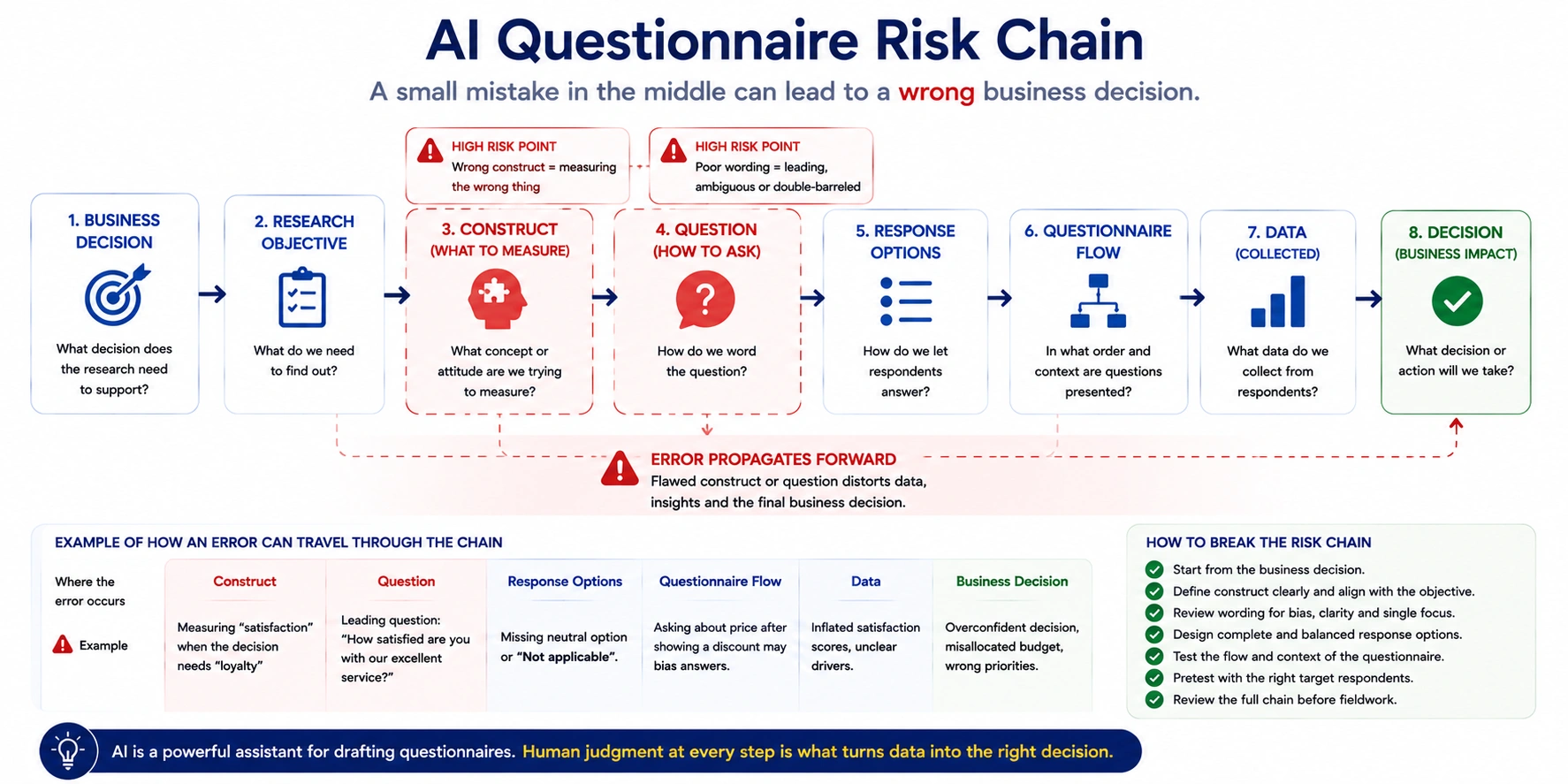
A safer sequence is: Business Decision → Research Objective → Construct → Evidence Needed → Questions
rather than: Topic → AI → 30 Questions
Risk 2: The question sounds good but measures the wrong Construct
Suppose the Research Objective is to measure Customer Loyalty.
AI proposes: “Overall, how satisfied are you with our service?”
This may be a perfectly reasonable Satisfaction Question.
It is not automatically a Loyalty Measure.
If the team reports: “Customer Loyalty = 8.7/10”
the problem is not Grammar. It is Measurement.
Constructs that are commonly confused include:
Satisfaction ≠ Loyalty
Recommendation ≠ Retention
Purchase Intent ≠ Actual Purchase
Brand Awareness ≠ Brand Preference
Liking ≠ Willingness to Pay
AI can suggest how to operationalize a Construct, but the researcher must determine whether each item has a defensible relationship with what the study claims to measure.
Risk 3: AI can write Leading Questions very naturally
Consider: “How satisfied are you with our fast and convenient Delivery Service?”
It sounds polished.
But: “fast and convenient”
already embeds positive evaluations in the question.
A more neutral version might be: “Overall, how satisfied are you with our Delivery Service?”
Then measure specific dimensions separately:
“How satisfied are you with Delivery Speed?”
“How satisfied are you with the convenience of the ordering process?”
AAPOR recommends keeping Survey Questions free from wording that pushes respondents toward a particular answer and asking about one concept at a time.
Risk 4: AI can combine several issues to make a question look efficient
Consider: “How satisfied are you with our Price, Product Quality and Service?”
If a customer answers: 3/5
we cannot tell whether:
Price = 2
Quality = 5
Service = 3
or something entirely different. This is a Double-barreled Question.
Both Pew Research Center and AAPOR recommend asking one concept at a time because multi-concept questions can be difficult for respondents to answer and difficult for researchers to interpret. A more useful design separates:
- Satisfaction with Price
- Satisfaction with Product Quality
- Satisfaction with Service
AI may treat combining questions as an efficient way to shorten the Survey.
Shorter is not better when the resulting data cannot be interpreted clearly.
Risk 5: Response Options can look complete while being unusable
AI might generate these age categories:
- 8–25
- 25–35
- 35–45
- 45+
Respondents aged 25, 35 and 45 fit more than one category.
The options overlap. Or consider: “How often do you buy this Product?”
- Very often
- Often
- Sometimes
- Rarely
- Never
The scale appears balanced, but “often” may mean very different things to different people.
For one Category, monthly purchasing may be frequent.
For another, weekly purchasing may be infrequent.
Pew Research Center recommends that Closed-ended Questions provide reasonable, exhaustive and mutually exclusive Response Options. It also notes that the options offered and their presentation can influence responses.
Risk 6: AI may know less about the respondent’s context than the Questionnaire implies
Suppose AI writes: “What is the main reason you use this bank’s Mobile Banking service?”
The question assumes that the respondent:
Uses Mobile Banking
Uses this bank’s service
Can identify one “main” reason
A Screener or Routing Question may be needed first: “In the past three months, have you used this bank’s Mobile Banking service?”
Yes → Experience Questions
No → Skip
AI can create Routing Logic. But without clear information about the Target Population, Eligibility and Customer Journey, it can easily generate Assumptive Questions.
Risk 7: Question Order can change responses
Compare two Questionnaire structures.
Version A: Overall Satisfaction → Delivery Speed → Staff → Price
Version B: Delivery Problems → Complaints → Waiting Time → Overall Satisfaction
The Overall Satisfaction Question may be identical.
The context is not.
Pew Research Center explains that Question Order can create Order Effects because earlier questions can influence the context respondents use when answering later questions. Survey experiments have also demonstrated meaningful response differences when wording or order changes.
Asking AI to “put these questions in a logical order” is therefore not enough.
Researchers should also ask whether the sequence unintentionally primes later answers.
Risk 8: AI can generate Response Options from what seems plausible rather than what customers actually experience
Suppose the question is: “What is the main reason you stopped using the service?”
AI suggests:
- Too expensive
- Poor service
- Difficult to use
- Better competitor
- No longer needed
The list sounds reasonable.
But perhaps important real-world reasons include:
Delivery coverage changed
The required Payment Method is unavailable
Products are frequently out of stock
The customer’s employer changed Procurement Policy
AI-generated options may force respondents into the nearest available answer instead of capturing their actual experience.
Pew Research Center notes that researchers can use Pilot Studies and Open-ended Questions to identify common answers before developing Closed-ended Response Options.
AI-generated categories should therefore be treated as: Hypotheses about possible responses
not: Evidence that the list represents the real market
Risk 9: AI can “improve” a Tracking Question and accidentally break the Trend
Suppose a company asks every year: “Overall, how satisfied are you with our service?”
This year, AI rewrites it as: “Thinking about your most recent experience, how satisfied were you with our service?”
The new version may sound more precise.
But the Reference Frame has changed from Overall Experience to Most Recent Experience.
If the score moves, the team cannot easily determine whether: Customer Experience changed
or: Measurement changed
Pew Research Center emphasizes maintaining consistent Question Wording and Context when measuring trends because even relatively small changes can affect responses.
Do not automatically allow AI to rewrite Tracking Questions simply because the new version sounds better.
Risk 10: Grammatically correct Translation does not guarantee Measurement Equivalence
For Thai-English Questionnaires, the challenge is not simply whether the translation is correct.
Terms such as:
Value
Trust
Convenience
Worth it
Engagement
Loyalty
may not have one translation that preserves exactly the same meaning and intensity in every context.
AI can produce a Translation Draft quickly.
Cross-language Research still needs to consider whether respondents in different languages interpret the Construct and Response Scale comparably.
Pew Research Center uses a multistep Translation Process for Cross-national Surveys and emphasizes comparability across languages and cultures rather than linguistic correctness alone.
Risk 11: AI can generate convincing benchmarks or “best practices” that have not been verified
Consider: “Create an NPS Questionnaire based on Industry Best Practice.”
AI may respond with:
Recommended Questions
Industry Benchmarks
Ideal Survey Length
Suggested Thresholds
If those claims cannot be traced to credible sources, they should not automatically become part of the Research Design.
AI-generated Output is not Evidence by itself.
For methodological claims such as:
“This Scale is validated.”
“This is the standard Threshold.”
“This question is an Industry Standard.”
“The Industry Average is X.”
Researchers should verify the Original Source, Population, Method, Date and Definition.
A safer rule is:
AI can suggest the source.
The researcher verifies the source.
Risk 12: The information entered into the Prompt may contain Research Data that should not be shared without review
A team might prompt: “Here are 5,000 customer complaints. Create a Follow-up Questionnaire.”
Before uploading the data, check whether it contains:
- Names
- Phone numbers
- Email addresses
- Customer IDs
- Transaction details
- Employee information
- Sensitive information
- Other data unnecessary for the task
Using AI in Research is therefore not only an Accuracy issue.
It also involves Data Governance, Confidentiality, Access Control and the policies governing the AI Tool being used.
Before sending Research Data to AI, ask:
Is this data necessary for the task?
Can it be De-identified?
How does the Tool handle the data?
Who can access it?
Does organizational policy permit its use?
A better use of AI: Ask it to critique the Questionnaire, not just write one
Instead of: “Write a 20-question Customer Satisfaction Questionnaire.”
Break the task into stages.
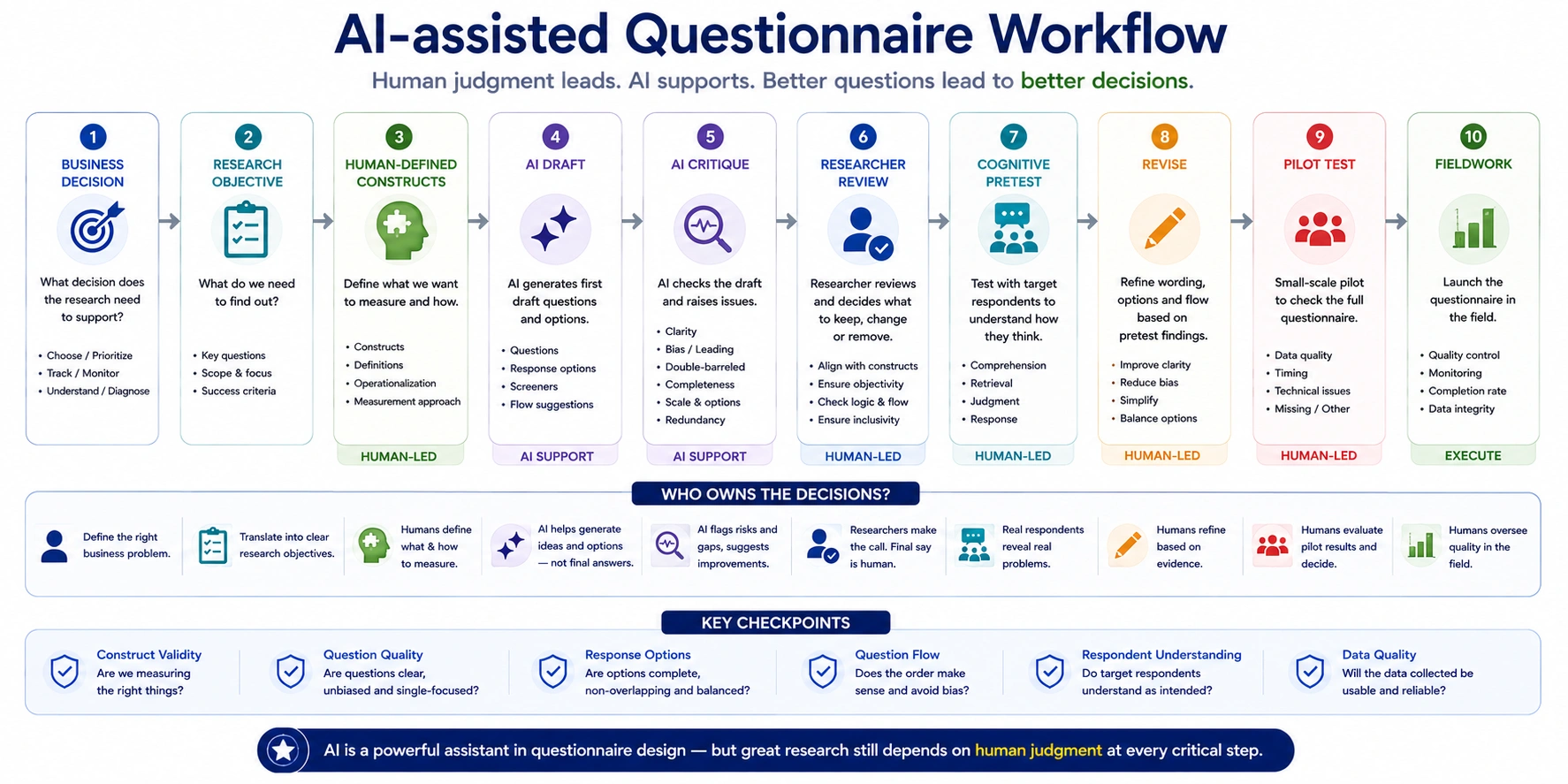
Step 1 Give AI the Business Decision and Research Objective.
Step 2 Ask it to propose the Constructs that need to be measured and explain how each relates to the Objective.
Step 3 Ask it to Draft Questions.
Step 4 Ask it to critique its own Draft for:
- Leading Wording
- Double-barreled Questions
- Ambiguous Terms
- Assumptions
- Recall Period
- Response Options
- Scale Consistency
- Question Order
Step 5 Researcher Review
Step 6 Pretest with Target Respondents
This uses AI as a Thinking Partner and QA Assistant rather than simply a Questionnaire Generator.
A better Prompt does not replace Research Design, but it can improve the Draft
Useful context to provide before asking AI to Draft includes:
Business Decision: What decision will the Research support?
Research Objective: What must the study learn?
Target Population: Who will answer?
Survey Mode: Online, Phone, Face-to-face or another mode?
Key Constructs: What needs to be measured?
Recall Period: Which period should respondents consider?
Analysis Need: Will results be compared across Segments or tracked over time?
Existing Questions: Are there Tracking Questions that must not change?
Constraints: Survey length, language, Routing and other limitations
Better context can make the AI Draft more relevant.
It still does not turn the Draft into a Validated Instrument.
Pretesting remains necessary even after several rounds of AI Review
AI may conclude: “This question is clear.”
Real respondents may interpret it differently.
Consider: “In the past 30 days, how often have you used this service?”
The researcher may define “used the service” as completing a Transaction.
Some respondents may count opening the App.
Others may count only Payments.
Others may count Logging In.
This kind of problem becomes visible when researchers observe how actual Target Respondents understand and answer the question.
AAPOR recommends Pretesting Questionnaires before Fieldwork, including Cognitive Interviews or other Qualitative Methods to understand how respondents interpret questions and arrive at their answers. It also recommends Pilot Testing the overall Survey process.
Pew Research Center similarly uses Focus Groups, Cognitive Interviews and Pretesting to refine new questions before they enter production surveys.
Ten checks before using an AI-generated Questionnaire
- Does every question connect to the Research Objective?
- Does each Measure represent the intended Construct?
- Is there any Leading or Loaded Wording?
- Are any questions Double-barreled?
- Are vague terms such as “often,” “normally” or “fast” used without a clear Reference?
- Are Response Options complete and Mutually Exclusive?
- Does any question make an assumption that has not been screened?
- Could Question Order create Priming or Context Effects?
- Have Tracking Questions changed enough to damage Trend Comparability?
- Has the Questionnaire been Pretested with Target Respondents?
If number 10 is still “No,” the Questionnaire should not be considered Fieldwork-ready simply because an AI review found no obvious problems.
Make the division of responsibility clear: What should AI support, and what remains with the researcher?
AI is useful for:
- Drafting
- Alternative Wording
- Brainstorming
- Consistency Checks
- Preliminary QA
- Translation Drafts
- Documentation
Researchers remain responsible for:
- Business Decision
- Research Objective
- Construct Validity
- Methodological Choice
- Target Population
- Questionnaire Logic
- Measurement Comparability
- Ethical and Privacy Review
- Pretesting
- Interpretation
- Final Sign-off
This distinction matters because the primary risk is not simply “using AI.”
The risk appears when AI is given responsibility for judgments that have not been validated.
The takeaway: Use AI to reduce Questionnaire Drafting time, not Questionnaire Standards
AI can make Questionnaire Development substantially faster.
It can help researchers move beyond a blank page, create Alternative Questions quickly and identify preliminary design issues.
But Questionnaire Quality is not measured by speed or fluent language.
A strong Questionnaire needs to:
Measure the intended Construct
Use Neutral Wording
Provide workable Response Options
Manage Questionnaire Flow carefully
Fit the Target Population
Be tested with real respondents before Fieldwork
The stronger workflow is therefore not: AI → Questionnaire → Fieldwork
It is: Decision → Objective → Construct → AI-assisted Draft → Researcher Review → Pretest → Revise → Fieldwork
AI can accelerate the middle of that process considerably.
Responsibility for determining whether the questions actually measure what the business needs to know still belongs with the researcher.

AI can quickly draft Questionnaire Items, Response Options, Screeners and Alternative Wording, but professional-sounding questions are not automatically valid measures. Key risks include measuring the wrong Construct, Leading Questions, Double-barreled Questions, incomplete or overlapping Response Options, Question Order Effects, AI-generated assumptions and poor fit with the Target Population. AI should therefore act as a Drafting Assistant, not the final authority on whether a Questionnaire is ready for Fieldwork.
Sources
- Pew Research Center. Writing Survey Questions. Guidance on Question Wording, Response Options, Question Order, Trend Measurement and Pretesting.
- American Association for Public Opinion Research. Best Practices for Survey Research. Guidance on Single-concept Questions, Neutral Wording, Questionnaire Order, Cognitive Interviews and Pilot Testing.
- Pew Research Center. Questionnaire Design and Translation. Guidance on Questionnaire Comparability across languages and cultures.
- Pew Research Center. Survey Experiments Can Measure Effects of Question Wording and More. Evidence that Question Wording and Question Order can affect responses.
- Pew Research Center. Testing Survey Questions Ahead of Time Can Help Sharpen a Poll’s Focus. Examples of Focus Groups, Cognitive Interviews and Pretesting before production Fieldwork.


.png)
.png)
.png)