.png)

.png)
.png)

Foreign Business Cases are everywhere.
A restaurant launches a Subscription and Repeat Purchase rises.
A Brand grows rapidly through TikTok.
A software company uses Freemium and User Growth accelerates.
A retailer launches a Loyalty Program and members spend more.
The natural question is: “If it worked there, can we do the same in Thailand?”
The answer is yes, as a Hypothesis. Not yet as a Prediction.
The result of a Business Case can depend on Customer Need, Purchasing Power, Brand Strength, Competition, Distribution, Regulation, Timing and Execution at the same time.
The real value of a foreign case is therefore not a template to copy line by line. It is a faster way to identify a Hypothesis worth testing locally.
Copy the principle, but do not copy the expected result
When a Business Model, Campaign or Product Concept succeeds overseas, the evidence demonstrates that it worked under a particular Population, Market Structure and Context.
It does not automatically demonstrate that the same Effect Size will occur in Thailand.
External Validity and Transportability address precisely this issue: whether conclusions obtained in one population or context can reasonably apply to another. Reviews of this field emphasize that strong evidence in the original setting does not automatically guarantee Generalizability to a different Target Population.
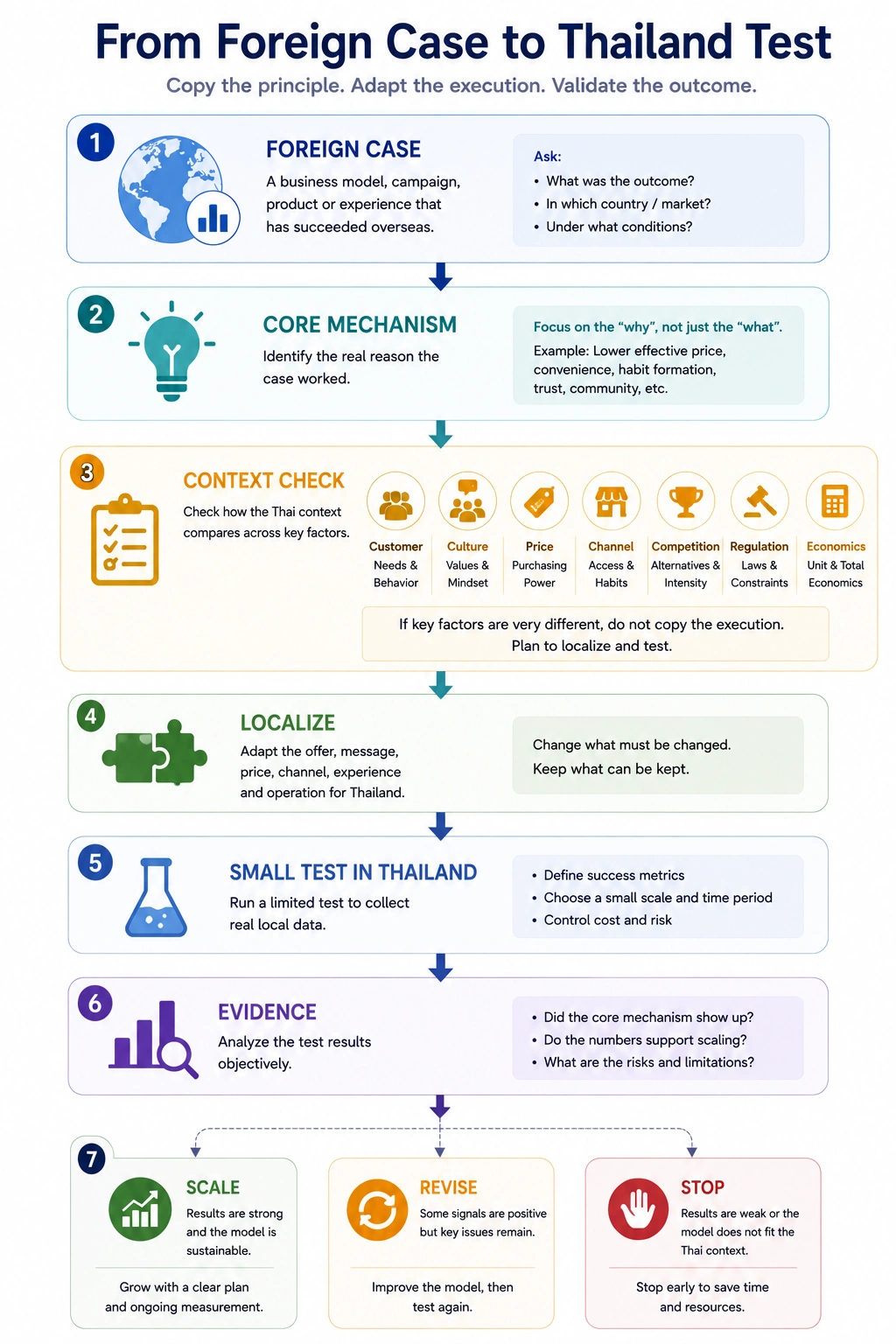
A useful business principle is: Copy the Mechanism → Adapt the Execution → Validate the Outcome
Copy the Logic that makes the case interesting. Revalidate the Price, Message, Channel, Customer Journey and Economics in Thailand before scaling.
A foreign case proves that something worked there, not that it will work here
Suppose a Subscription Program in the United States increases Purchase Frequency.
What is confirmed?
The Program produced a result under the Customers, Pricing, Competition, Channels and Market Context of that case.
What remains unknown for Thailand?
Do Thai customers perceive the same Value?
Is the same Price affordable?
Is the Natural Purchase Frequency similar?
Are the Alternatives the same?
Are Payment and Channel Behaviors comparable?
Does the Thai Brand begin with the same Customer Relationship?
This is an External Validity problem: whether findings from one Population and Context can reasonably be applied to another.
Research on Generalizability makes an important distinction: a study can produce credible effects in its original Sample while those effects may differ in a different Target Population.
Do not copy the Case before identifying the Mechanism
The first question should not be: “What did they do?”
Ask: “Why was that action expected to work?”
Take a Loyalty Subscription.
Visible Tactic: Customers pay a Membership Fee and receive benefits.
Possible Mechanisms:
- Lower Effective Price for frequent buyers
- Concentration of spending with one Brand
- Reduced need to compare competitors on every purchase
- Greater Convenience
- Habit formation
If Convenience is the real mechanism overseas but Thai customers care more about Product Variety, copying the Discount Structure may miss the relevant Need.
Visible Tactic ≠ Core Mechanism
Separate what can be copied from what should be localized
Useful elements to transfer as Starting Hypotheses include:
- Business Logic
- Customer Problem
- Core Mechanism
- Funnel Logic
- Measurement Framework
- Experiment Design
Elements that often need local validation include:
- Target Customer
- Proposition
- Language and Message
- Price Point
- Promotion Structure
- Sales Channel
- Payment Method
- Customer Journey
- Service Expectation
- Operating Model
- Unit Economics
The OECD's 2026 toolkit on adopting ideas from other places argues that successful transfer requires Recontextualization rather than simple replication because Institutional Structures, Cultural Norms and Local Needs differ. In the city survey cited by the OECD, more than nine in ten respondents adapted borrowed ideas to the local context.
Validate the Customer Need before copying the Feature
A case can succeed because it solves an important Need in the original market.
That Need may be: Less important in Thailand
Already solved by another alternative
Relevant only to a specific Segment
Interpreted differently by local customers
A Meal Subscription, for example, may win primarily through Time Saving in one market.
A Thai Segment may place greater value on:
Choice
Freshness
Price
Delivery Reliability
Flexibility without commitment
Validate the Need before perfecting the Feature.
The practical question is: “Do Thai target customers have the same Job-to-be-Done or Pain Point that drove the original case?”
Culture matters, but “Thai culture is different” is too broad to be useful
When a foreign model performs differently, it is tempting to say: “It is a cultural difference.”
That explanation needs to become testable.
Possible dimensions include:
Trust in Online Payment
Comfort with Subscription
Willingness to share Personal Data
Reliance on Influencers
Expectations of Service Recovery
Household Decision Making
Response to Direct Sales
Ghemawat's CAGE Framework emphasizes that international distance is not only geographic. Cultural, Administrative, Geographic and Economic differences can all affect the attractiveness and risk of transferring a Strategy between markets.
Treat “Culture” as a set of Hypotheses to investigate, not as the final explanation.
The same converted Price is not the same Customer Sacrifice
A Product that sells successfully for USD 20 overseas cannot be validated for Thailand by simply converting USD 20 into baht.
Evaluate the Price relative to:
Income
Local Alternatives
Category Spending
Purchase Frequency
Perceived Value
Switching Cost
Competitor Pricing
Foreign Price ≠ Thai Willingness to Pay
If Pricing is central to the Business Model, local Pricing Research or a Market Test is usually more informative than direct currency conversion.
The Channel behind the case may not have the same power in Thailand
Suppose a foreign Brand grows through a Direct-to-Consumer Website.
The same Category in Thailand may depend more heavily on:
Marketplaces
Social Commerce
Retail
Distributors
LINE
Sales Representatives Ask: Did the original case grow because the Product was exceptional, or because it enjoyed a particular Channel Advantage?
If the original business acquired customers cheaply through a strong Channel while Customer Acquisition Cost is substantially higher in Thailand, the Unit Economics may change even when customers like the Product.
Regulation can turn an attractive idea into an unworkable execution model
Some foreign cases depend heavily on:
Customer Data
Automatic Subscription Renewal
Financial Services
Health Claims
Promotion Mechanics
Cross-border Data
Delivery Models
Employment Arrangements
Regulatory requirements can differ by country.
Separate four questions:
Customer Desirability
Business Viability
Operational Feasibility
Regulatory Feasibility
Success overseas may provide evidence about Desirability in that market.
It does not automatically establish Regulatory Feasibility in Thailand.
Be careful with Business Cases written after success has already happened
Many Business Cases are reconstructed after a company becomes successful.
That makes it easy to create a clean story: “They did A, therefore B happened.”
But growth may have occurred alongside:
Brand Strength
Distribution Expansion
Investment
Category Growth
Competitor Weakness
Timing
Product Improvements
Pricing Changes
Network Effects
A case without a meaningful Counterfactual is often useful for generating Hypotheses.
It is weaker evidence that one visible Tactic caused the full business result.
Correlation in a Case ≠ Proven Causation
Look for Context Variables that could change the Effect
Before transferring a case to Thailand, ask two questions: What probably remains similar?
What could materially change the outcome?
Check at least:
- Customer
Is the Target Segment genuinely comparable? - Need
Is the underlying problem equally important? - Competition
What Alternatives exist in Thailand? - Price
Are Willingness to Pay and Purchasing Power comparable? - Channel
Where do Thai customers discover and purchase? - Regulation
Do local rules change the model? - Economics
Are CAC, Margin, Delivery, Labor and Operating Costs comparable?
Are CAC, Margin, Delivery, Labor and Operating Costs comparable?
In research terms, this is a Transportability question: whether factors that determine an outcome are sufficiently similar between the original and Target Population. External Validity research stresses the importance of defining the Target Population and evaluating relevant differences in Population and Context before generalizing an Effect.
You do not need to re-research everything, test the Assumptions that could break the model
Localization does not mean launching a large Research Project every time you see a foreign idea.
Suppose you are considering a Subscription Model.
Critical Assumptions may include:
- Customers purchase frequently enough
- Membership Value exceeds the Fee
- Benefits do not destroy Margin
- Customers accept the commitment
- Purchase Frequency genuinely increases rather than merely subsidizing purchases that would already occur
Prioritize Assumptions that have: High Impact. Low Existing Evidence
The objective is not maximum Research.
It is reducing the uncertainties that matter most to the decision.
Example: Subscription worked overseas, should we launch the same model in Thailand?
Do not begin by copying the Monthly Fee and Benefits.
- Step 1: Extract the Mechanism
Customers commit in advance in exchange for Value that may increase repeat behavior. - Step 2: Validate Local Need
Does the Thai Target Segment purchase the Category frequently enough? - Step 3: Validate the Proposition
Do customers prefer Discounts, Free Delivery, Priority Service or Exclusive Products? - Step 4: Validate Price
At what Membership Fee does perceived Value remain attractive? - Step 5: Pilot
Launch with a limited Customer Segment. - Step 6: Measure
Track:
Enrollment
Active Member Rate
Purchase Frequency
Incremental Purchase
Retention
Margin
Cost of Benefits
Then decide:
Go
Revise
Stop
The Business Logic can come from the foreign case.
The evidence for Thailand still needs to be created in Thailand.
The larger the investment, the stronger the local Evidence should be
Copying a Landing Page idea is usually cheap and reversible.
Opening:
A factory
A Store Network
A Subscription Infrastructure
A new Distribution Model
or a full Product Line
is much harder to reverse.
A useful principle is:
Low-cost Reversible Decision → Test quickly with lighter Evidence
High-cost Hard-to-reverse Decision → Require stronger Local Evidence
External Validity research cautions against confident extrapolation when the similarity between the original study Population and the Target Population is uncertain or insufficiently observed.
A practical SME Framework: Copy, Localize, Test, Scale
- Copy the Principle
Identify the Mechanism or Business Logic worth learning from. - Check the Context
Compare Customer, Need, Culture, Price, Channel, Competition, Regulation and Economics with Thailand. - Localize the Execution
Adapt the Proposition, Price, Message, Journey and Operating Model where the Context requires it. - Test Critical Assumptions
Test first the assumptions that could make the model unattractive or unviable if they are wrong. - Define a Decision Rule
Before seeing the result, define what would lead to Go, Revise or Stop. - Scale from Local Evidence
Do not scale because the foreign case is famous. Scale when evidence from Thailand begins to support the decision.
The takeaway: Foreign cases should reduce thinking time—not reduce the standard of evidence
A strong foreign Business Case can reveal:
A new Business Model
An interesting Customer Problem
A Mechanism worth testing
Metrics worth tracking
Failure Points worth anticipating
But External Validity reminds us that results from one Population and Context do not automatically Generalize to another, while the OECD's recent guidance on transferring ideas stresses adaptation to Local Institutions, Cultural Norms and Needs rather than simple replication.
A useful SME sequence is:
Foreign Case → Hypothesis
Thai Research → Context
Small Test → Local Evidence
Decision Rule → Go / Revise / Stop
Instead of asking only: “What did they do successfully?”
ask: “What made it work, do those conditions exist in Thailand, and which assumption should we test before making the expensive commitment?”

A successful foreign case is evidence that an idea can work under certain conditions—not evidence that it will produce the same result in Thailand. Separate the Core Mechanism from the Execution, then check Customer Need, Culture, Price and Purchasing Power, Channel, Competition, Regulation and Unit Economics in the Thai context. When factors that influence the outcome differ materially, localize the execution and run a Small Test before scaling.
Sources
- OECD. A Toolkit for Adopting Ideas from Other Cities: Adapting and Implementing Borrowed Ideas, 2026. Explains why ideas transferred across locations should be Recontextualized and adapted to differences in Institutional Structures, Cultural Norms and Local Needs.
- Findley, Kikuta & Denly. External Validity. Annual Review of Political Science, 2021. Reviews how inferences from one Sample relate to broader or different Target Populations and Contexts.
- Degtiar & Rose. A Review of Generalizability and Transportability. Annual Review of Statistics and Its Application, 2023. Reviews Target Population, Generalizability, Transportability and differences in Treatment Effects across populations.
- Ghemawat. Distance Still Matters: The Hard Reality of Global Expansion. Harvard Business Review. Introduces the CAGE Framework covering Cultural, Administrative, Geographic and Economic Distance between markets.
- Stuart et al. Generalizability of Randomized Trial Results to Target Populations. Explains why credible effects in an original Study Sample may not equal effects in a different Target Population and why extrapolation requires caution.


.png)
.png)
.png)