.png)

.png)
.png)

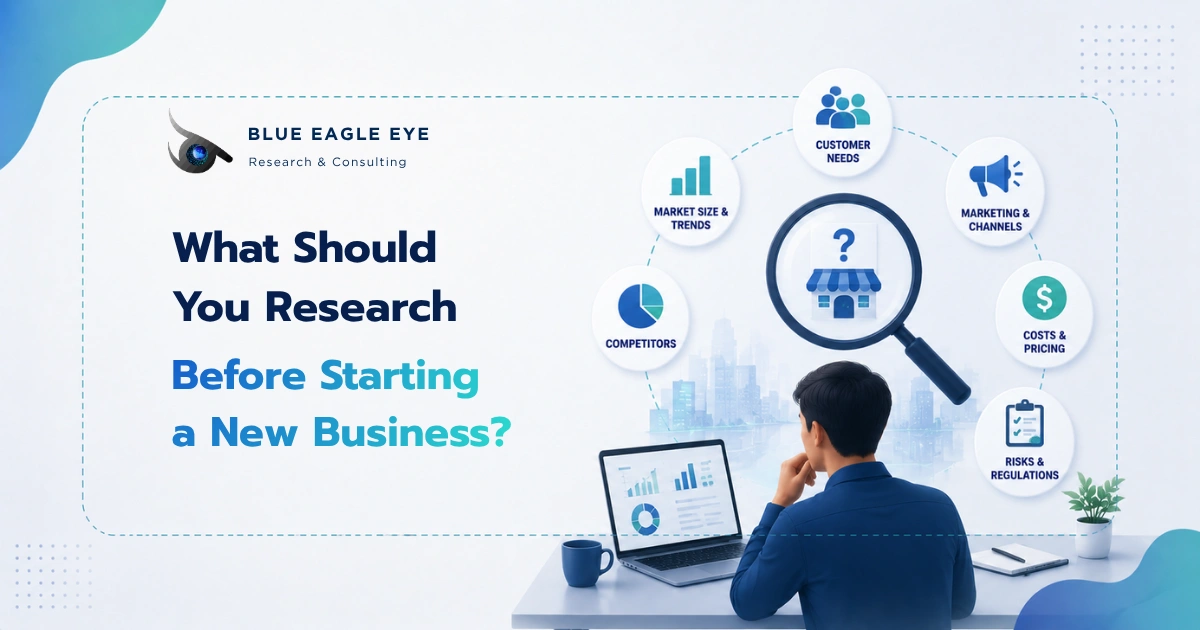
Before opening a store, launching a service, or developing a new product, entrepreneurs often start with two questions: “How big is the market?” and “How many competitors are there?” Both matter. Neither is enough.
A market can be large while your target customers have little reason to change their current behavior. Competition can be limited because an opportunity is underserved or because Demand is weak. And people saying an idea “sounds interesting” does not mean they will pay when the offer becomes real.
Market Research before launch should therefore do more than collect evidence in favor of an idea. It should identify which business assumptions remain uncertain and which ones need to be tested before committing money, time and resources.
Research the assumptions that would hurt most if they were wrong
Market Research before a business launch should not simply try to prove that an idea is “interesting.”
It should test five questions:
1.Customer - Who is genuinely likely to buy?
2.Problem / Need - Is the need important enough to drive action?
3.Demand - Is there evidence beyond stated interest?
4.Competition & Alternatives - How do customers solve the problem today?
5.Business Economics - Can an acceptable market price support the required costs and Margin?
Start with Secondary Research to understand the market, then use Primary Research and Small Experiments to test the assumptions that matter before committing significant resources.
Pre-launch research is not about knowing everything
A new business contains many unknowns. Research cannot remove all uncertainty before launch. A more practical objective is to reduce uncertainty around the assumptions that matter most to the decision.
For a healthy-meal business, for example, critical assumptions might include:
- Office workers in the target area have a meaningful need for healthier meals.
- The need occurs frequently enough to support Repeat Purchase.
- Customers will accept a price premium.
- Convenience materially affects choice.
- Reachable demand is sufficient to support the location's Fixed Costs.
Each statement is something to test, not something to treat as a Fact from the beginning.
That is the purpose of Market Validation.
1. Research the Customer: Who is actually likely to buy?
“Adults aged 25–45” is rarely enough to make a launch decision. Beyond demographics, understand:
- What is the customer trying to accomplish?
- What Problem or Need exists?
- In which situations does it occur?
- How frequently does it occur?
- How do customers solve it today?
- What drives or blocks their choice?
- Who uses, pays for and influences the purchase?
A Meal Subscription customer, for example, may not buy simply because they “care about health.” They may buy because they have no time to plan meals, want predictable calories, or find daily food decisions inconvenient. Those motivations can lead to different Products, Messages and Pricing.
Do not rely only on “Would you be interested?”
Interest and Purchase Intent can be useful measures, but they are still Stated Intent, not actual purchase behavior. Ask about recent behavior as well:
- When did this problem last happen?
- What did you do?
- How much did you spend?
- What did you dislike about the current solution?
- Have you switched brands or solutions before? Why?
Past behavior does not guarantee future behavior, but it reduces reliance on hypothetical answers alone.
2. Research the Problem: Is it important enough to trigger action?
A customer can have a problem without considering it important enough to buy a new solution. Examine at least four dimensions:
Frequency - How often does the problem occur?
Severity - How consequential is it when it happens?
Current Solution - What does the customer do today?
Switching Friction - How difficult or costly is changing?
If customers complain about something but continue using the existing solution, an important question is: What is stopping them from switching? That can be more informative than simply asking whether they want something better.
3. Research Demand: Are people interested, or likely to buy?
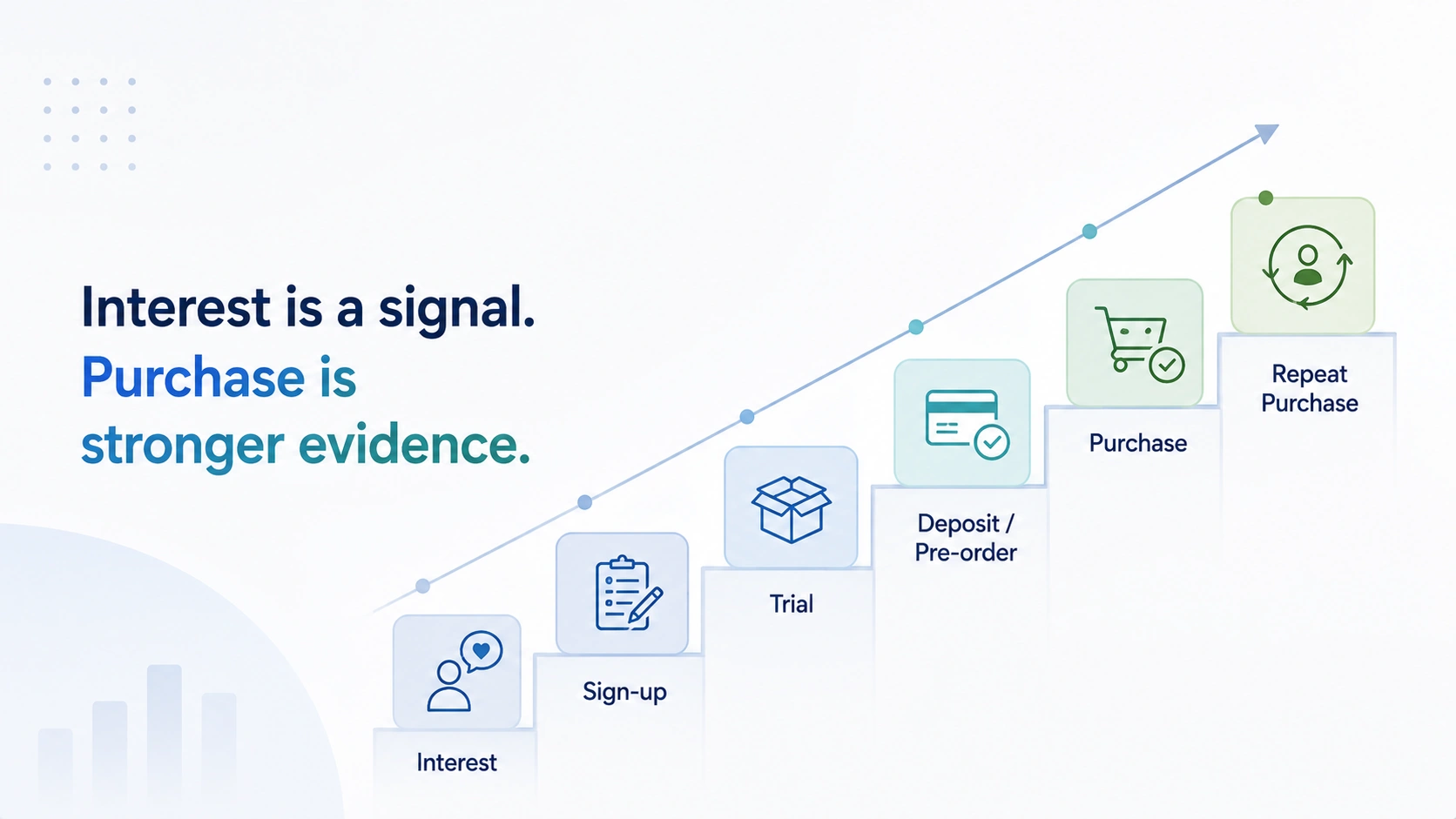
This is where Market Validation requires particular care. Likes, Search Volume, Survey Intent, Waiting Lists and positive comments can all be Demand Signals. None automatically equals actual purchasing demand.
Demand Evidence can be thought of in levels:
Lighter evidence: Search, Social Conversation, Survey Interest
Stronger commitment: Sign-up, Request for Quote, Trial, Booking
Closer to purchase behavior: Deposit, Pre-order, Paid Pilot, Actual Purchase
As customer actions involve more Cost, Commitment or Trade-off, the evidence generally moves closer to real market behavior. Context still matters. A handful of deposits, for example, does not establish national Market Size.
4. Research the Market: Is it large enough for the business you are actually building?
Market Size matters, but a large industry number can mis lead if the business can access only a small part of it.
Separate:
Total Market - the broad market
Relevant Market - the portion matching your Category and Customer
Reachable Market - customers you can realistically access given location, Channel, Price and resources
A single restaurant in Bangkok is not competing for the Revenue of Thailand's entire food industry. A more useful question is: “Is there enough demand among the customers we can realistically reach to support the sales level this business requires?”
For businesses in Thailand, Secondary Research can start with official sources such as the National Statistical Office (NSO) for business and population structures and the Department of Business Development (DBD) for registered-business data. DBD, for example, publishes monthly new-business registrations by province. Such data can indicate business activity, but new registrations are not direct evidence of Customer Demand.
5. Research Competition: Look beyond businesses that sell the same product
Competitive Research should ask more than “How many competitors are there?”
Examine:
- What does the customer currently use instead?
- What do competitors charge?
- How are competitors positioned?
- What do customers praise or complain about?
- Which channels do competitors use?
- Where might customer needs remain underserved?
- What Barriers to Entry exist?
The U.S. Small Business Administration recommends considering Market Share, Strengths and Weaknesses, Entry Barriers and Indirect Competitors when conducting Competitive Analysis.
Indirect competitors may matter more than expected
If you are opening a Café for office workers, competition is not limited to nearby cafés. It might include:
Convenience stores
Food delivery
Office pantries
Co-working spaces
Coffee brought from home
All compete for the same occasion or customer need. Define the Competitive Set from the customer's decision, not only from your company's product category.
6. Research Pricing: Does the customer see enough value at a viable price?
Pricing Research should not begin and end with: “How much would you pay?”
Survey answers can differ from behavior when real money is involved. Before launch, examine:
- Prices of current Alternatives
- Category Price Range
- Customers' reference prices
- Benefits that may justify a premium
- Differences in Price Sensitivity by Segment
- The Margin the business needs to operate
Where appropriate, test price through a real Offer, Landing Page, Quotation, Pilot or Pre-order with transparent conditions. The objective is not to find “the price customers like most.” It is to identify a range where Customer Value and Business Economics can plausibly coexist.
7. Research Business Economics: If customers buy, can the business survive?
Demand alone is not enough. A business can attract buyers and still have weak economics if Customer Acquisition, product costs or Fixed Costs are too high.
Before launch, estimate:
- Average Selling Price
- Variable Cost / COGS
- Gross Profit or Contribution Margin, as appropriate
- Expected Orders / Customers
- Purchase Frequency
- Customer Acquisition Cost, where relevant
- Fixed Costs
- Break-even Volume
Most pre-launch numbers are still assumptions rather than established facts. Build Base / Better / Worse scenarios rather than relying on a single forecast as if it were certain.
Is Secondary Research enough?
Secondary Research is a strong starting point. It can reveal Market Structure, Trends, Competitors, Price Ranges and useful background without collecting everything from scratch.
The U.S. SBA similarly places Market Research and Competitive Analysis within business planning, noting that Market Research uses consumer behavior and economic trends to help confirm and improve a business idea. But Secondary Research often cannot fully answer:
Do our customers actually experience this Problem?
Why do they choose the current solution?
What would make them switch?
Will they buy our specific Offer?
Those questions usually require Primary Research or an Experiment.
You do not always need to start with a large survey
When the business still has a weak understanding of the Problem, launching a large Survey immediately can produce precise-looking numbers around the wrong question. One practical sequence is:
Step 1: Secondary Research
Understand the Market, Category, Competition, Pricing, Trends and available data.
Step 2: Customer Interviews / Observation
Understand the Problem, Context, Current Behavior, Alternatives and Purchase Criteria.
Step 3: Quantitative Validation
Once the Hypothesis is clearer, use Surveys or Behavioral Data to assess Patterns, Segments or the scale of a Demand Signal.
Step 4: Market Experiment
Test the Offer in a realistic setting through methods such as:
- Landing Page
- Prototype
- Pop-up
- Small Batch
- Paid Pilot
- Pre-order
- Limited-area Launch

Research should end with a decision, not a pile of information
Before beginning the Research, define what evidence would change the decision. For example: Decision: Should we test a Delivery-only Kitchen?
Evidence needed:
- A Customer Segment consistently experiences the Problem.
- A repeatable Purchase Occasion exists.
- The Offer generates response from the target customer.
- Tested Pricing has plausible Contribution Margin.
- A Pilot shows enough Demand to justify the next experiment.
Then define a Decision Rule:
Go - Critical evidence meets the required threshold.
Revise - Demand exists, but the Offer, Price or Segment needs adjustment.
Stop - A critical assumption fails and there is insufficient reason to invest further.
The thresholds should not be copied from another company. They need to reflect the Economics, Risk and Investment involved in your business.
Seven questions to answer before making the full investment
- Who is genuinely likely to buy?
- Is the Problem or Need important and frequent enough?
- Is there Behavioral Evidence of Demand, or only stated interest?
- What Alternatives do customers use, and why would they switch?
- Can a viable price work for both Customer Value and Margin?
- Can the Reachable Market support the required Break-even Volume?
- What evidence would make us Go, Revise or Stop?
Not having every answer does not automatically mean you should not launch. It tells you which risks remain unknown and what should be tested next.
The takeaway: Do not research a new business just to prove the idea is good
Useful Market Validation should not simply make a founder feel more confident. It should create a genuine possibility of discovering that an assumption is wrong. Before making the full investment, investigate five areas:
Customer - Who will buy?
Problem - Why should they care?
Demand - Is there evidence they will act?
Competition - What alternatives already exist?
Economics - If they buy, can the business work?
Then do not stop at the report. Turn remaining uncertainty into: Hypothesis → Evidence → Decision Rule → Small Experiment. The purpose of pre-launch Research is not to eliminate every risk.
It is to find the important risks before paying a much higher price to learn about them after launch.

You do not need to know everything before launching a business. You do need to reduce uncertainty around five critical questions: Who is the Customer? Is the Problem important? Is there evidence of Demand beyond stated interest? What Alternatives already exist? Can the Business Economics work? Then use small experiments to collect behavioral evidence before making a larger investment.
Sources
- U.S. Small Business Administration — Plan Your Business — Market Research and Competitive Analysis principles.
- Department of Business Development — Open DBD — official Thai new-business registration data, including monthly provincial data.
- National Statistical Office — 2024 Business Trade and Services Survey — structure of Thai trade and service establishments.


.png)
.png)
.png)