
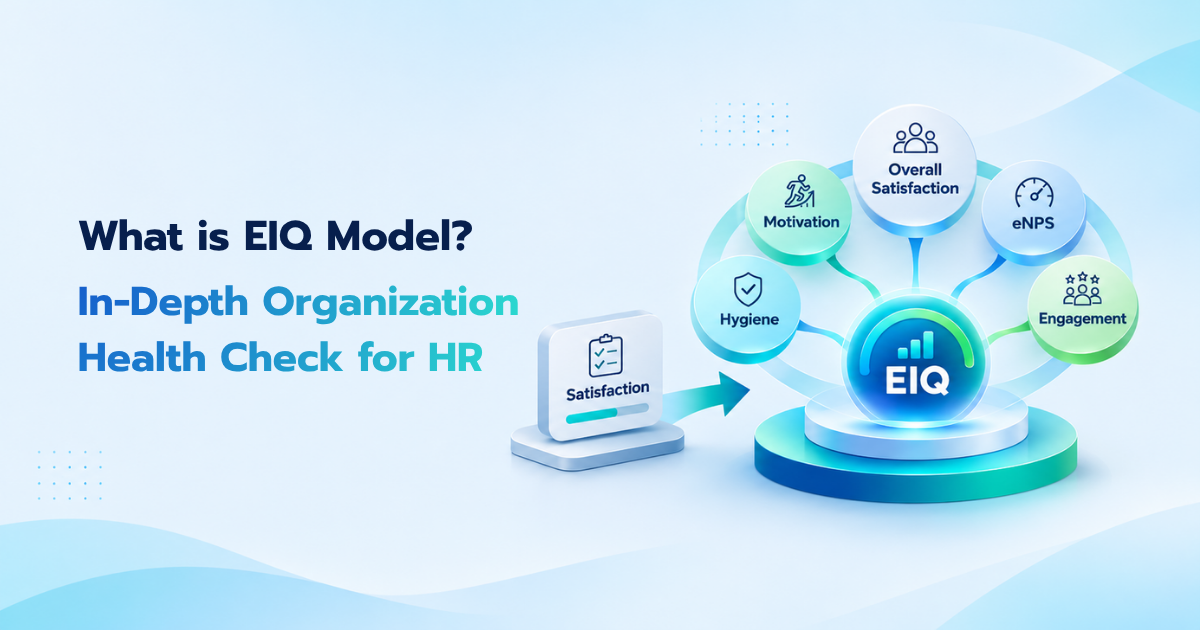



A high Employee Satisfaction score is positive, but it does not automatically mean Employee Engagement is strong or that every employee group is having the same experience. Employees can be satisfied with compensation and working conditions while lacking a sense of meaning, growth or connection to the organisation. At the same time, a positive company average can hide problems in specific departments or levels. Blue Eagle Eye’s Employee EngageIQ, or EIQ, is designed as an Organization Health Check that examines both breadth and depth rather than relying on a single KPI.
An Employee Survey that asks only “Overall, how satisfied are you with working here?” can provide useful information. But if an organisation wants to understand organisational health and decide what to improve, one question is rarely enough.
Satisfaction, Engagement and Employee Advocacy are not the same construct. An employee may be satisfied with benefits and the work environment without feeling deeply involved in the work. Another employee may feel strongly engaged with their role but still hesitate to recommend the organisation as a place to work.
Gallup defines Employee Engagement in terms of employees’ involvement and enthusiasm in their work and workplace and explicitly distinguishes its engagement measure from simple Satisfaction measures.
This is the problem Blue Eagle Eye’s Employee EngageIQ, or EIQ, is designed to address. The model approaches Organization Health across both breadth and depth, moving from workplace Hygiene and Motivation Factors through Overall Satisfaction, Engagement and eNPS. BEE’s proposal states that the model is intended to be more than a KPI and to support future actions and company direction.
A useful Employee Survey should answer more than “Are employees satisfied?”
Employee Satisfaction matters, but it is not the same as Employee Engagement and it cannot substitute for eNPS. Blue Eagle Eye’s Employee EngageIQ (EIQ) Model examines Hygiene Factors, Motivation Factors, Overall Satisfaction, Engagement and eNPS. It also uses a three-dimension analysis of Satisfaction, Engagement and eNPS and examines differences by organisational level and department. The purpose is not simply to create more scores, but to use different measures for different questions and identify where additional investigation or action may be needed.
What is Employee EngageIQ?
Employee EngageIQ is Blue Eagle Eye’s framework for examining Employee Experience and Organization Health across several dimensions rather than relying on one overall score.
The EIQ Model includes Hygiene Factors, Motivation Factors, Overall Satisfaction, Engagement and eNPS, with statistical modelling and calculations used to analyse different dimensions before results are summarised through an overall EIQ Score.
The more useful question is therefore not simply “What is our EIQ Score?”
It is “What do the dimensions behind that score tell us, how do the measures relate to each other, and which employee groups are having different experiences?”
This makes EIQ useful as a Diagnostic Framework as well as a Measurement Framework.
Why is Satisfaction alone not enough?
Imagine that an organisation has a high Employee Satisfaction score.
That number alone does not tell us whether employees:
- See opportunities for growth
- Find their work meaningful
- Receive appropriate Recognition
- Trust the quality and fairness of management
- Have sufficient Autonomy
- Feel committed to the organisation’s goals
- Would recommend the organisation as a place to work
Satisfaction is therefore part of the picture rather than the whole picture.
BEE’s EIQ Model expands the view from Overall Satisfaction to include the working environment, motivational factors, Engagement and Employee Advocacy.
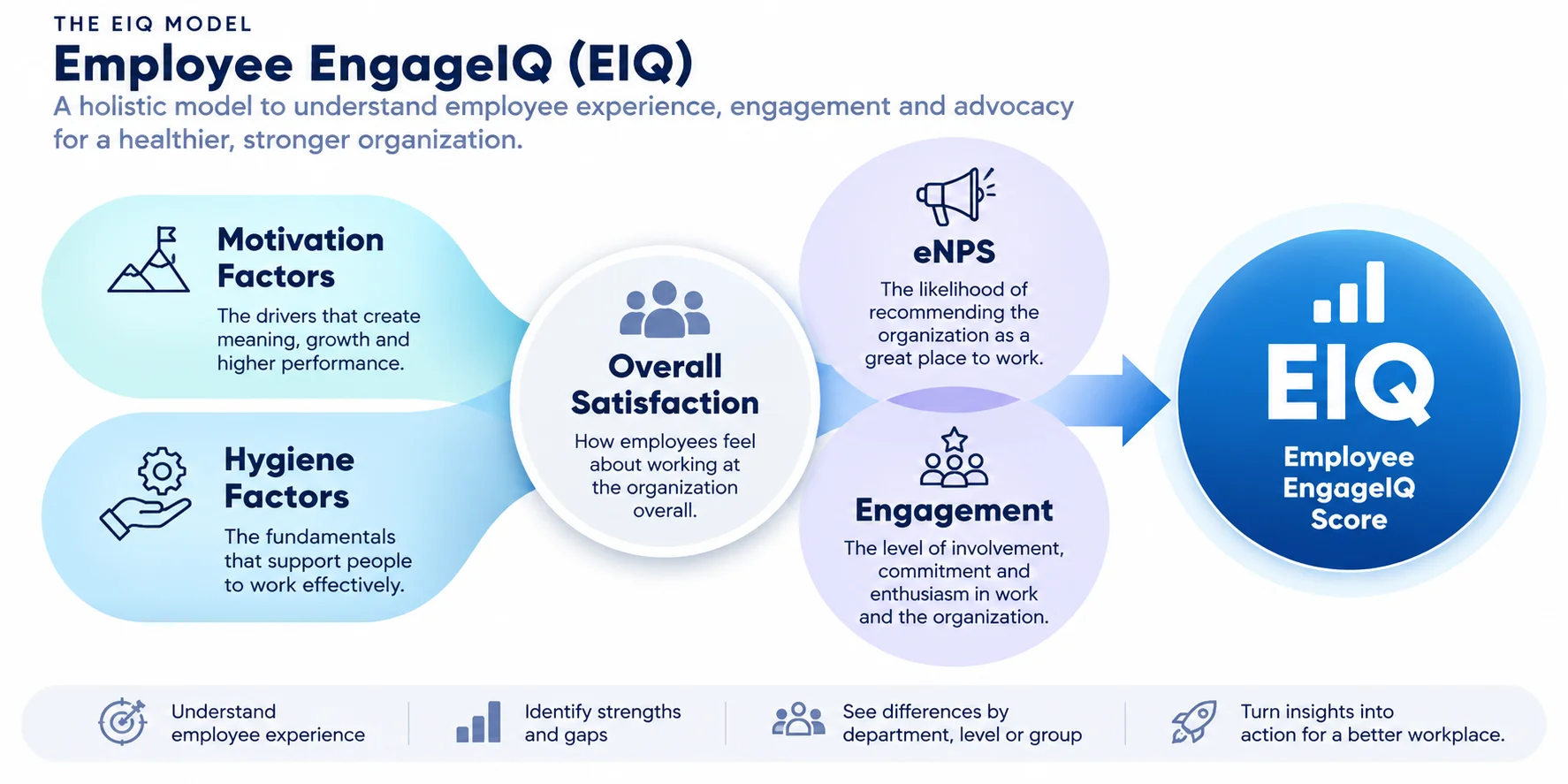
Five important components of the EIQ Model
1. Hygiene Factors: Are the foundations of the working environment creating problems?
BEE’s EIQ Model includes 11 Hygiene Factors:
- Relationship with manager
- Relationship with team members or colleagues
- Relationship with subordinates, where relevant
- Salary
- Monetary Benefits such as insurance and retirement plans
- Non-monetary Benefits such as flexible hours, Work from Home and other benefits
- Company Policies and Administration
- Supervision, including fairness and competence
- Physical Work Environment such as space, lighting, noise and equipment
- Job Security
- Facilities such as break rooms, parking, restrooms and ergonomic furniture
These dimensions describe practical conditions employees encounter in their day-to-day working environment.
The useful question is therefore not only “Are employees satisfied?” but “Which foundational elements are contributing to a positive or negative experience?”
2. Motivation Factors: What helps employees grow and feel motivated by their work?
EIQ separately examines seven Motivation Factors: Advancement, Achievement, Recognition, The Work Itself, Personal Growth, Job Autonomy and Responsibility.
Keeping these factors visible can improve decision-making because employee problems do not all have the same solution.
Improving Facilities may remove an important Pain Point but may not address an employee’s lack of career growth.
Adding Learning programmes may not solve a team’s concerns about unfair Supervision.
An Employee Survey that compresses these experiences into one average can hide these differences.
3. Overall Satisfaction: How do employees evaluate the overall experience?
Overall Satisfaction provides a summary evaluation of the employee’s work experience.
It can be useful for tracking trends, comparing relevant employee groups and analysing relationships with other measures.
But Satisfaction should not automatically be interpreted as Engagement.
Employees can be satisfied with stable employment, benefits and convenient working conditions without necessarily feeling deeply involved in their work or connected to the organisation’s purpose.
The more useful question is therefore not only “Is Satisfaction high?” but “What do Engagement and eNPS look like alongside it?”
4. Engagement: How connected are employees to their work and organisation?
The BEE EIQ Model examines Engagement through six dimensions: Meaningful Work, Learning & Development, Organizational Commitment, Well-being, Autonomy and Leadership & Management.
Meaningful Work considers whether employees feel that their role has value.
Learning & Development examines opportunities to build skills and progress.
Organizational Commitment considers attachment to the organisation and its objectives.
Well-being covers physical and mental well-being.
Autonomy considers the freedom and trust employees experience in performing their work.
Leadership & Management includes aspects such as feedback, Recognition and effective management.
Conceptually, this distinction is consistent with Gallup’s treatment of Employee Engagement as employees’ involvement and enthusiasm in their work and workplace, rather than simply their satisfaction with employment conditions.
5. eNPS: Would employees recommend the organisation as a place to work?
Employee Net Promoter Score, or eNPS, uses a recommendation question to examine Employee Advocacy.
In the EIQ structure, respondents are grouped as:
- Promoters: scores of 9–10
- Passives: scores of 7–8
- Detractors: scores of 0–6
eNPS is then calculated as the percentage of Promoters minus the percentage of Detractors, consistent with the Employee NPS approach described by Bain & Company.
eNPS is best treated as an Employee Advocacy or loyalty signal rather than a direct prediction of individual turnover. Recommending an employer and actually leaving the organisation are related questions but not the same behaviour.
This is one reason the EIQ Model examines eNPS alongside Engagement and Satisfaction rather than treating it as a stand-alone verdict.
Can Satisfaction be high while Engagement is low?
Conceptually, yes, because the measures answer different questions.
Employees might rate Compensation, Benefits, Job Security and the Work Environment positively, creating a relatively positive overall experience, while at the same time feeling that:
- Their work lacks challenge or meaning
- Career progression is unclear
- Recognition is limited
- They feel disconnected from organisational goals
- They have insufficient Autonomy
This illustrates why Organization Health should not be reduced to Satisfaction alone.
Likewise, high Engagement does not automatically guarantee high eNPS. Employees may feel strongly connected to their work while having other reasons for hesitating to recommend the organisation as an employer.
Reading the measures together can therefore be more informative than reading each KPI in isolation.
What can Quadrant Analysis reveal that an average may miss?
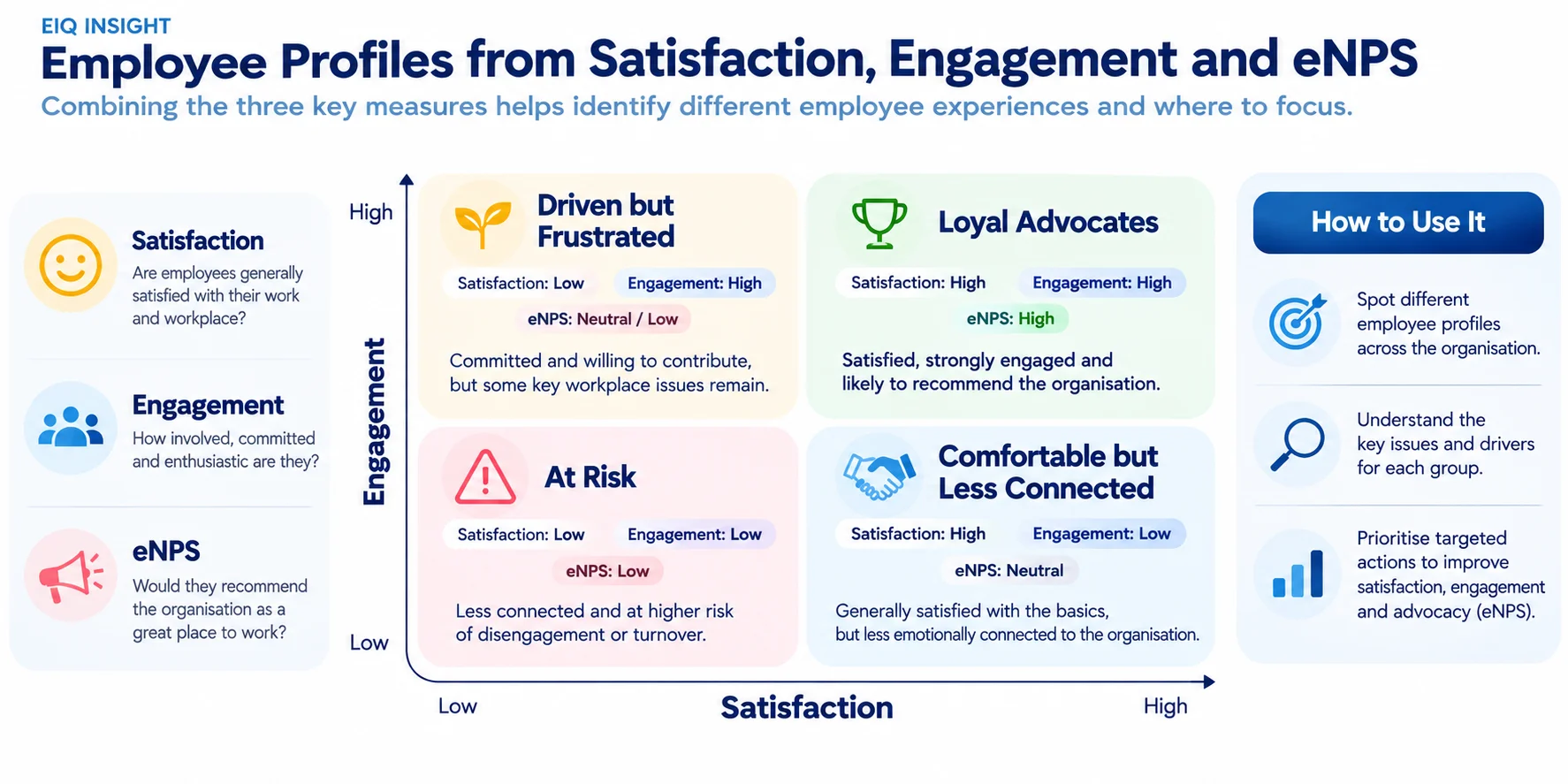
BEE’s EIQ proposal includes a three-dimension analysis of eNPS, Engagement and Satisfaction.
The value of this approach is not simply determining whether each measure is high or low. It allows the organisation to examine patterns across multiple measures at the same time.
Useful questions may include:
- Do groups with high Satisfaction also show high Engagement?
- Are highly engaged groups more likely to contain Promoters?
- Are there groups with relatively positive Satisfaction but lower eNPS?
- Which groups show positive signals across several dimensions?
- Which combinations suggest a need for further investigation?
A relationship between measures should not automatically be treated as causation. If Engagement and eNPS move together, that does not by itself prove that one causes the other.
The company average can hide problems inside specific teams
Another important part of EIQ is that the analysis does not stop at the Total Company Score.
BEE’s proposal includes analysis by organisational level, such as Director / Management, Middle Management and Staff, as well as analysis across departments or functions to identify Positive and Negative Areas within subgroups.
An organisation might report healthy overall Engagement while finding that:
- Management scores Learning & Development positively while Staff scores it lower
- Department A reports high Satisfaction but weak Recognition
- Department B has positive Engagement but lower eNPS than other teams
- Employees at a particular tenure stage perceive Advancement differently from the rest of the organisation
The overall result is not necessarily wrong. It is simply incomplete if management needs to understand where intervention is required.
What is the difference between Vertical and Horizontal Analysis?
Vertical Analysis examines differences between organisational levels such as Management, Middle Management and Staff.
It can help answer questions such as: Do leaders and frontline employees see Organization Health in the same way? Are there issues senior employees rate positively that Staff experience differently?
Horizontal Analysis looks across Departments or Functions.
This can help distinguish an organisation-wide issue from a more local issue. For example, is Leadership a company-wide concern or concentrated in one team? Is Recognition consistently weak or primarily an issue within certain functions?
The conversation therefore moves from “What is our company score?” to “Where is the issue, who experiences it, and what should we investigate next?”
How should an Employee Survey lead to action?
More data does not automatically produce better decisions.
A useful starting point is to define the Decision Question:
- Are we trying to improve Engagement or address a Hygiene Pain Point?
- Is the issue organisation-wide or concentrated in a particular Segment?
- Is the lowest score genuinely the most important issue?
- Which factors are associated with the Outcome the organisation cares about?
- Which issues can be acted on now, and which need additional Research?
The lowest-scoring item is not automatically the highest priority.
If Facilities scores poorly but Recognition, Leadership or Growth Opportunity is more strongly associated with Engagement, management should consider Performance, Importance, the number of employees affected and feasibility before selecting an Action.
What is the role of the EIQ Score?
The EIQ Model summarises results through an EIQ Score out of 1,000, while the BEE proposal also presents Engagement, Satisfaction, eNPS, Hygiene Factors and Motivation Factors alongside the overall score.
For external interpretation, however, a particular score should not automatically be described as “good” or “bad,” and benchmark figures should not be published without enough information about the underlying dataset, data period, sample composition and Norm methodology.
The more defensible way to use EIQ in educational content is to treat the EIQ Score as a Summary Indicator while using the underlying dimensions and subgroup analysis for Diagnosis.
How does an Employee EngageIQ Study work?
The BEE proposal uses Quantitative Online Self-completion research through a Web-based Platform accessible across devices, with a workflow that covers questionnaire preparation, survey links, data collection, data cleaning and analysis.
In the example project, results are designed to be reported at Total Company, Department or Position level rather than by named individual, and the proposal states that employee names and details will not be revealed without appropriate consent.
Sample Size, Interview Length and specific Deliverables should nevertheless be designed according to the scope of each project rather than treated as fixed EIQ standards based on one proposal.
Confidentiality is part of Research Quality
Employee Research is particularly sensitive because respondents may be giving feedback about managers, colleagues, policies, compensation and the organisation that employs them.
If employees do not believe their responses are protected, they may provide safer answers rather than accurate ones.
The EIQ proposal therefore emphasises reporting at aggregate levels such as Company, Department or Position rather than identifying individuals.
In practice, organisations should also consider appropriate Minimum Bases for subgroup reporting, Access Control, Data Retention and the treatment of Open-ended Comments according to the privacy risks of each project.
How is EIQ different from simply asking more Employee Survey questions?
The difference is not the number of questions.
A 100-item survey can still produce weak decision support if there is no framework connecting each measure to a business question.
The value of EIQ is in structuring Organization Health so that different pieces of evidence can be interpreted together:
- Hygiene Factors describe foundations of the working environment
- Motivation Factors examine sources of motivation and growth
- Overall Satisfaction summarises overall evaluation of the experience
- Engagement examines employees’ connection with their work and organisation
- eNPS provides an Employee Advocacy signal
- Quadrant Analysis examines multiple measures together
- Vertical / Horizontal Analysis shows where and among whom differences occur
The post-survey conversation therefore changes from “What is our score?” to “What does the evidence mean, and what should we do next?”
Ask these seven questions before running an Employee Survey
- What decision will the organisation make using the survey?
- Are we measuring Satisfaction, Engagement, Advocacy or several different constructs?
- Which workplace and Motivation Factors are needed to explain the results?
- Which Levels, Departments, Tenure groups or other Subgroups need to be analysed?
- Are subgroup Sample Bases sufficient for interpretation?
- Do employees understand the Confidentiality approach and feel safe enough to answer honestly?
- When the results arrive, how will the organisation decide what becomes a Priority and what Action follows?
If the final question is unclear, adding more survey items may not make the research more useful.
The takeaway: Organization Health should not be reduced to one KPI
Employee Satisfaction is useful evidence, but it is not the same as Employee Engagement, and eNPS should not be used as a substitute for either.
Blue Eagle Eye’s Employee EngageIQ therefore looks across Hygiene Factors, Motivation Factors, Overall Satisfaction, Engagement and eNPS, while also examining relationships and differences across employee groups.
The real value is not creating another score.
It is helping the organisation distinguish foundational workplace issues from Motivation, understand Engagement separately from Satisfaction, examine Employee Advocacy, and identify which employee groups may be experiencing different problems.
A useful Employee Survey should therefore not end with “Is the score good or bad?”
The next questions are: “What does this evidence mean, what do we still not know, and what should the organisation investigate or do next?”

Satisfaction, Engagement and eNPS answer different questions and should not be treated as interchangeable measures. BEE’s Employee EngageIQ combines Hygiene Factors, Motivation Factors, Overall Satisfaction, Engagement and eNPS, then analyses both the overall organisation and relevant employee subgroups to show what employees experience, where differences exist and which issues deserve further investigation.
Sources
- Blue Eagle Eye Company Limited. Proposal for Employee EngageIQ Study, 24 July 2025. Source for the Employee EngageIQ Model, Hygiene Factors, Motivation Factors, Engagement dimensions, eNPS structure, Quadrant Analysis, Vertical / Horizontal Analysis, methodology and confidentiality principles.
- Gallup. Employee Engagement and State of the Global Workplace 2026. Gallup defines Employee Engagement in terms of employees’ involvement and enthusiasm in their work and workplace and distinguishes Engagement from simple employee satisfaction.
- Bain & Company. Employee Net Promoter Score Explained. Source for the Promoter, Passive and Detractor categories and calculation of Employee NPS as the percentage of Promoters minus the percentage of Detractors.