.png)

.png)
.png)
You describe a new product idea and people respond, “That sounds interesting,” “I would probably buy it,” or a Survey shows that 70% of respondents are interested. That is useful information.
What you still do not know is whether those same people will buy when the product has a real price, competing alternatives and an actual payment decision.
The gap between “I like it” and “I bought it” is one of the key risks in a new business. Demand Validation should therefore move progressively from asking for opinions toward observing behavior that requires real commitment.
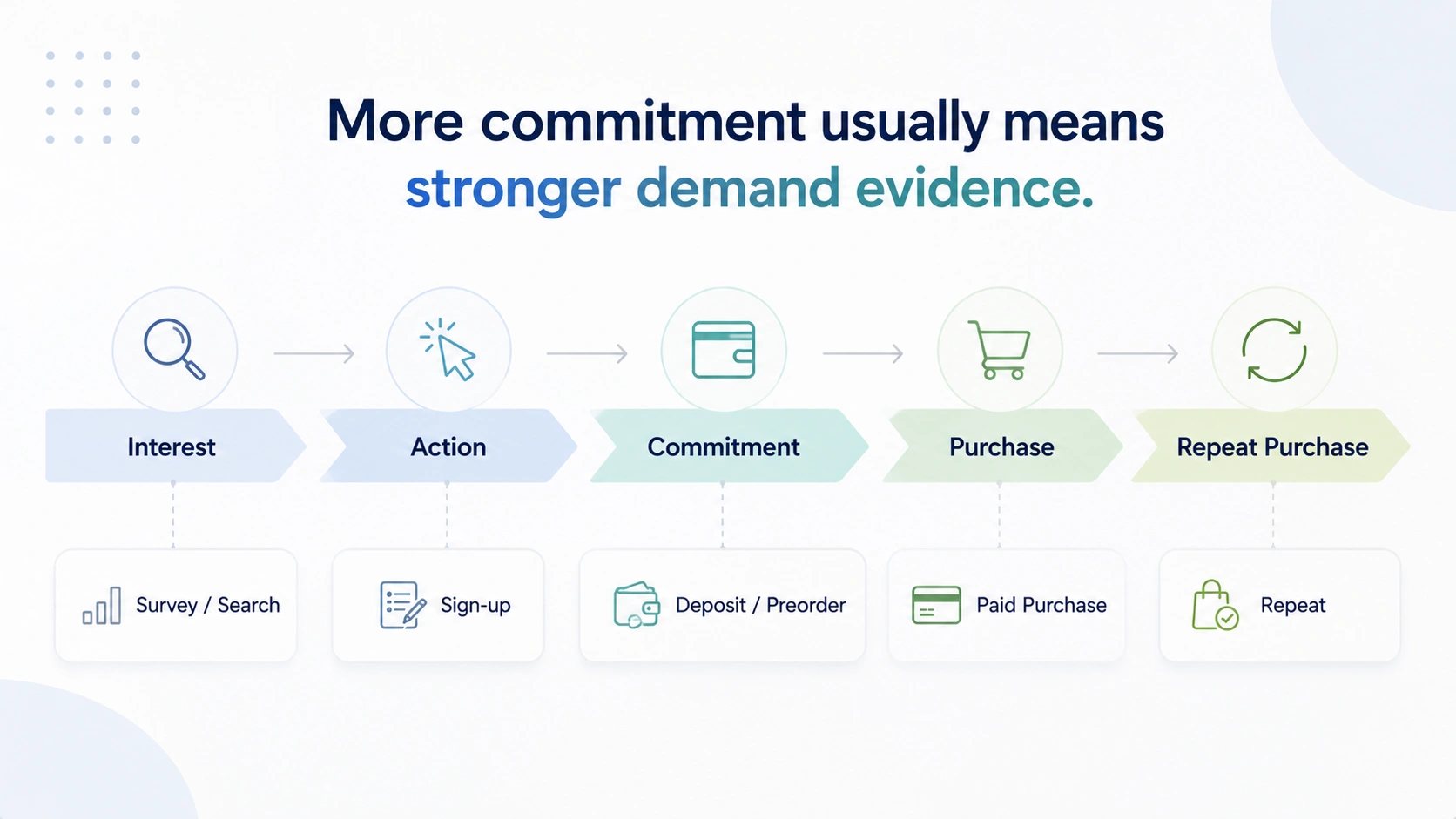
The more customers commit, the stronger the evidence of demand
A Survey response saying “I would buy this” can be useful, but it is still Stated Intent, not an Actual Purchase.
Think of Demand Evidence in stages:
1.Interest - Search, Social Engagement, Survey Interest
2.Consideration - Click, Landing Page Visit, Sign-up, Request for Information
3.Commitment - Booking, Trial, Deposit, Preorder
4.Behavior - Actual Purchase
5.Repeat Behavior - Repeat Purchase or continued usage
No single signal proves demand across an entire market. But multiple forms of consistent evidence can substantially reduce uncertainty before a larger investment.
Interest is not the same as Demand
Start by separating three concepts.
Interest means that a customer pays attention, for example by clicking, reading, asking questions or saying the idea sounds appealing.
Purchase Intent is a stated likelihood or intention to buy.
Actual Demand, for business decision purposes, needs to move closer to observable behavior: customers spending time, signing up, trying, booking, putting down money or purchasing under realistic conditions.
Purchase Intent is useful research evidence, but it should not be treated as Actual Purchase without qualification.
Shopify's current Market Demand guidance notes that keyword and Search data can indicate what people are looking for, but Search alone does not tell you how many of those people are actually interested in buying.
Treat Demand as levels of evidence, not a simple Yes or No
Instead of asking, “Do we have Demand?”, ask: “How strong is the evidence we have today?”
Level 1: Customers show interest
Examples include:
- Search Volume
- Google Trends
- Social Comments
- Video Views
- Survey Interest
These signals can reveal whether a Topic or Problem attracts attention. They do not yet tell you whether customers will choose your Offer or accept the required price.
Level 2: Customers take an action
Examples include:
- Clicking an ad
- Visiting a Landing Page
- Joining a Waitlist
- Providing an email address
- Requesting information
- Requesting a quotation
This is stronger than a hypothetical Survey response because the customer must take an action. However, a Sign-up still does not equal a Purchase. Shopify recommends Landing Pages, Waitlists and “notify me” sign-ups as measurable Demand Signals before committing to a large inventory order.
Level 3: Customers accept a cost or commitment
Examples include:
- Booking a Demo
- Starting a Trial
- Reserving a slot
- Paying a Deposit
- Placing a Preorder
- Joining a Paid Pilot
As the customer gives up more time, money or flexibility, the evidence moves closer to actual demand. Shopify also identifies Preorders as a way to validate demand before committing to full production.
Level 4: Customers actually purchase
An Actual Purchase is stronger evidence because the customer exchanges money for the Offer under real conditions. Even one purchase, however, does not prove the entire business case. You still need to ask:
- Is the Margin viable?
- Do customers return?
- Was demand created only by a heavy Discount?
- Will the economics still work at higher Volume?
Level 5: Customers return or continue using the product
For businesses dependent on Repeat Purchase or Retention, the first transaction is only part of the evidence. Repeat behavior suggests that the Offer may create value beyond curiosity or Trial. The interpretation still depends on the category because some products naturally have long purchase cycles.
Why is “70% are interested” not enough?
Suppose a Concept Survey reports:
70% are interested
60% say they are likely to buy
That tells you the Concept was not immediately rejected. It does not yet tell you:
- At what price will they buy?
- What will they buy instead if they do not choose you?
- When will they purchase?
- Do they have a real budget?
- Will they still choose you when competitors are visible?
- What proportion of stated Interest will become actual transactions?
Hypothetical questions remove many of the real-world frictions of a buying decision, including money, urgency, convenience and alternatives.
Surveys are useful for measuring Patterns, Preferences, Barriers and Purchase Intent. Higher-risk Demand Validation should usually add some form of Behavioral Evidence.
Are Customer Interviews still useful?
Very much so, but they answer a different type of question. Interviews are useful for understanding:
How the Problem occurs
- What customers do today
- Where Friction exists
- Which Alternatives they use
- The Purchase Context
- How customers describe the Problem in their own language
What interviews cannot reliably establish on their own is the size of market demand. Interviews help answer Why and Context. Experiments and transaction data move closer to answering Will they act? The two approaches complement each other.
How can an SME test Demand without a large budget?
You do not need full-scale production to begin.
1. Landing Page Test
Build a realistic Offer page containing:
- Problem / Benefit
- Product or Service
- Price or Price Range, where appropriate
- A clear Call to Action
Then send relevant target customers to the page. Possible measures include:
- Click-through Rate
- Landing Page Conversion
- Sign-up
- Request for Information
- Add to Cart
A Click or Sign-up is still not a Purchase, but it can help compare Messages, Segments and Offer
2. Waitlist
A Waitlist can be useful when the product is not ready to sell but you want to see whether customers are willing to leave their contact details and wait. To interpret the result, know: How many people saw the Offer → how many joined → where they came from “500 people on the Waitlist” has limited meaning if you do not know the size and source of the audience exposed to the Offer.
3. Preorder or Deposit
When operationally and legally appropriate, a transparent Preorder with clear delivery and refund conditions moves closer to real demand because money or a Deposit is involved. However, Preorders from a small Early Adopter group still do not prove Mass Market Demand.
4. Paid Pilot / Small Batch
Service businesses can test a Paid Pilot. Product businesses can sell a Small Batch to a limited geography or customer segment. This produces evidence beyond Sales alone:
- Conversion
- Price acceptance
- Objections
- Usage
- Repeat Purchase
- Returns / Complaints
- Cost-to-serve
Demand Validation then begins to connect with Business Economics.
How useful are Search Volume and Social Media for validating Demand?
Search Volume can indicate how often people search for a topic or category. Google Trends can show Relative Search Interest over time and geography. But:
Search Interest ≠ Sales
Social Engagement ≠ Market Demand
Viral Content ≠ Purchase Intent
People may search because they want information rather than a product. Social audiences may not match your Target Market. Trends can also spike and disappear quickly. Use these sources as Discovery Signals and Supporting Evidence, not as standalone proof of Demand.
Do not look only at the number of responses, look at the rate
Suppose Business A collects 500 Waitlist sign-ups. That sounds strong. But if 500,000 people saw the Offer: Sign-up Rate = 0.1%
Business B gets only 200 sign-ups, but only 2,000 relevant people saw the Offer: Sign-up Rate = 10%
Absolute counts alone can therefore mislead. Build a Funnel: Exposure → Click → Sign-up → Trial → Purchase → Repeat. Then examine Conversion between stages. Conversion Rates should not be compared mechanically across businesses without considering Category, Traffic Source, Price and Offer.
Real Demand must also exist at a price the business can sustain
Another common mistake is: “If many people want it, there is Demand.” That is incomplete. If customers want the product at THB 199 but the business needs THB 499 to make the economics work, you may not have sufficient Demand for the commercially viable Offer. Demand Validation should therefore test:
- Price
- Value Proposition
- Package / Size
- Payment Conditions
- Alternatives
- Margin
The business question is not simply: “Do people want this product?” It is: “Are enough customers willing to choose this Offer under a price and set of conditions that can support the business?”
Example: 80% say they are interested, but Demand may still be uncertain
Suppose a business tests a new service:
Survey: 80% interested
Landing Page: 12% Sign-up
Trial: 4% start
Paid Conversion: 1.5% purchase
Repeat Purchase after 60 days: not yet known
What can we say?
FACT: Survey Interest is high, and a smaller proportion progressed to Paid Purchase. What should we not yet say? “The market has very strong demand.” We still need to know:
Where did the Survey sample come from?
Was the Traffic representative of the Target Customer?
Is 1.5% Paid Conversion economically viable?
What is Customer Acquisition Cost?
Do customers return?
How large is the Reachable Market?
Demand Validation should not stop at one metric.
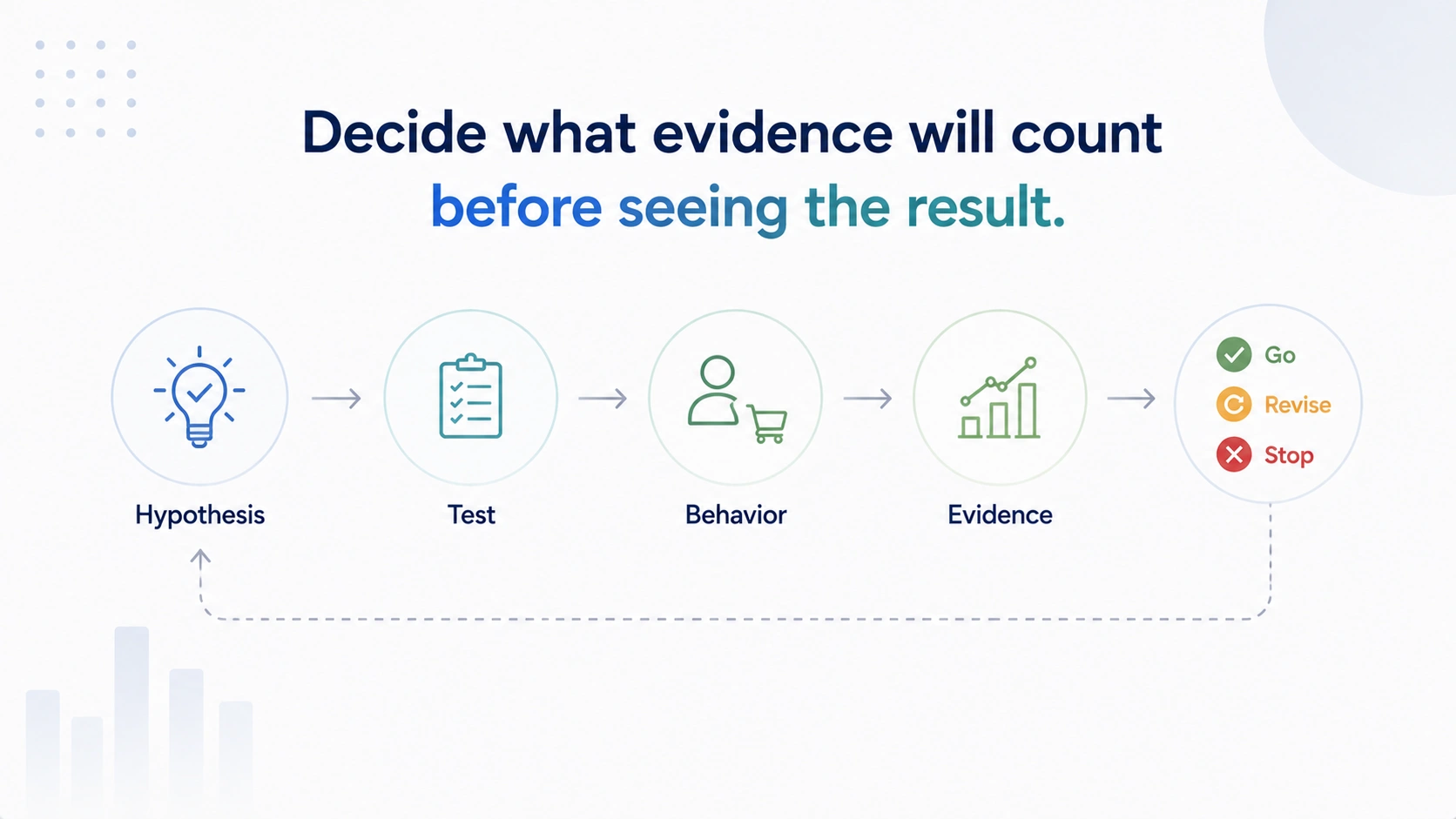
Define the success criteria before seeing the test result
Before running the test, write down:
Hypothesis - We believe Customer Segment X has Problem Y and will choose Offer Z at Price P.
Test - We will show the target group a Landing Page and open a Preorder.
Metric - Preorder Conversion, CAC and Gross Margin.
Decision Rule - If the required thresholds are met → Go
If Interest is strong but Paid Conversion is weak → Revise Offer / Price
If response is consistently weak → Revisit Problem / Segment before investing further
Setting the Decision Rule before seeing the results reduces the temptation to reinterpret every outcome as evidence that confirms the original idea. Strategyzer's Test Card follows the same logic: state what you believe, define how you will test it, specify what you will measure, and determine in advance what result will count as sufficient evidence.
Seven questions to ask before saying “there is Demand”
Before increasing investment, answer:
1. Which Target Customer is showing the Demand?
2. Is the evidence Interest, Intent or Actual Behavior?
3. How much Commitment did the test require from the customer?
4. Was a realistic Price included?
5. Is the Conversion sufficient for the Business Economics?
6. Is the Demand limited to Promotions or Early Adopters?
7. What evidence is still missing before the next investment decision?
The clearer these answers become, the more meaningful the word “Demand” becomes.
The takeaway: Do not ask only whether customers like the idea, watch what they are willing to do
Positive feedback, Likes, Search Volume and Purchase Intent can all be useful. They should not be treated as direct substitutes for Actual Demand. Strong Demand Validation progressively increases the level of customer commitment: Interest → Action → Time → Money → Purchase → Repeat You do not need to build at full scale to learn.
Start with an experiment that is inexpensive enough to limit downside, but realistic enough that customers must make a genuine choice. The most useful question is therefore not: “Do customers say they want it?” It is: “When there is a real price, real alternatives and a real decision, what do customers actually do?”
That is where Demand begins to move from opinion toward evidence that can support a business decision.

“That sounds interesting” is a Demand Signal, not proof of purchase. Demand Validation should look for progressively stronger evidence of customer commitment from Search and Survey Interest to Sign-ups, Trials, Deposits, Preorders and Actual Purchases. Use the test that gets as close to real buying behavior as the cost and risk of the decision justify.
Sources
- Shopify. Market Demand: How to Identify and Calculate It for Your Product (2026) — Search, surveys and Demand Signals.
- Shopify. Find Your Product-Market Fit and Choose What Sells (2026) — Waitlists, Preorders and low-risk Demand tests.
- Shopify. What Makes a Good Business Idea (2026) — Preorders and customer commitment.
- Shopify. Market Validation: How To Validate Your Idea in 8 Steps (2026) — Market Validation and customer research.
- Strategyzer. Validate Your Ideas with the Test Card — hypothesis-led customer experiments.


.png)
.png)
.png)