.png)

.png)
.png)
Many new-product tests begin with a simple question: “Do you like this idea?”
When most respondents say it sounds interesting, the team becomes more confident.
The problem is that Liking is not the same as Purchase.
Customers can like an idea while feeling little Need for it, seeing no meaningful difference from existing alternatives or deciding that the Price is not worth the Benefit.
A useful Concept Test therefore goes beyond whether an idea looks attractive. It should help the business understand whether the Target Customer sees a real Need, understands the Benefit, perceives enough Value, identifies important Barriers and gives the Concept enough evidence to justify further investment.
Qualtrics describes Concept Testing as an early-stage research method for evaluating a Product or Service Concept with its Target Audience before launch, helping teams understand what works, what needs improvement and which ideas deserve further development.
Article Content
A good Concept Test does not need to be large, it needs to support a decision
Concept Testing evaluates a Product Concept with potential customers before the business invests in full development or production.
A Concept should make it reasonably clear what the Product is, who it is for, which problem it addresses, what benefit it offers and, where relevant, its likely Price.
For SMEs with limited budgets, a practical approach is:
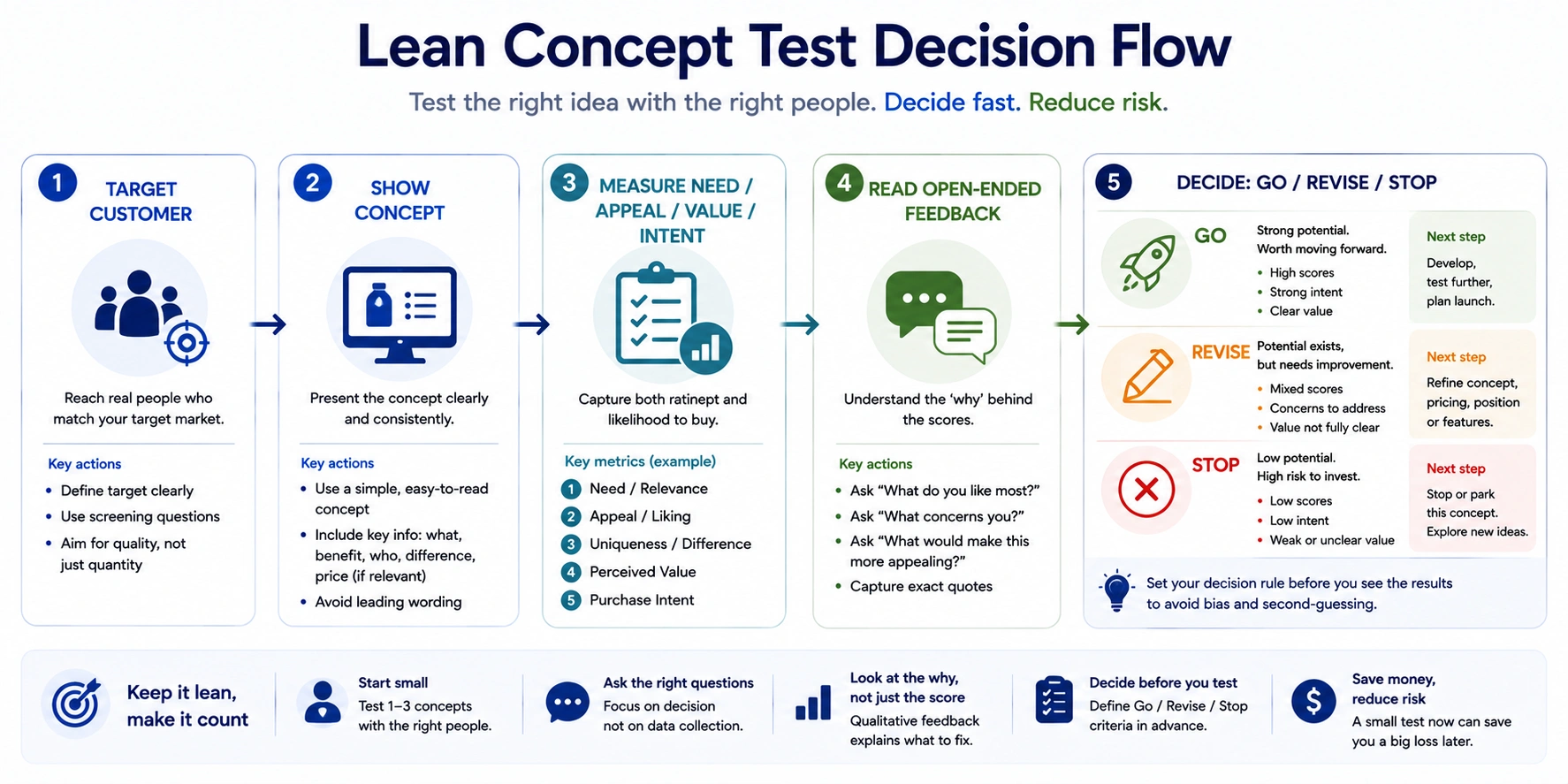
1. Start with the Business Decision.
2. Narrow the test to one to three meaningful Concepts.
3. Present each Concept clearly and fairly.
4. Recruit customers who match the Target Market.
5. Measure both ratings and the reasons behind them.
6. Define Go / Revise / Stop criteria before seeing the results.
Concept Testing cannot guarantee future Sales, but it can reduce the risk of investing in an idea customers do not understand, need or value enough.
What is Concept Testing, and how is it different from asking whether people like an idea?
Concept Testing exposes potential customers to a Product, Service or Offer before the business commits to full development.
A useful Concept should explain at least:
- What the Product is
- Who it is for
- Which Problem or Need it addresses
- Its main Benefit
- How it differs from Alternatives
- Where relevant, an indicative Price
Qualtrics describes Product Concept development as clarifying what the idea is, what it will look like, who it is for and why people may buy it before moving into further validation.
The purpose is not to get customers to approve the idea.
It is to collect evidence for a decision.
First, start with the Decision, not the Questionnaire
Before writing Survey Questions, write down the decision the research needs to support.
For example:
- Choose Concept A or B
- Remove or retain a Feature
- Revise the Positioning
- Explore whether Price weakens perceived Value
- Decide whether to Go / Revise / Stop
When the Business Decision is unclear, the Questionnaire often becomes a long list of interesting questions that produces information but little direction.
For an SME with a limited budget, removing questions that do not support a decision is often more valuable than maximizing Sample Size.
For a low-budget Concept Test, narrow the field to one to three Concepts
If you have 10–20 ideas, do not necessarily run a full Concept Test on all of them.
Early-stage Internal Screening, Customer Interviews or Quick Idea Screening can narrow the list first.
Then take the strongest one to three Candidates into deeper testing.
SurveyMonkey distinguishes Idea Screening from Product Concept Testing. Idea Screening is useful when there are many early-stage options and directional learning is acceptable, while Product Concept Testing is designed for more developed Concepts requiring deeper feedback.
For SMEs, reducing the number of Concepts before Fieldwork can lower recruitment, incentive and analysis costs substantially.
[H2] Make the Concept understandable before testing it
Poorly explained Concepts can make good ideas appear weak.
Before launching the Test, show the Concept to someone outside the development team and ask: “What do you think this Product is?”
If the answer differs substantially from what the team intended, the Stimulus probably needs revision.
A Stimulus can be:
- Short text
- Product Mockup
- Packaging image
- Simple Landing Page
- Storyboard
- Early Prototype
- Short Video
SurveyMonkey supports Concept Testing with different Stimulus formats including Text, Image and Video depending on the research task.
A limited budget does not require a polished Prototype when the main question is still whether the Value Proposition makes sense.
If you compare Concepts, keep the presentation comparable
Imagine:
Concept A has polished Visuals, detailed Benefits and a Price.
Concept B has two lines of plain text.
If A wins, you cannot tell whether customers preferred: The Idea or The Presentation
Concepts used for comparison should therefore have similar:
- Length
- Level of detail
- Visual quality
- Information structure
- Price conditions
The purpose is to ensure that differences in ratings reflect the Concept as much as possible rather than unequal Presentation Quality.
What should a low-budget Concept Test measure? Start with six dimensions
A Concept Test does not need 40 questions.
For an early-stage decision, six dimensions can provide a practical starting point.
1. Need
Does the Target Customer have the Problem or Need the Concept is designed to address?
If the Need is weak, attractive execution may not produce strong Purchase Interest.
2. Relevance
How relevant is the Concept to the customer’s own situation?
A Need can exist in the market without being relevant to every Segment.
3. Appeal
How attractive is the overall idea?
Appeal is useful, but it should not become the only decision metric.
4. Uniqueness
Does the customer perceive a meaningful difference from existing Alternatives?
A Concept can be good yet provide too little reason to Switch.
5. Value
Does the Benefit feel worth the Price, Effort or other trade-off?
Value is not simply whether something is cheap or expensive. It is the relationship between what customers receive and what they give up.
6. Purchase Intent
After seeing the Concept, how likely is the customer to consider buying it?
SurveyMonkey includes measures such as Appeal, Uniqueness and Purchase Intent in its Concept Testing framework.
Purchase Intent remains Stated Intent rather than Actual Purchase, so it is more useful for Screening and Comparison than as a direct Sales forecast.

Scores tell you what happened; Open-ended Feedback helps explain why
Suppose Purchase Intent is 3.1 out of 5.
The score suggests the Concept is not especially strong.
It does not tell you why.
After important rating questions, add a few short Open-ended Questions such as:
- What is most appealing about this Concept?
- What is unclear or makes you hesitate?
- If you could change one thing, what would it be?
- What do you currently use to solve this Problem?
- What might make you choose your current Alternative instead?
These responses help distinguish whether a weak score comes from:
Low Need
Unclear communication
Insufficient Value
Price resistance
or a strong existing Alternative
This is why low-budget Concept Testing benefits from combining Quantitative Ratings with Qualitative Explanation.
Who answers matters more than simply maximizing the number of respondents
If a Product is designed for restaurant owners, 500 responses from the general public may be less useful than 50–100 relevant owners or managers.
The Sample should match the actual Target Market.
Use Screeners such as:
- Category usage
- Purchase frequency
- Decision-making role
- Target geography
- Whether the respondent experiences the Problem being addressed
Using an Existing Customer List can reduce cost, but it introduces a limitation: Existing Customers may already know and favor the Brand more than the broader market.
Do not automatically treat them as representative of New Customers.
Does every SME need 200 respondents per Concept?
No.
Commercial Concept Testing systems often use larger Samples to enable structured comparison. SurveyMonkey, for example, lists 200 respondents per Concept as the default in its Concept Testing Module.
That is not a universal rule for every SME.
Required Sample Size depends on:
- Decision Risk
- Number of Concepts
- Difference you need to detect
- Target Population
- Number of Segments
- Whether you need Statistical Precision or Directional Learning
At an early stage, a smaller directional test followed by a stronger second round may provide better value than spending the entire budget on one large study.
The important point is to describe the evidence accurately.
A small exploratory Sample provides: “Directional Evidence” not: “Proof that most of the market wants this Product.”
With a very limited budget, start with Qualitative Concept Testing
Before launching a Survey, interview a small number of Target Customers.
The goal is not to estimate:
“What percentage likes the Concept?”
It is to understand:
- How customers interpret the idea
- Whether the Need is real
- Which wording creates confusion
- Which Benefits matter
- Which Barriers exist
- Which Alternatives customers currently use
A practical sequence might be:
Round 1: 8–12 Customer Interviews to improve the Concept
Round 2: Quick Survey to compare Candidate Concepts
Round 3: Prototype, Landing Page or Pre-order Test for the strongest Concept
The interview number should not become a fixed rule. The principle is simply not to pay for a large Survey to discover problems that a small number of customer conversations could reveal first.
Monadic or Sequential Monadic: Which design fits a limited budget?
In a Monadic Test, each respondent evaluates one Concept.
The advantage is cleaner evaluation with less direct Comparison Bias.
The disadvantage is that testing several Concepts usually requires more respondents.
SurveyMonkey uses Monadic Design in its Product Concept Testing approach to reduce comparison effects between Concepts.
In a Sequential Monadic Test, one respondent evaluates several Concepts in sequence.
This uses the Sample more efficiently but introduces greater risk of:
Order Effects
Comparison Effects
Survey Fatigue
For SMEs:
If the decision is important and the budget allows it → Monadic is generally stronger.
If the test is early-stage and highly budget-constrained → Sequential Monadic can be useful, but randomize the order and interpret results more directionally.
Include Price when Price is central to the Value Proposition
A Concept such as: “A convenient high-protein drink that keeps you full for longer” may receive strong Appeal.
The reaction may change considerably when customers learn that it costs 180 baht per bottle.
If Price is central to the Purchase Decision, include it in at least one testing round.
However, asking: “How much would you pay?”
does not automatically produce Actual Willingness to Pay.
Concept Testing can identify early Price reactions, while important Pricing Decisions may require more specific Price Research or Behavioral Testing.
Do not select a winner using one average score
Suppose: Concept A
Appeal = 4.4
Uniqueness = 2.8
Purchase Intent = 3.2
Concept B
Appeal = 4.0
Uniqueness = 4.1
Purchase Intent = 3.9
If you look only at Appeal, A wins.
But if the objective is to develop something differentiated that customers might actually consider buying, B may deserve more attention.
Before the Test, define:
Primary Metric = Purchase Intent
Supporting Metrics = Need, Uniqueness, Value
Diagnostic Metrics = Likes, Dislikes, Open-ended Feedback
This reduces the temptation to choose the metric that supports the team’s preferred Concept after results appear.
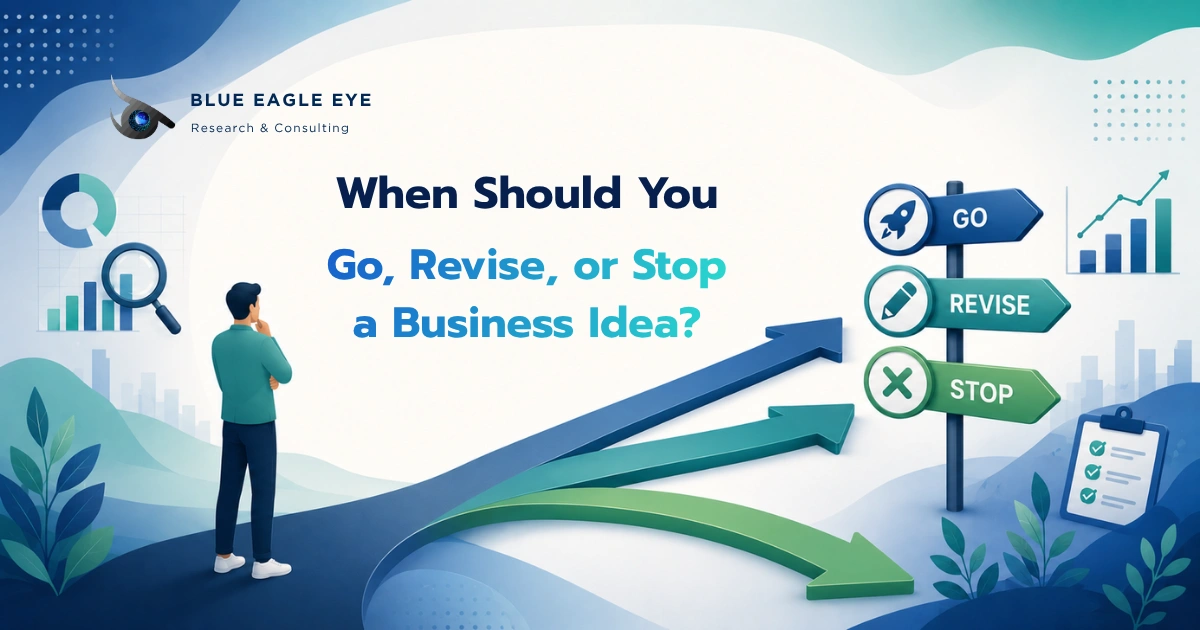
Define the Decision Rule before seeing the data
This is one of the simplest ways to bring discipline to a small Concept Test.
For example:
GO
Purchase Intent reaches the agreed level and no Critical Barrier appears.
REVISE Need and Appeal are promising, but Value, Price or Messaging contains issues that appear fixable.
STOP Need is weak or Target Customers see little reason to move from existing Alternatives.
Thresholds should not be copied blindly from another study. They depend on the Scale, Category, Benchmark and Research Design.
The value is in setting the logic before seeing which Concept wins.
Example: A low-budget Concept Test for an SME
Imagine a restaurant business considering a Ready-to-eat Product for office workers.
Business Decision: Should Concept A move into Product Development?
Concept: A high-protein Ready-to-eat meal, heated in three minutes, priced at 89 baht, designed for office workers who want a convenient and filling lunch.
Target: Office workers aged 25–45 who purchase Ready-to-eat lunch at least twice a month.
Questions:
- How easy is the Concept to understand?
- How relevant is it to your needs?
- How appealing is it overall?
- How different does it feel from existing options?
- Does 89 baht feel like good Value?
- How likely would you be to consider buying it?
- What is most appealing?
- What creates the most hesitation?
- What do you currently use instead?
If the Concept performs well, the business still does not need to move immediately into large-scale production.
The next step could be a small Prototype Batch, Landing Page Test or Pre-order Test to obtain a stronger Behavioral Signal.
What can a Concept Test tell you, and what can it not tell you?
A Concept Test can help indicate:
- Whether customers understand the idea
- Whether Need and Relevance appear strong
- Which Benefits resonate
- Which Barriers matter
- Which Concept appears more promising
- Concept Test alone does not prove:
- Customers will purchase at the stated rate
- Market Size is large enough
- Repeat Purchase will occur
- Unit Economics will work
- Distribution will succeed
- Competitors will not respond
Concept Testing is one step in Product Validation.
It is not complete proof of Product-Market Fit.
Checklist before running a low-budget Concept Test
- Do we know what decision the test must support?
- Does the Sample represent people who could realistically buy?
- Does the Concept clearly explain Product, Target, Need and Benefit?
- If several Concepts are tested, are they presented fairly?
- Does the Survey measure more than Liking?
- Are Open-ended Questions included to explain the scores?
- Is Price introduced where appropriate?
- Is the Sample sufficient for the level of confidence required?
- Did we define the Primary Metric and Decision Rule before seeing results?
- If the Concept passes, what Behavioral Test comes next?
If these ten questions are answered clearly, a small Concept Test can support a better decision than a much larger study with no decision framework.
The takeaway: A limited budget is not a reason to skip Concept Testing, it is a reason to test only what matters
For an SME, the efficient approach is: Start with the Decision.
Recruit the right Target Customers.
Reduce the number of Concepts.
Measure Need, Relevance, Appeal, Uniqueness, Value and Purchase Intent.
Ask why through Open-ended Feedback. End with Go / Revise / Stop.
Concept Testing cannot guarantee Product success.
It can answer a more useful pre-launch question: “Based on the evidence we have now, is this Concept strong enough to justify the next investment?”
If the answer is not yet clear, the right action may not be to produce more.
It may be to improve the Concept and run another small test.

A useful low-budget Concept Test does not have to begin with a large Sample or expensive research platform. Start with a clear Business Decision, test a small number of comparable Concepts with the relevant Target Customer, measure Need, Relevance, Appeal, Uniqueness, Value and Purchase Intent, and capture the reasons behind the scores. Define a Go / Revise / Stop Decision Rule before seeing the results to reduce the risk of selecting only evidence that supports the team’s preferred idea.
Sources
- Qualtrics. Concept Testing Program. Concept Testing as a method for validating Product Ideas and evaluating Features, Branding and Messaging before further investment.
- Qualtrics. Concept Testing: The Ultimate Guide. Concept Testing as early-stage Market Research with a Target Audience before launch.
- Qualtrics. Product Development Guide. Product Concept framing around the Idea, Target Customer and reasons customers may buy.
- SurveyMonkey. Product Concept Testing. Monadic Testing and the distinction between Product Concept Testing and Idea Screening.
- SurveyMonkey. Concept Testing Survey Templates. Measures including Appeal, Uniqueness and Purchase Intent, plus commercial Sample defaults.
- SurveyMonkey. Product and Creative Development Solutions. Stimulus formats including Text, Image and Video.

.png)
.png)
.png)