.png)

.png)
.png)

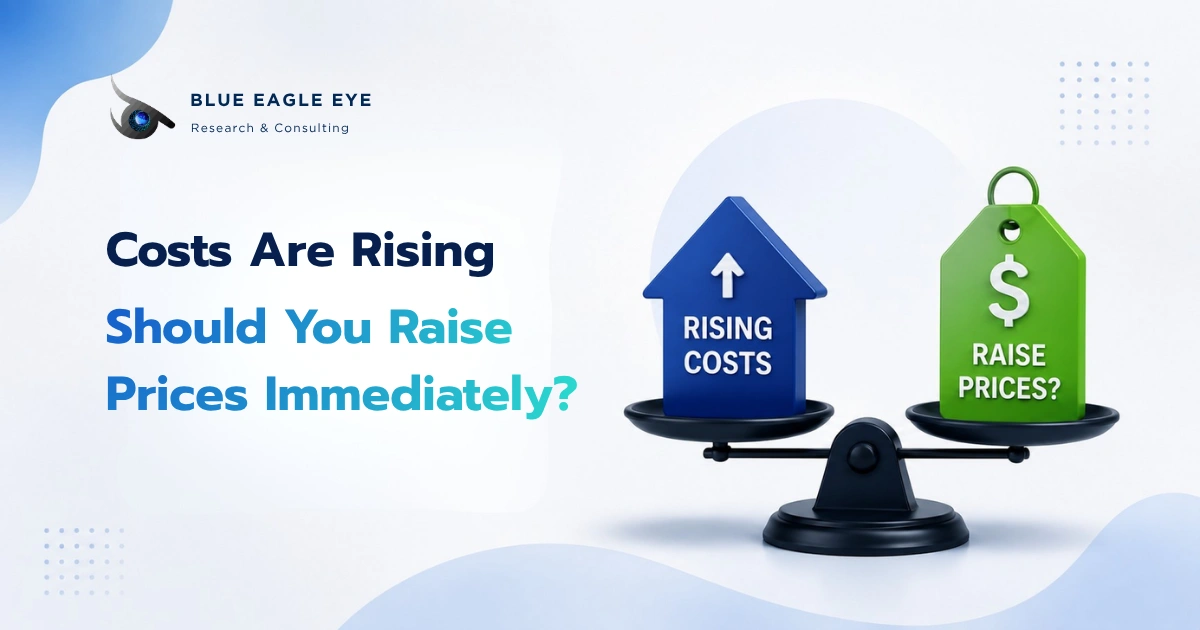
“Costs are going up. Should we raise our prices?” sounds like a straightforward business question. It rarely has a straightforward answer. Keeping the same price can steadily squeeze margins. But raising prices too quickly or by too much, can reduce purchase volume, encourage customers to switch, or make the offer feel less valuable compared with alternatives. A more useful question is therefore not simply, “How much have our costs increased?” It is: “What price allows the business to protect its economics while remaining consistent with customer value and market conditions?”
Short answer: not based on cost alone.
Higher costs are a clear reason to review your pricing strategy. They do not mean the selling price must automatically increase by the same percentage.
If one input cost rises by 10%, for example, that does not necessarily mean the final selling price should also rise by 10%. That input may represent only part of total costs. More importantly, the ability to increase prices depends on customer value, willingness to pay, competitive pricing and the alternatives available to customers.
In Thailand's 2026 economic environment, the Bank of Thailand has reported pressure from elevated production costs while also highlighting constraints from household purchasing power and intense competition.
The implication is not that businesses should avoid price increases. It is that a business should not assume every additional baht of cost can automatically be passed on to customers.
.webp)
Four things to check before raising prices
1. Where are costs increasing, and what is the real impact on margin?
Avoid starting with the general feeling that “everything is getting more expensive.”
Break the increase down into components such as:
- Raw materials
- Labour
- Logistics
- Rent
- Platform and transaction fees
- Advertising
- Financing costs
Then calculate how those changes affect contribution margin or profit per unit.
Suppose a product sells for THB 100 with total costs of THB 60. A 10% increase in one cost component does not automatically turn total costs into THB 66. It depends on how large that component is within the total cost structure. This is where SMEs should use actual cost data rather than adjusting prices simply because costs “feel higher.”
Question to answer: If we keep the current price, what happens to our margin—and how long can the business operate at that level?
2. How much more are customers willing to pay?
The important question is not simply whether customers like your product. It is whether they still perceive sufficient value at the new price.
Customer Willingness to Pay (WTP) refers to the price a customer is prepared to pay for an offer under a given set of purchase conditions and alternatives. Pricing research can use both qualitative and quantitative approaches to investigate willingness to pay and support pricing decisions.
One caution matters: stated willingness to pay is not the same as actual purchase behaviour.
For a relatively small price change, SMEs may first examine existing evidence such as sales by customer segment, promotion response, previous price changes or controlled pricing experiments. When the pricing decision carries significant business risk, more structured Pricing Research can reduce reliance on assumptions.
3. What alternatives do customers have if you raise the price?
Price sensitivity is not determined by your price alone. It also depends on what customers can choose instead.
If a product moves from THB 100 to THB 110, will customers:
Buy the same amount?
Buy less?
Switch brands?
Choose a smaller pack?
Wait for a promotion?
Or stop buying the category altogether?
Competitive pricing analysis therefore should not stop at “Who is cheaper than us?”
The better question is: “What is the customer comparing us with?”
Your most important competitor may not always sell the same product. The alternative could be a substitute product, another way of solving the same problem, or simply deciding not to buy.
This is why pricing decisions are closely connected to both Market Research and Customer Insight.
4. Do you need to pass on the full cost increase?
Protecting margin is not a binary choice between “raise prices” and “do nothing.”
A business might instead:
- Increase prices selectively on the most affected products
- Introduce different packages or pricing tiers
- Reduce promotions that do not generate incremental sales
- Adjust minimum order requirements
- Change pack size or product configuration without damaging core value
- Remove costs that customers do not value
- Strengthen perceived value before changing the price
The key is to treat pricing as a balance between margin, customer value and demand—not simply as changing the number on a price tag.
.webp)
A five-question pricing check for SMEs
Before approving a new price, ask:
1. What happens to our margin if we keep the current price?
Calculate the real financial impact rather than simply applying the percentage increase in costs.
2. Which customer segments are most at risk from a price increase?
Do not assume every customer has the same price sensitivity.
3. Where would the new price position us against customer alternatives?
Include both direct competitors and substitutes.
4. Are there other ways to protect margin?
Consider product mix, packaging, promotions and cost structure.
5. Can we test before changing prices everywhere?
Where channels and customer groups allow it, a controlled test can provide more useful evidence than changing prices across the entire business and waiting to see what happens.
What data should you use for a pricing decision?
Not every SME needs to begin with a large research project.
Start with internal evidence such as Sales Data, Margin by Product, Average Order Value, Promotion Response and sales performance before and after previous price changes.
Then identify what you still do not know.
If the main uncertainty concerns why customers perceive the price in a certain way, Customer Interviews or Qualitative Research may be useful.
If the business needs to measure Price Sensitivity or systematically compare possible price levels, Pricing Research or an appropriate quantitative method may be more suitable.
The principle is simple: choose the method based on the decision and uncertainty—not the other way around.
.webp)
What cost data alone cannot tell you
Cost data can show how much pressure is being placed on profitability. By itself, however, it cannot tell you:
- Whether customers will accept the new price
- How much demand may change
- Whether competitors will follow your price increase
- Which customer segments are most affected
- Which price will produce the best business outcome
Even Pricing Research cannot predict real-world purchasing perfectly. Actual behaviour can still be affected by competitors, promotions, channels, timing and economic conditions. A stronger pricing decision therefore combines multiple sources of evidence and monitors actual customer response after implementation.
The takeaway: Rising costs should trigger a pricing review—not an automatic price increase
When costs rise, the first question should not be, “What percentage should we add to the price?”
Ask instead:
How much is our margin actually affected?
Which customers can accept the new price?
What alternatives do they have?
Can we protect profitability in another way?
Answering these questions turns pricing from a simple cost reaction into a decision informed by internal data, Customer Insight and Market Reality.
Ultimately, a sustainable price is not only one that covers your costs. It also needs to support the business while leaving customers with enough perceived value to choose your offer.

Rising costs are a reason to review pricing, not an automatic reason to raise prices immediately. Before changing prices, examine four things together: margin impact, customer willingness to pay, competitive alternatives, and options for protecting margin without passing the full cost increase to customers.


.png)
.png)
.png)